 Gold Coin Catalogue
Syracuse: why its coins are art
The richest Greek city in the west made the most beautiful coins of antiquity. Who ruled it, why its engravers outdid everyone, and how it fell.
Syracuse at a glance
For three hundred years Syracuse, on the east coast of Sicily, was the richest and strongest Greek city in the west, and its coins are often called the most beautiful ever made.
Cicero, who knew it as a Roman governor's city, still called it 'the greatest of the Greek cities and the most beautiful of all'. It was never ruled by one dynasty: rich landowners, tyrants, democracies and kings took turns, as the ruler strip on this card shows. Its world was squeezed between three powers: Carthage, which held the west of Sicily, Athens, which tried to conquer it, and finally Rome, which did. Four things made its coins special: great wealth, a culture of public show (chariot races, victories, festivals), a large mint with many dies to cut, and engravers who were allowed to sign their work and so competed for fame. The cards that follow tell the story in order.

Ortygia, the island where Syracuse began, at sunset with Etna behind.
Source: Cicero, Roman orator and statesman, Against Verres 2.4.117: Syracuse, the greatest Greek city ↗
Sources
- Kraay, Archaic and Classical Greek Coins (1976)
- Rutter, Greek Coinages of Southern Italy and Sicily (1997)
A colony and its sacred spring
Corinthian settlers led by Archias founded Syracuse on the island of Ortygia in 733 BC, beside a freshwater spring they named after the nymph Arethusa.
Myth said Arethusa had fled the river god Alpheus under the sea from Greece and come up here as a spring, a few steps from the salt water. She became the city's emblem: her head, ringed by dolphins for the sea around Ortygia, is on nearly every Syracusan coin for three centuries. The spring still flows today.


Source: Thucydides, Athenian historian of the 5th century BC, 6.3: the founding of Syracuse ↗ · Ovid, Roman poet (about AD 8), Metamorphoses 5.572: Arethusa and Alpheus ↗
Sources
The first coins: a chariot and a nymph
Syracuse began striking silver around 510 BC: a chariot on one side, and soon the head of Arethusa on the other.
The chariot was a rich man's boast. Syracuse's aristocrats and tyrants raced teams at Olympia and Delphi, and Gelon won the Olympic chariot race in 488 BC, while he was still lord of nearby Gela. A little Nike flying over the horses to crown them was added soon after. This pairing, chariot and nymph, stayed the city's coin for a century, which is exactly why its engravers had to find new ways to make the same picture exciting.
Which side is the front? Numismatists call the side struck from the fixed lower die, set in the anvil, the obverse, and the side from the upper die, which was hammered, the reverse. On Syracuse's first tetradrachms the upper die was a punch that left a square dent, and Arethusa began as a tiny head inside it, so the chariot was on the anvil. She grew into the star of the coin under Kimon and Euainetos, yet most auction catalogues and museums still call the chariot side the obverse. Only from Agathokles' time, after 317 BC, do they list her head first. The Greeks had no such words: obverse and reverse are modern labels.
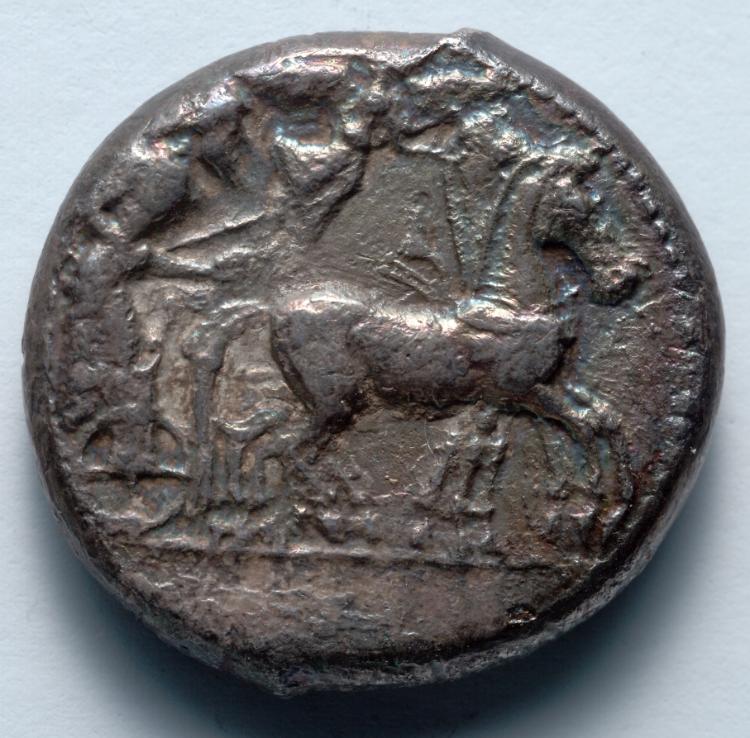
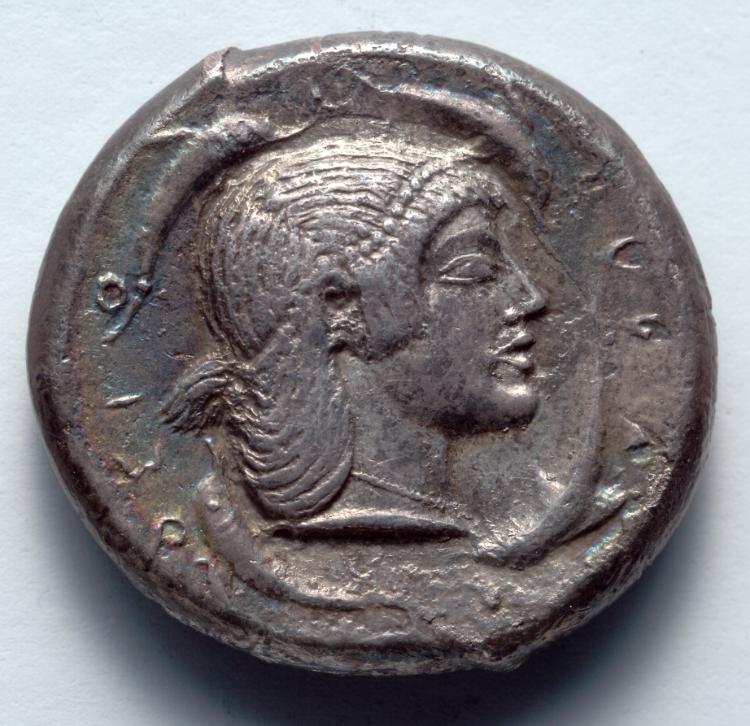
A tetradrachm of Gelon's time, 485–478 BC.
Source: Pausanias, Greek travel writer (2nd century AD), 6.9.4: Gelon's chariot at Olympia ↗
Sources
- Boehringer, Die Münzen von Syrakus (1929)
- Cleveland Museum of Art 1917.987
The Demareteion: a queen's coin?
After Gelon crushed a Carthaginian army at Himera in 480 BC, the story goes that his wife Damarete was given a gold crown and turned it into a coin, the famous Demareteion.
Diodorus says the Carthaginians, grateful for her help with the peace, crowned Damarete with 100 talents of gold, and that she struck a coin from it worth ten Attic drachms. Collectors have long given the name to this ten-drachm silver piece with an olive-wreathed Arethusa and a lion, perhaps for Africa. It is one of the most famous coins of the ancient world, and very rare. Gelon's brother Hieron I then beat the Etruscans at sea off Cumae in 474 BC and was praised by Pindar for his chariot wins: Syracuse was now a great power.

Münzkabinett, Staatliche Museen zu Berlin · CC BY-SA 4.0

Münzkabinett, Staatliche Museen zu Berlin · CC BY-SA 4.0
Source: Diodorus of Sicily, Greek historian (1st century BC), 11.26.3: Damarete's crown ↗ · Pindar, Greek poet who wrote for Hieron (470 BC), Pythian 1: Hieron and the sea battle off Cumae ↗
Sources
- Kraay, Greek Coins and History (1969)
Same subject, many hands
Syracuse kept coming back to the same few subjects (Arethusa, Athena, Nike, the chariot), and each generation of engravers tried to outdo the last.
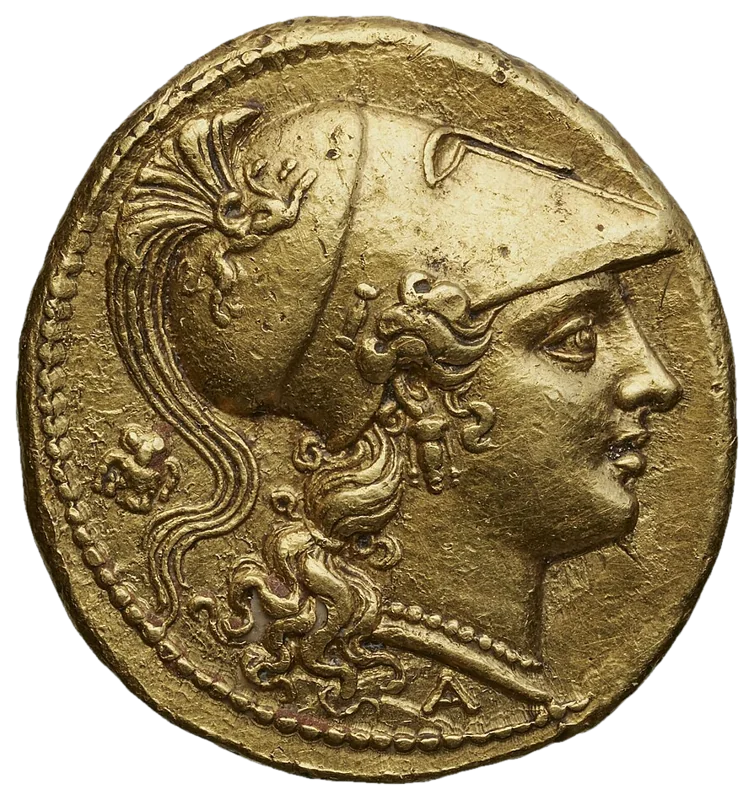
Because the subject was fixed, all the invention went into how it was drawn. Athena faces you head-on in a triple-crested helmet under Eukleidas, a daring view that wore down at the nose first. Under Dionysios she turns to profile, under Agathokles she wears a plain Corinthian helmet, and under Pyrrhus her helmet carries a griffin or a Pegasus. Nike does the same: she crowns the charioteer, nails captured armour to a trophy for Agathokles, drives the chariot herself for Hiketas, and almost dances on tiptoe for Pyrrhus. Put side by side, they read like one picture painted again by different masters.

Münzkabinett, Staatliche Museen zu Berlin · CC BY-SA 4.0

Münzkabinett, Staatliche Museen zu Berlin · Public Domain Mark 1.0

Münzkabinett, Staatliche Museen zu Berlin · Public Domain Mark 1.0
Bibliothèque nationale de France · CC BY 4.0

Nike nailing captured armour to a trophy, a silver tetradrachm of Agathokles, c. 305–295 BC.
Sources
- Fischer-Bossert, Coins, Artists, and Tyrants: Syracuse in the Time of the Peloponnesian War (ANS, 2017)
- Berlin Münzkabinett 18203186
Why Syracuse's coins are better
Wealth, rivalry, a love of public show and engravers competing for fame came together in one city.
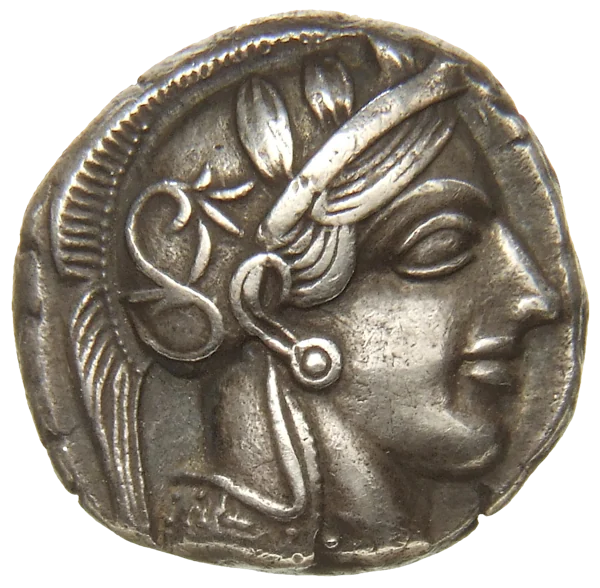
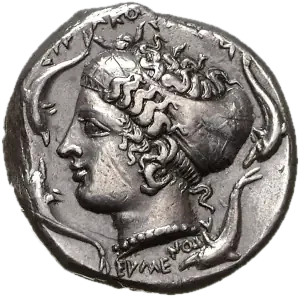
Wealth: Syracuse ruled the grain lands of eastern Sicily and took huge booty from its wars, so it struck big coins in large numbers. Show: the chariot and Nike advertised victories in the games and in war, and the city liked to be seen. Rivalry: other Sicilian cities hired the same engravers, and Syracuse wanted the best. Work: every die wore out after some thousands of strikes, so a busy mint needed a steady flow of new dies, and each one was a chance to try something new. Fame: from about 425 BC the best engravers were allowed to sign their dies, something almost unknown elsewhere, so they competed openly, and the masters' best dies were copied by the rest of the workshop. Many of these engravers probably also cut gems, which explains the jewel-like detail.
Münzkabinett, Staatliche Museen zu Berlin · Public Domain Mark 1.0
Münzkabinett, Staatliche Museen zu Berlin · Public Domain Mark 1.0
Two silver coins of the same years, side by side: one city that never changed its design, and one that kept trying to beat it.
Sources
- Kraay, Archaic and Classical Greek Coins (1976)
- Fischer-Bossert, Coins, Artists, and Tyrants (2017)
- Visonà, review in American Journal of Archaeology 122.4 (2018)
The signing masters
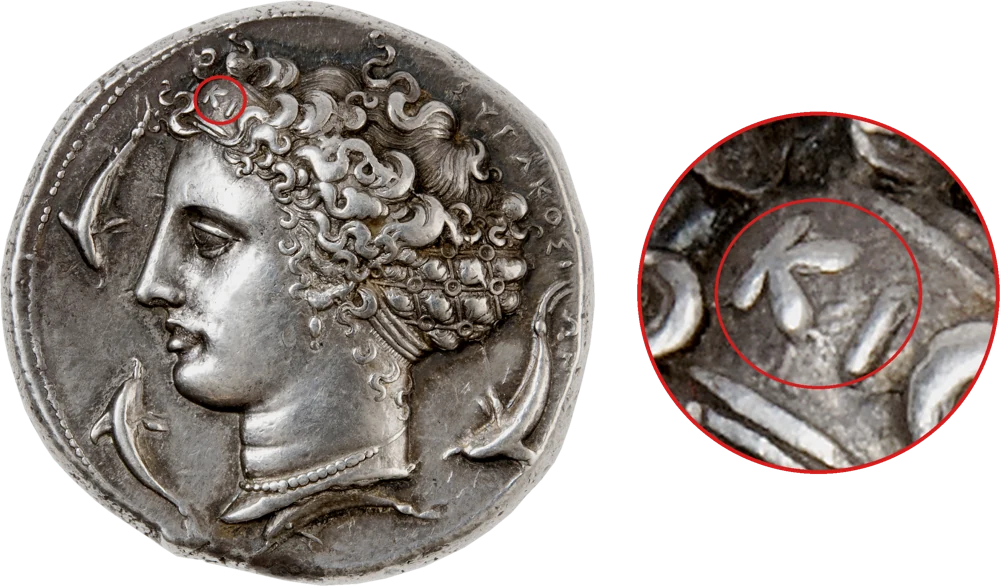
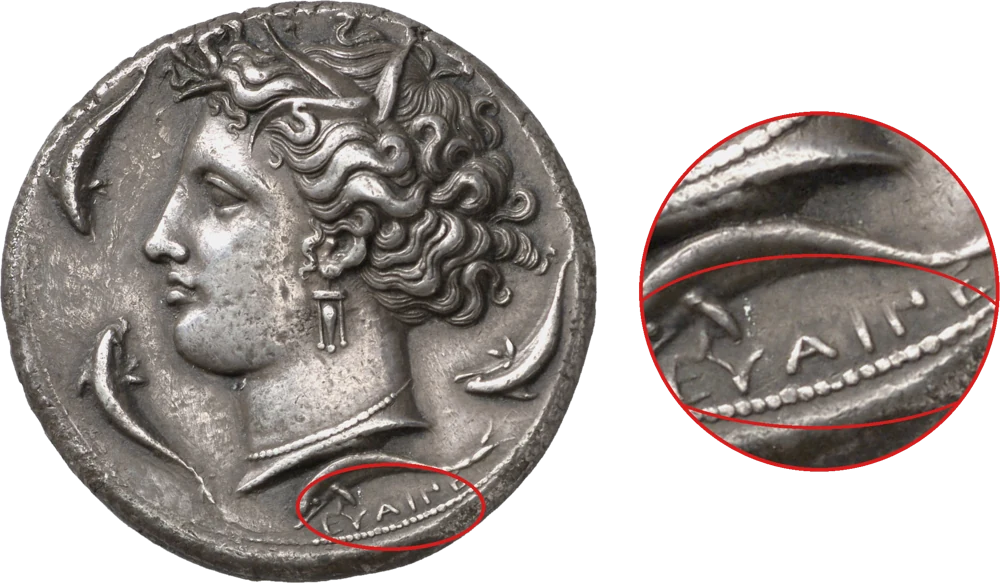
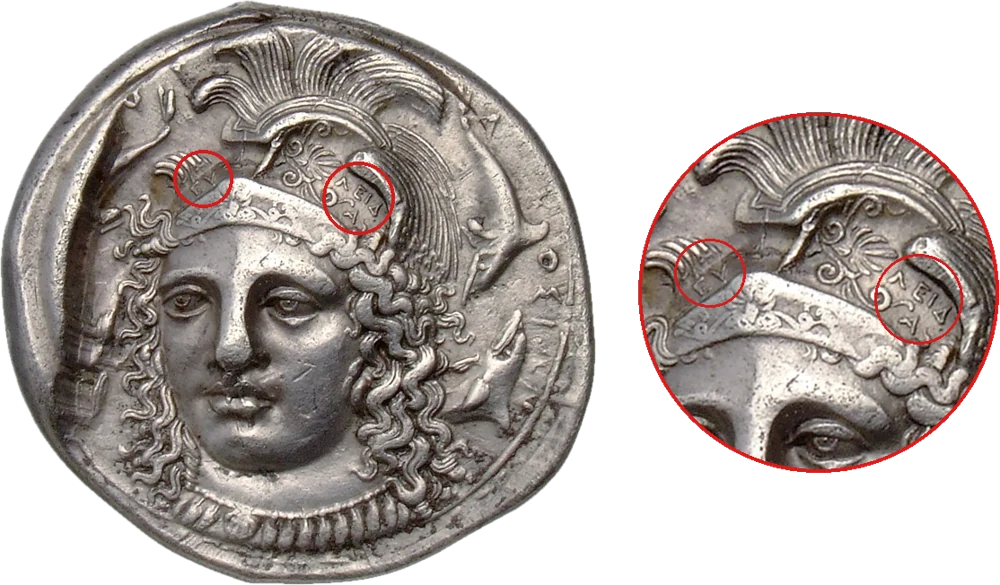
After Syracuse destroyed the Athenian invasion of 415–413 BC, engravers such as Kimon, Euainetos and Eukleidas cut the finest dies of antiquity, and signed them.
Look for tiny letters: Kimon put his name on Arethusa's headband, Euainetos under a dolphin or on the chariot's ground line, Eukleidas across Athena's helmet. The red rings below show where. Their ten-drachm pieces (decadrachms) show captured armour below the chariot, once read as prizes for victory games after 413 BC. Euainetos also signed coins for Katane and Kamarina, and his Arethusa was copied across the Greek world, from Thessaly to the Carthaginian mints of western Sicily.
Münzkabinett, Staatliche Museen zu Berlin · Public Domain Mark 1.0
Münzkabinett, Staatliche Museen zu Berlin · Public Domain Mark 1.0
Münzkabinett, Staatliche Museen zu Berlin · Public Domain Mark 1.0
The masters' signatures, ringed in red and enlarged.
Source: Thucydides, Athenian historian of the 5th century BC, 7.87: the Athenians in the quarries ↗
Sources
- Gallatin, Syracusan Dekadrachms of the Euainetos Type (1930)
- Jongkees, The Kimonian Dekadrachms (1941)
- Berlin Münzkabinett, Euainetos (person record)
Dionysios I: gold for a war
When Carthage attacked again, the tyrant Dionysios I paid his mercenaries in gold: the great 100-litrai coin, with Arethusa and young Herakles wrestling the Nemean lion.
Dionysios held Syracuse for 38 years, fought Carthage for most of them, and ringed the city with walls and the fortress of Euryalos. Greek cities struck gold only in emergencies, so Syracuse's gold coins mark its crises. The dies are attributed to Kimon and Euainetos, the masters of the silver.

Münzkabinett, Staatliche Museen zu Berlin · CC BY-SA 4.0

Münzkabinett, Staatliche Museen zu Berlin · CC BY-SA 4.0

The fortress of Euryalos, begun under Dionysios I.
Sources
- Kraay, Archaic and Classical Greek Coins (1976)
Agathokles takes the war to Africa
A potter's son who seized power in 317 BC, Agathokles was besieged by Carthage in 310 BC, slipped out by sea and landed in Africa to attack Carthage at home.
Before him, Timoleon of Corinth had freed Syracuse from its tyrants in 344 BC, and his coins carry Corinth's Pegasus for the mother city. Agathokles later took the title of king, as Alexander's generals had just done, and his coins show Athena, Nike with her trophy and the winged thunderbolt of Zeus.
Münzkabinett, Staatliche Museen zu Berlin · Public Domain Mark 1.0

Münzkabinett, Staatliche Museen zu Berlin · Public Domain Mark 1.0
Source: Diodorus of Sicily, Greek historian (1st century BC), Books 19–20: Agathokles ↗ · Plutarch, Greek biographer (about AD 100), Life of Timoleon ↗
Sources
Pyrrhus: the dancing Nike
Called in against Carthage, Pyrrhus, king of Epirus, was hailed king of Sicily, and Syracuse struck for him a gold stater of Athena and a Nike who seems to dance.
It copies the idea of Alexander's Athena and Nike staters, but the unknown Syracusan engraver gave it a grace Alexander's never had: Athena's helmet carries a griffin or a Pegasus, and Nike alights on tiptoe with a wreath and a trophy. Pyrrhus left in 276 BC, saying, according to Plutarch, 'What a wrestling ground we are leaving for Carthage and Rome.' It is one of the rarest and most admired gold coins of the Greek world.
Bibliothèque nationale de France · CC BY 4.0
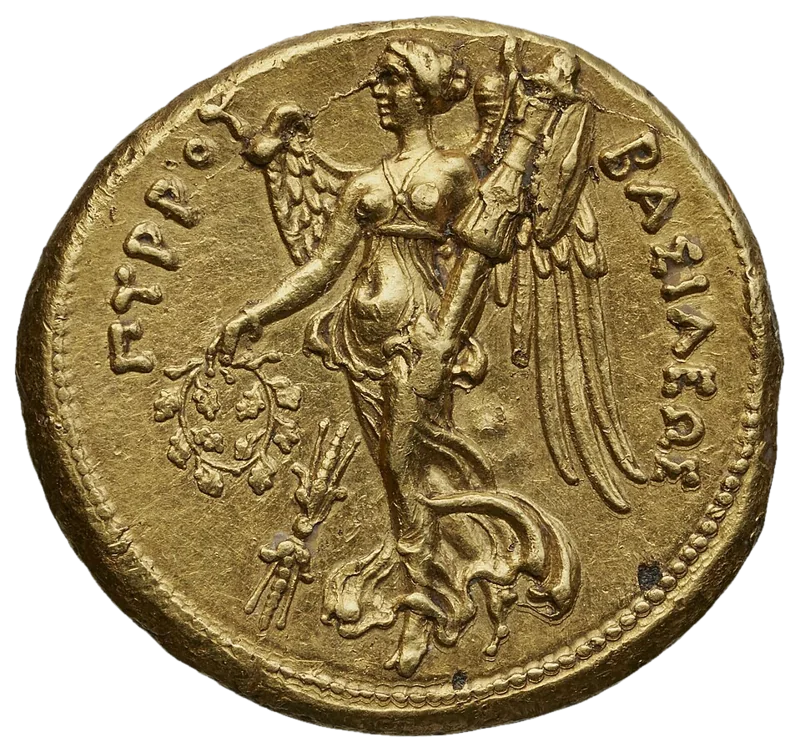
Bibliothèque nationale de France · CC BY 4.0
Source: Plutarch, Greek biographer (about AD 100), Life of Pyrrhus 22–23: Pyrrhus in Sicily ↗
Sources
- Bibliothèque nationale de France, Cabinet des médailles
Hieron II: fifty years of peace
Hieron II kept Syracuse rich and free for half a century by siding with Rome, and put his queen Philistis on the coins.
He made an alliance with Rome in 263 BC and kept it through the long war with Carthage. This was the age of Archimedes, Hieron's relative and engineer, and of the city's huge theatre. Coins with the veiled head of Queen Philistis are some of the few Greek coins that portray a queen.

Bibliothèque nationale de France · CC BY 4.0

Bibliothèque nationale de France · CC BY 4.0


Queen Philistis on a silver 16 litrai, and the Greek theatre of Syracuse.
Source: Polybius, Greek historian (2nd century BC), 1.16: Hieron's treaty with Rome ↗
Sources
- Berlin Münzkabinett 18217873
The fall: Rome takes Syracuse
Hieron's teenage grandson broke with Rome in 215 BC; Rome besieged the city, and in 212 BC it fell and Archimedes was killed.
For two years Archimedes' machines kept the Roman fleet off the walls, until the Romans got in during a festival. The restored democracy struck its last gold during the siege. The Roman general Marcellus carried the city's statues and paintings to Rome, which, Livy says, began the Romans' passion for Greek art. Syracuse became the capital of Roman Sicily, but its own coinage, and its golden age, were over.

Bibliothèque nationale de France · CC BY 4.0

Bibliothèque nationale de France · CC BY 4.0
Source: Livy, Roman historian (about 10 BC), 25.31: the fall of Syracuse ↗ · Polybius, Greek historian (2nd century BC), 8.3–7: Archimedes' machines ↗ · Plutarch, Greek biographer (about AD 100), Life of Marcellus 14–19: the siege ↗
Sources
The mint's second life
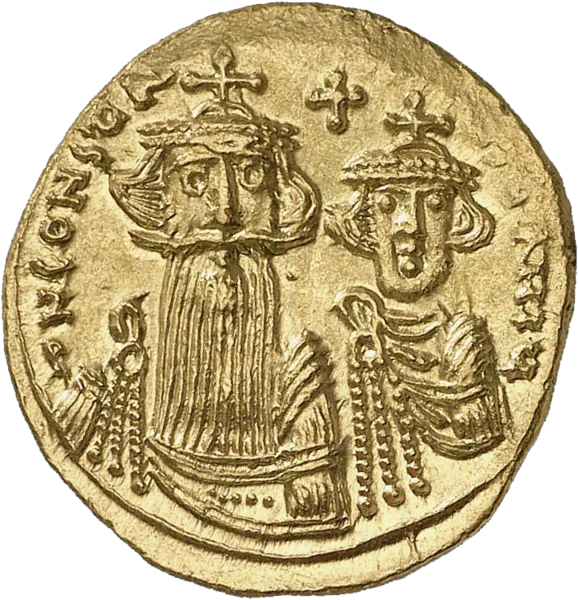
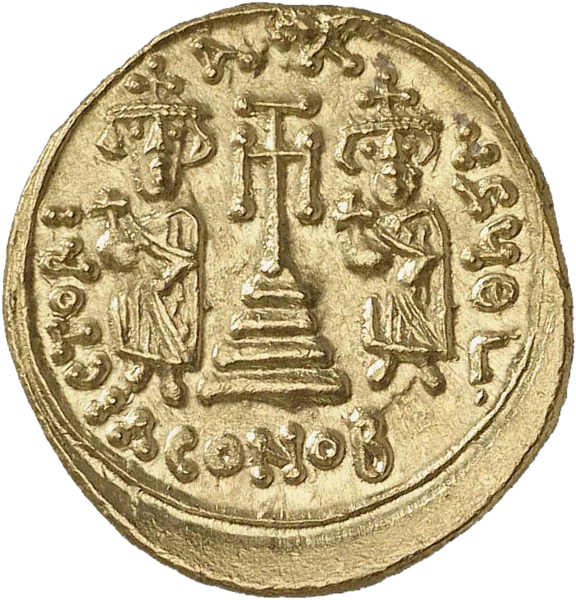
Eight centuries later Syracuse struck gold again, as the Byzantine mint of Sicily, until the Arabs took the city in 878.
The emperor Constans II even moved his court to Syracuse in 663 and was murdered there in his bath in 668. Its solidi grew more and more distinctive, and it was the last Byzantine mint in the west. After a nine-month siege the city fell in May 878, and no Byzantine coins were struck in Sicily again. So, how long did Syracuse make coins? About three hundred years as a free Greek city (c. 510–212 BC), and over two hundred more as a Byzantine mint.
Münzkabinett, Staatliche Museen zu Berlin · Public Domain Mark 1.0
Münzkabinett, Staatliche Museen zu Berlin · Public Domain Mark 1.0
Gold again at Syracuse, some eight centuries after Hieron II, struck a few years before Constans II moved his court to the city in 663.
Sources
- Grierson, Byzantine Coinage (Dumbarton Oaks, 1999)
- Dumbarton Oaks, 'Lasting Impressions' exhibition: seal of a Sicilian mint official