 Gold Coin Catalogue
Ancient mints through the ages
What the buildings that made coins looked like, from a Greek city's workroom to Rome's mint and the late Roman mints, and how much of that we really know.
What is left
No mint survives whole
No ancient mint is still standing, and only a handful have been dug up. What survives is pits, moulds, scraps of metal, blanks that were never struck, and inscriptions naming the staff.
Every Greek mint found so far made bronze small change. The buildings where gold and silver were struck have never been found, so every picture of an ancient mint, including the three here, is a reconstruction. Under each one, plain text marks what the digs show and pink marks our guesses. Mint buildings changed enough over a thousand years that one picture would mislead.
Source: Camp and Kroll, The Agora Mint and Athenian Bronze Coinage (Hesperia, free) ↗ · Faucher et al., A mint workshop at Karnak (BIFAO, free) ↗
Sources
- Camp and Kroll, 'The Agora Mint and Athenian Bronze Coinage', Hesperia 70 (2001)
- Faucher, Coulon, Frangin and Giorgi, 'Un atelier monétaire à Karnak au IIe s. av. J.-C.', BIFAO 111 (2011)
Greek cities
A Greek city mint
At Athens the mint was a plain public building by the market square, about 27 by 29 metres. Its big workroom had pits, water basins and a drain, and bronze blanks still lay on the floor.
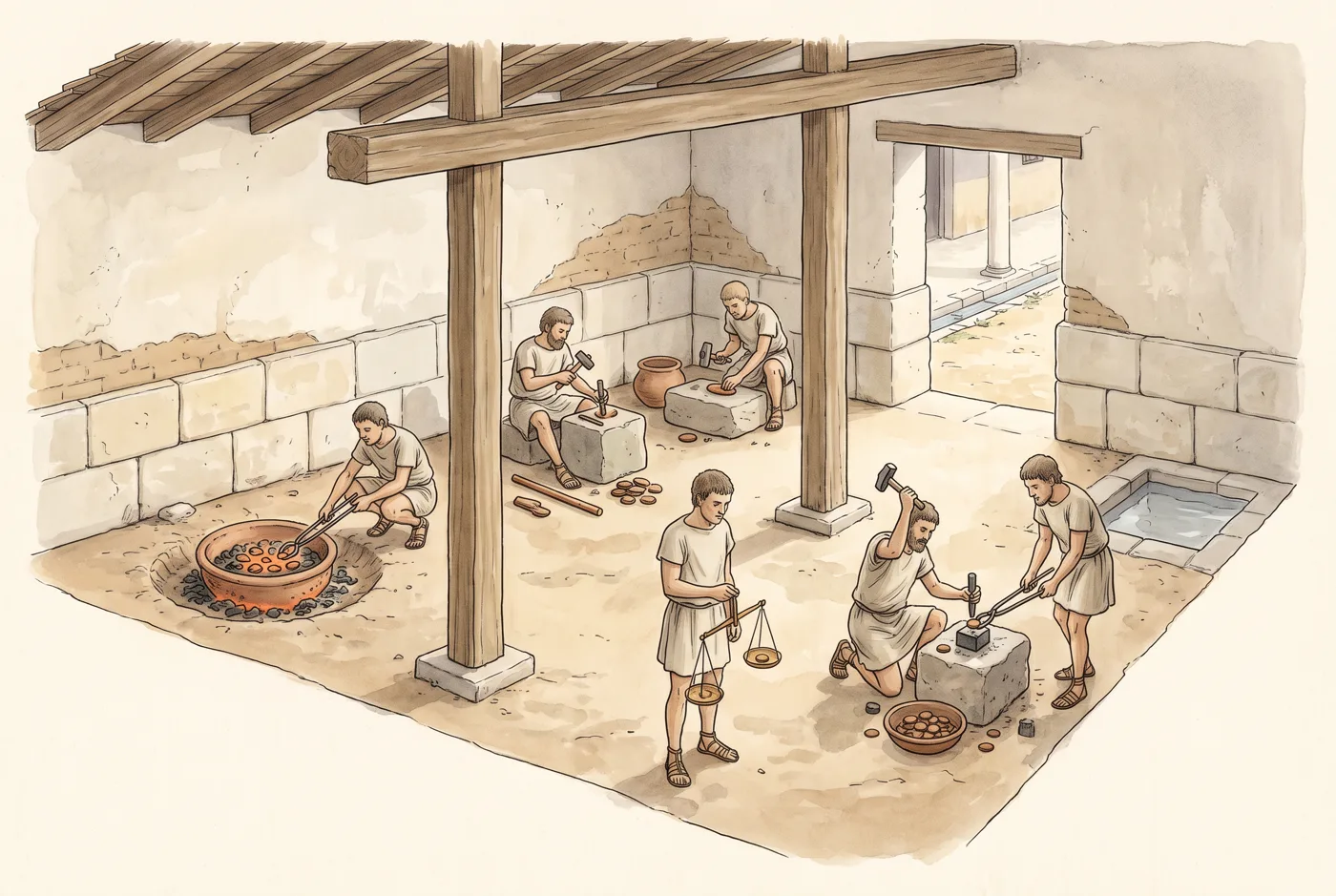
Plain text: shown by digs, inscriptions or coins. Pink: our guess.
- The room
Stone footings of a 27 × 29 m building. Mudbrick walls, posts and roof: the usual Greek way, not found here. - Making the blanks
Slices chopped off a forged bronze rod with a chisel, then hammered flat. - Checking the weight
Weighing each blank on a hand balance. - Warming the blanks
Clay basins scorched by fire, set in pits in the floor. Heating blanks in them is our guess. - Striking
Blank on the lower die; one man holds the upper die and hits it with a hammer. A second man with tongs. - Water
Basins cut into the floor and lined with plaster. What the water was for isn't known.
The blanks were made by forging a bronze rod, scoring it with a chisel, chopping off a slice and hammering it flat. The same chopped blanks turn up at Halieis and Olynthos in the 4th century BC. The first diggers took the pits for furnaces, but a lab test in 1997 found no trace of melting: the metal arrived ready. At Halieis the mint stood against the city wall, and its excavators thought coins were struck there 'only as required'. A Greek mint was a part-time workshop, not a factory.

George E. Koronaios, via Wikimedia Commons · CC BY-SA 4.0

Heinz Schmitz, via Wikimedia Commons · CC BY-SA 4.0
Source: Camp and Kroll, The Agora Mint and Athenian Bronze Coinage (Hesperia, free) ↗ · Boyd and Rudolph, The Lower Town of Halieis (Hesperia, free), p. 339 ↗
Sources
- Camp and Kroll, Hesperia 70 (2001)
- Boyd and Rudolph, 'The Lower Town of Halieis, 1970–1977', Hesperia 47 (1978)
Where was the silver struck?
Not in that building: tests there found 'only the slightest traces of silver'. Ancient writers name a separate silver mint at Athens, the argyrokopeion. It has never been found.
When Athens ran short of silver near the end of its war with Sparta, it melted gold statues of Victory on the Acropolis and struck gold coins, and afterwards the dies were dedicated to the goddess there. A law of 375 BC set a public slave, the tester, among the bankers' tables in the market to check coins: fakes were cut through and given to the Mother of the Gods.
Source: Camp and Kroll, The Agora Mint and Athenian Bronze Coinage (Hesperia, free) ↗
Sources
- Camp and Kroll, Hesperia 70 (2001), p. 144 and note 14
- Stroud, 'An Athenian Law on Silver Coinage', Hesperia 43 (1974)
Rome
Rome's mint
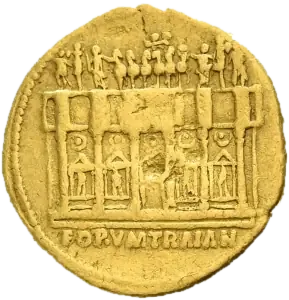
Probably after a fire in AD 80, Rome's mint moved near the Colosseum, perhaps into a plain block of small vaulted rooms around a courtyard, now under the church of San Clemente. In AD 115 its staff set up statues naming about ninety of themselves.
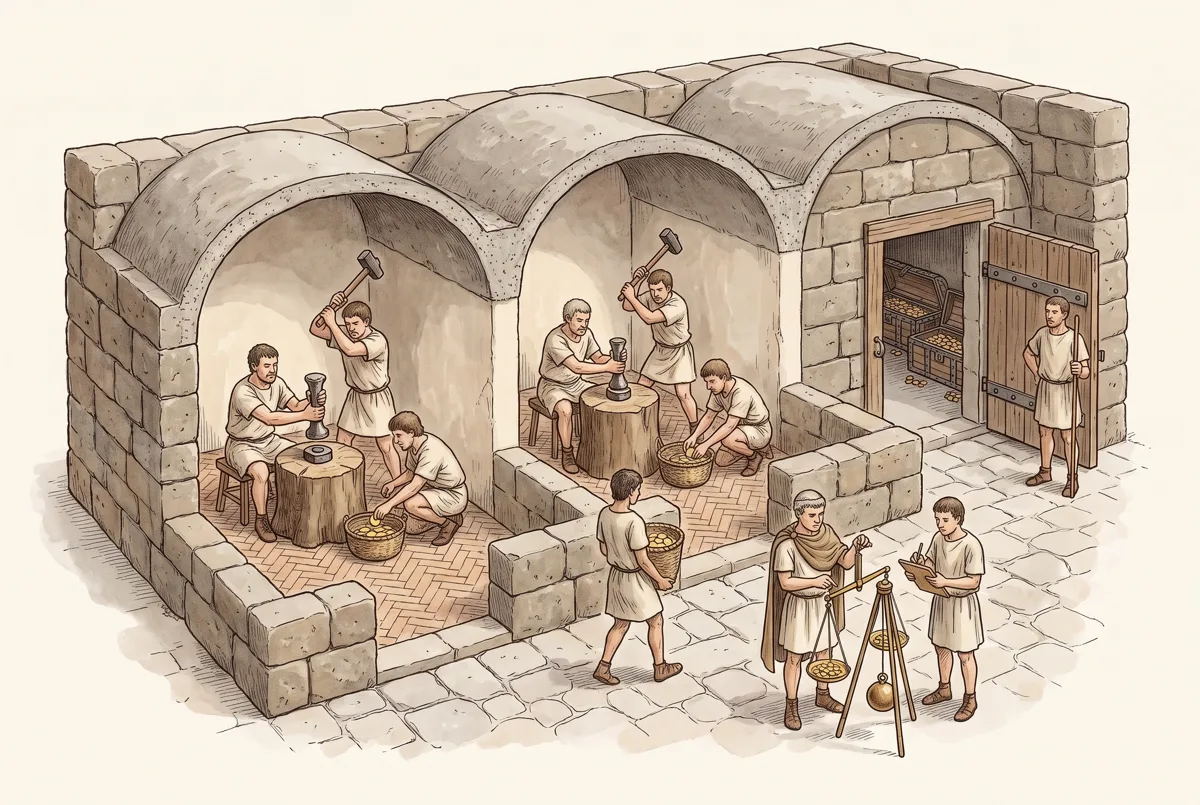
Plain text: shown by digs, inscriptions or coins. Pink: our guess.
- Workshops
Small vaulted rooms round a courtyard, under the church of San Clemente. Whether this building was Rome's mint is disputed. One striking team per room is our guess. - The striking team
Suppostores set the blanks, malliatores swung the hammers (staff list of AD 115). A token in Vienna shows three men: one holds the die, one swings, one sets the blank by hand. - Strongroom
A guarded room for the gold: nothing of it survives. - Blanks brought in
Blanks carried to the workshops in baskets. - Foreman and clerk
The foreman Felix, a freedman of the emperor, checked the gold, silver and bronze; coins were struck so many to the pound. The clerk, and weighing coins in bulk on a balance.
Before that the mint stood beside the temple of Juno Moneta on the Capitol, 'where the temple and mint of Moneta now stand', wrote the Roman historian Livy. The AD 115 list names Felix, a freedman of the emperor, who checked the gold, silver and bronze; 16 workshop heads; and a striking crew of 17 signatores, 11 suppostores who set the blanks and 32 malliatores who swung the hammers. Half were slaves. Coins were counted so many to the pound. In AD 271 the mint workers rose against the emperor Aurelian.

Valerio b. cosentino, via Wikimedia Commons · Public domain
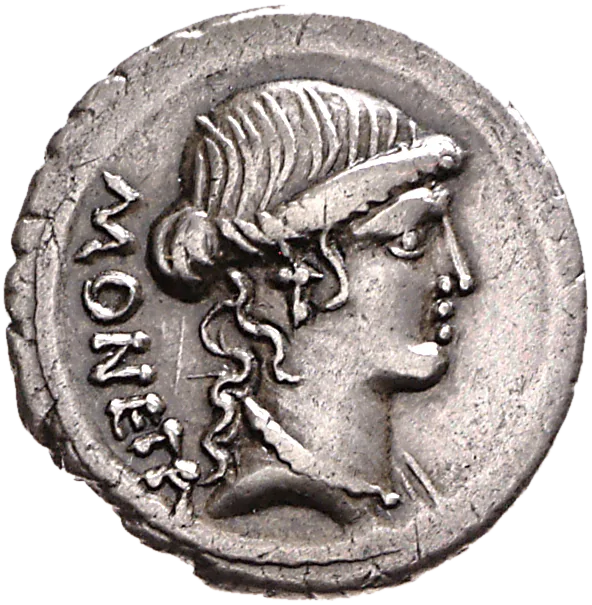
Münzkabinett, Staatliche Museen zu Berlin · Public Domain Mark 1.0
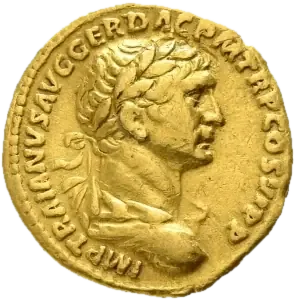
Münzkabinett, Staatliche Museen zu Berlin · CC BY-SA 4.0
Münzkabinett, Staatliche Museen zu Berlin · CC BY-SA 4.0
Source: Livy, History of Rome 6.20 (the Roman historian) ↗ · Woytek, System and product in Roman mints (free PDF) ↗ · Historia Augusta, Life of Aurelian 38 (the mint workers' revolt) ↗
Sources
- Livy, History of Rome 6.20.13
- Corpus Inscriptionum Latinarum VI 42–44 (AD 115)
- Woytek, 'System and product in Roman mints', Revue belge de numismatique 158 (2012)
- Coarelli, 'Moneta', in Lexicon Topographicum Urbis Romae III (1996)
- Historia Augusta, Aurelian 38
Late Rome
Blanks by the hundred
Late Roman mints cast their bronze blanks in throwaway clay moulds, up to 192 at a pour. At Thessaloniki the mint sat in rooms at the end of the city forum, with four kilns.
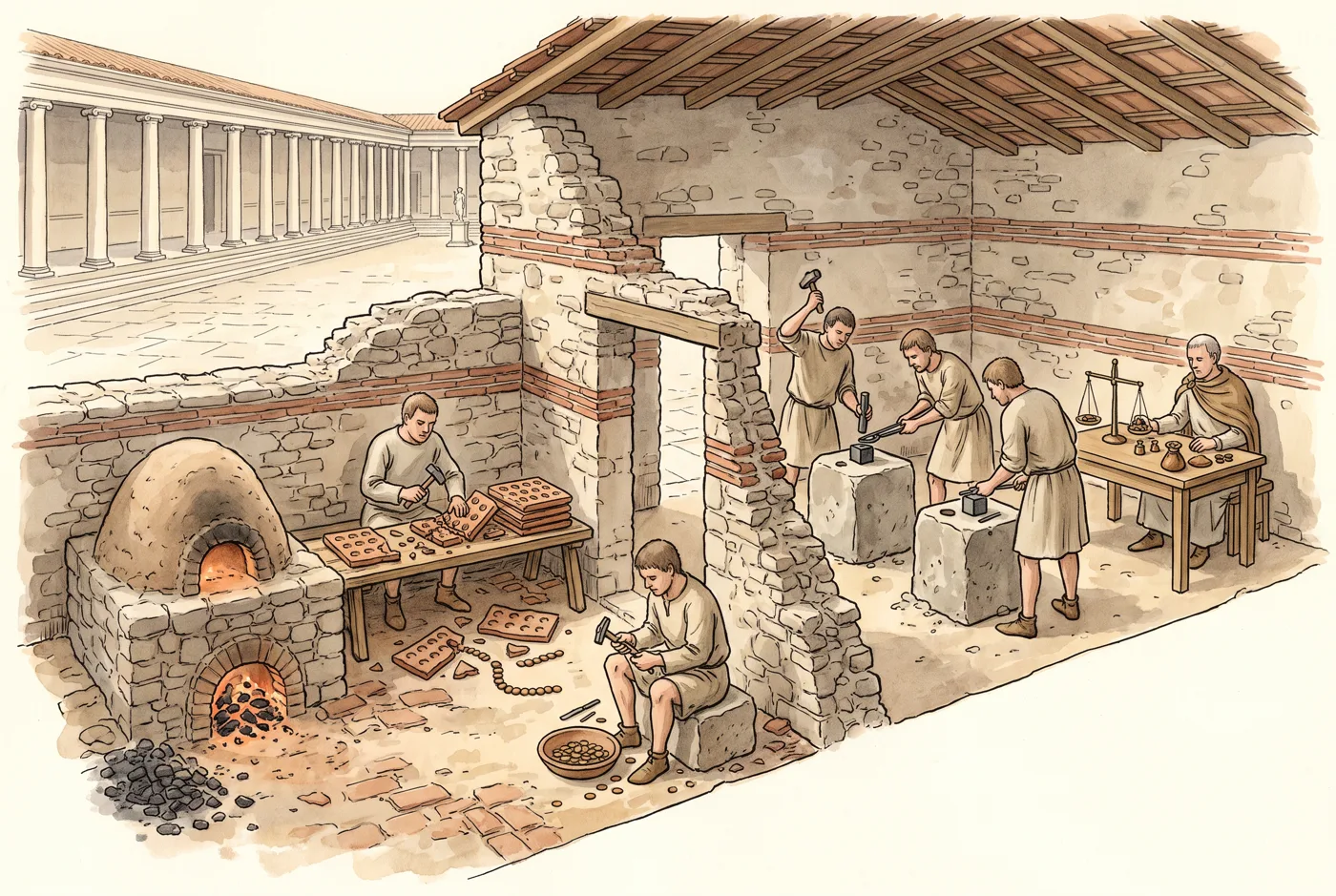
Plain text: shown by digs, inscriptions or coins. Pink: our guess.
- The kiln
Four metalworking kilns in Thessaloniki's forum. Its dome: only the bases survive. - Breaking the moulds
Clay moulds cast up to 192 blanks at once, joined in short strings. - Cutting apart
Blanks keep a stub where they left the string. The chisel. - Two striking teams
Each team put its own number on the coins, so bad work could be traced. - The official
Weighing and bagging the coins.
Each mould was six thin clay panels with two rows of eight hollows on each face, wrapped in raw clay and fired. Bronze poured in through a narrow channel filled every hollow, and the mould was broken to get the blanks out. One broken piece still holds four blanks. From about AD 294 some fifteen imperial mints each ran several teams, and each team put its own number on the coins, so bad work could be traced.

Evilemperorzorg, via Wikimedia Commons · CC BY-SA 3.0
Source: Archaeological Museum of Thessaloniki: a clay mould for bronze blanks ↗
Sources
- Archaeological Museum of Thessaloniki, exhibit of the month, April 2019
- Velenis, 'Νομισματοκοπείο στην αρχαία αγορά της Θεσσαλονίκης', in Χαρακτήρ (1996)
Gold followed the emperor
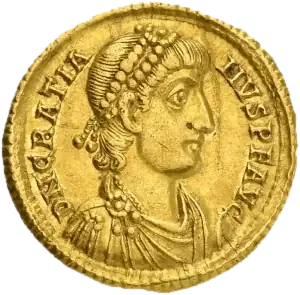
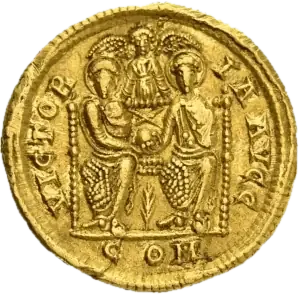
Gold was different. From about AD 367 tax gold was melted into bars and sent to the emperor's treasury, and gold coins were struck where the court was.
A hoard of fifteen such bars was found in a Carpathian mountain pass. They were stamped at Sirmium about AD 379–380, signed by the assayers Lucianus and Flavius Flavianus, and are now in London and Vienna. Solidi marked COMOB under the design are usually read as 'refined gold of the court'. The court's own gold workshop has never been found.

Joyofmuseums, via Wikimedia Commons · CC BY-SA 4.0
Münzkabinett, Staatliche Museen zu Berlin · CC BY-SA 4.0
Münzkabinett, Staatliche Museen zu Berlin · CC BY-SA 4.0
Source: British Museum: gold bar stamped by the assayer Lucianus ↗ · Kunsthistorisches Museum Vienna: gold bar from Sirmium ↗
Sources
- Codex Theodosianus 12.6.13 (AD 367)
- Hendy, Studies in the Byzantine Monetary Economy (1985)
- British Museum C_1894-1207-2
- Kunsthistorisches Museum, gold bar from Sirmium