 Gold Coin Catalogue
Famous dies: Apollo with Alexander's face
In 2026 two gold staters of the same king, mint and years sold one after the other: one for $6,000, one for $37,500. The difference was the die that struck it. These are dies collectors know by sight.
Two staters, one sale
At one auction two gold staters of the same king, mint and years sold one after the other: the first for $6,000, the second for $37,500.
Both were struck at Kolophon, a Greek city on the coast of what is now Turkey, about 322–319 BC. Both show the god Apollo on the front and a two-horse chariot on the back, the design King Philip II of Macedon had made famous, still being struck years after his death. Both are about 8.6 grams of gold, and the second is only one step better in grade. Bidding opened at $1,500 for the first and $4,500 for the second. What the bidders paid six times more for was the die. A die is the engraved metal stamp that strikes the picture into the coin, and each one was cut by hand. The die for the second coin was cut by a far better artist, and collectors know it by sight.
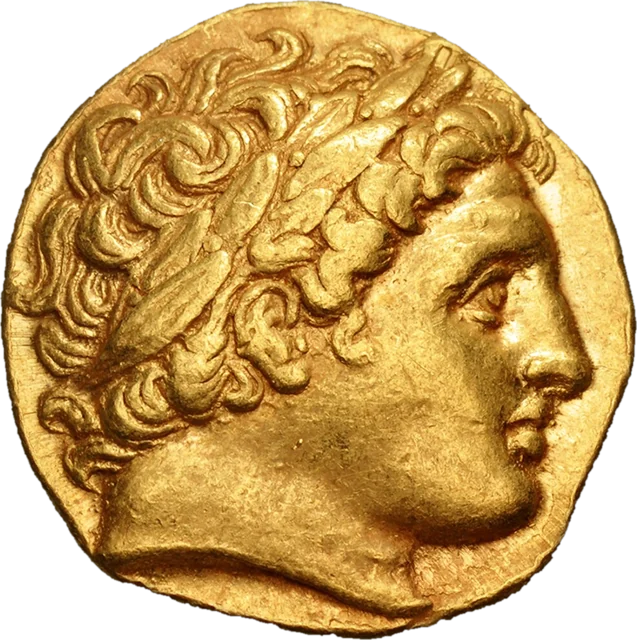
Classical Numismatic Group, Feature Auction 133 (2026), lot 171 · Auction photo, credited
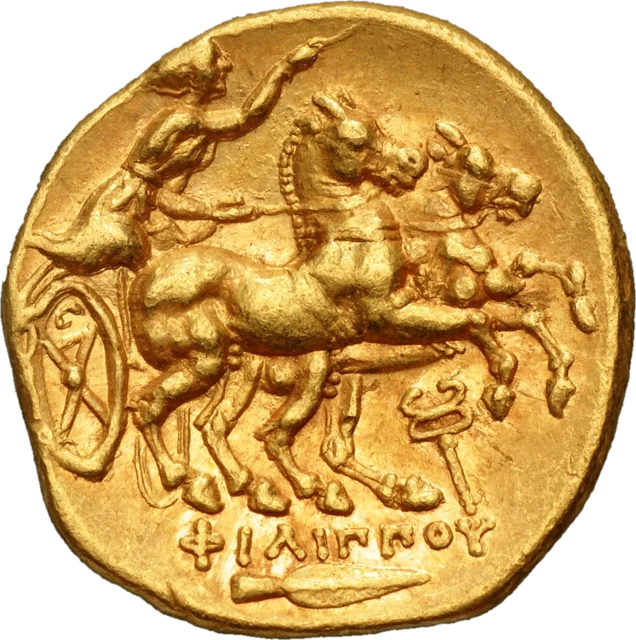
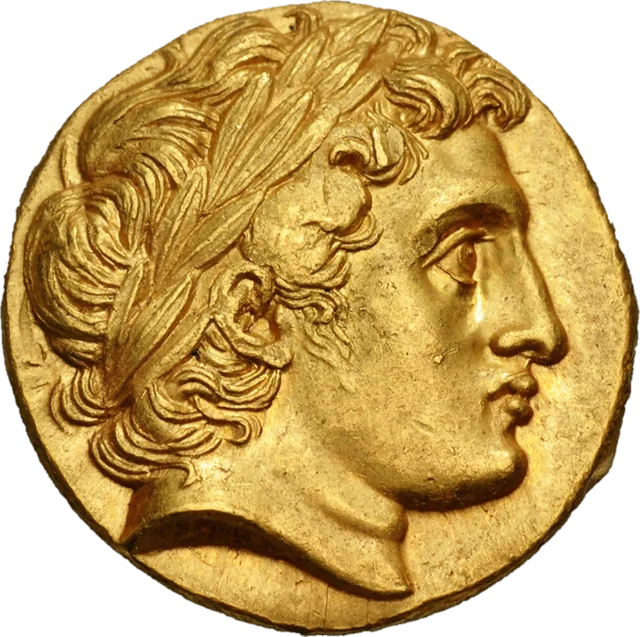
Classical Numismatic Group, Feature Auction 133 (2026), lot 172 · Auction photo, credited
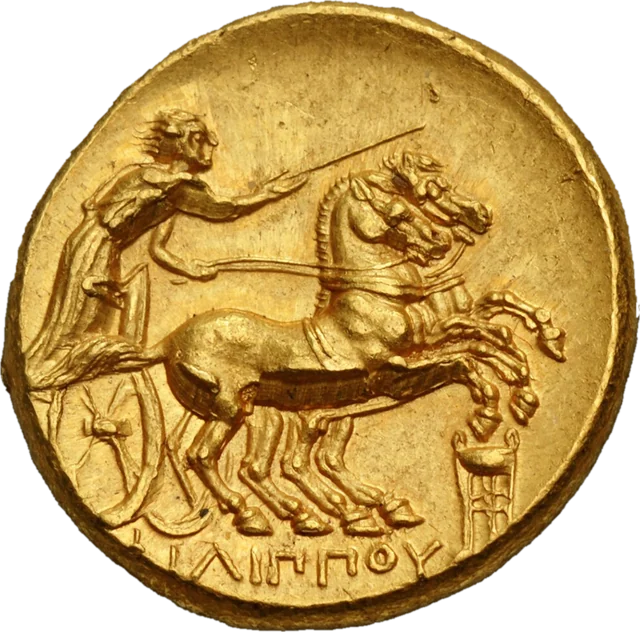
Hammer prices, before the buyer's fee.
Source: Classical Numismatic Group (American auction house), Feature Auction 133, lot 171: sold for $6,000 ↗ · Classical Numismatic Group, Feature Auction 133, lot 172: sold for $37,500 ↗
Sources
- Classical Numismatic Group, Feature Auction 133 (15–16 September 2026), lots 171 and 172
Apollo with Alexander's face
On this one die the god's head is a portrait: cataloguers describe it as Apollo "with the features of Alexander III", Alexander the Great, who had died a year or so before.
Alexander died in Babylon in 323 BC. His half-brother Philip III Arrhidaios became king in name, together with Alexander's baby son, while the generals shared out the real power. The mints of Asia Minor went on striking gold with the old, trusted pictures of Philip II. On an ordinary die Apollo is an ideal young god. On this one he has a heavy brow, a wide-open eye, a strong nose and a full chin. The Swiss auction house Nomos put it this way: "The head on this coin is clearly that of a real person, not just an ideal head that was designed to represent Apollo." No ancient writer says why an engraver did it, or who he was. The coin here is another one from the same front die; it sold in 2024 for $22,500.
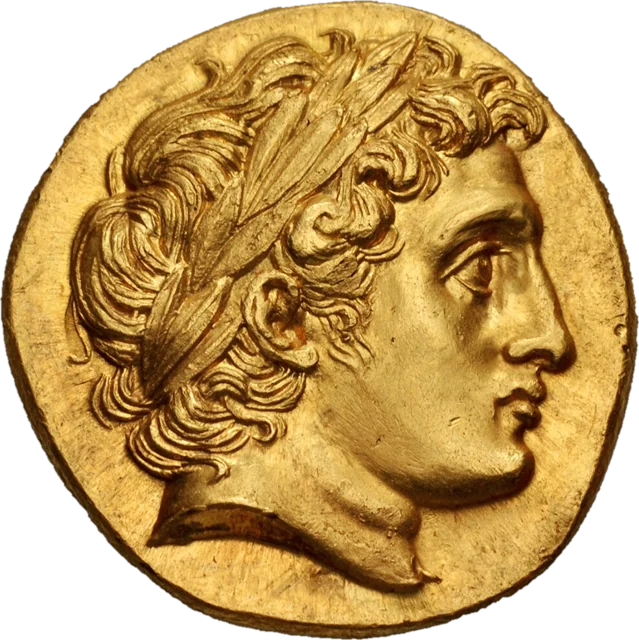
Classical Numismatic Group, Triton XXVII (2024), lot 152 · Auction photo, credited
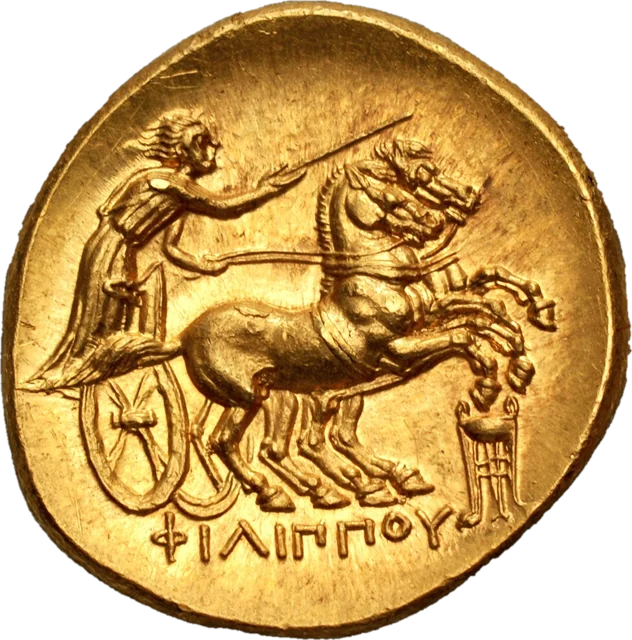
Source: Nomos AG (Swiss auction house), Auction 7 (2013), lot 46: "a true portrait of Alexander III" ↗ · Classical Numismatic Group, Triton XXVII, lot 152: the same front die, sold for $22,500 ↗
Sources
- Margaret Thompson, 'Posthumous Philip II Staters of Asia Minor', in Studia Paulo Naster Oblata I (1982), no. 12
- Georges Le Rider, Le monnayage d'argent et d'or de Philippe II (1977), pl. 90, 16 and pl. 93, 26
- Classical Numismatic Group, Feature Auction 133, lot 172, and Triton XXVII, lot 152 (catalogue notes)
Chasing one die
A collector can set out to own a coin from this one engraver's die: in the seven years to November 2026 one came up at auction twelve times.
That is nearly two sales a year, in Zurich and in the United States. Hammer prices ran from 17,000 Swiss francs to $130,000, and the three highest were all in 2026. The top one, at Heritage in September 2026, was a coin graded Choice Mint State with a star for eye appeal and "Fine Style" by NGC, a grading firm that seals coins in a plastic holder: with the buyer's fee it cost $158,600. They do not only go up: the coin sold for $22,500 in January 2024 had made $24,000 in 2019. Each catalogue entry says which die struck the coin, in words like "same obverse die" or "this obverse die", so the die is something a buyer can search for by name. Coins of this issue are also in the collections of the American Numismatic Society in New York, the Ashmolean Museum in Oxford and the Alpha Bank in Athens, and the Athens coin is from the same dies. Rarity alone does not set the price. In January 2026 one collection sold two staters of this issue in a row: the one from this die made $37,500, and one with an ordinary Apollo, which the auction house called very rare, made $8,500.
Hammer prices, before the buyer's fee. A coin can come back to auction, so twelve sales may be fewer than twelve coins.
Source: Numismatica Ars Classica (Swiss auction house), Auction 138, lot 131: "Jameson 978 = Gillet 785 (this obverse die)" ↗ · Classical Numismatic Group, Triton XXIX, lot 128: "Very rare with 'normal' style Apollo portrait", sold for $8,500 ↗
Sources
- Lot pages of Nomos, Leu Numismatik and Classical Numismatic Group, and Numismatica Ars Classica's lists of prices realised for auctions 132, 138, 158 and 165
- Sylloge Nummorum Graecorum: American Numismatic Society 309; Alpha Bank 260; Ashmolean 2456
Known by its die
Collectors follow a great die the way art historians follow a painter: the catalogue entry for lot 172 lists the famous coin struck from the same die.
Margaret Thompson was curator of Greek coins at the American Numismatic Society in New York, and her 1982 study sorted these staters by mint. Robert Jameson was a Paris collector whose catalogue appeared from 1913. His coin from this die later belonged to Charles Gillet, a French industrialist whose Greek coins were sold in Zurich in 1974 as the collection of a "Kunstfreund", an art lover. Colin Kraay and the photographer Max Hirmer chose the type for their book Greek Coins (1966). Lot 172 is not that famous coin. It was struck from the same front die, and that alone puts those names in its description. Lot 171, from an ordinary die, lists none of them.
Source: Classical Numismatic Group, Feature Auction 133, lot 172: the full catalogue line ↗
Sources
- Collection R. Jameson, Monnaies grecques antiques (Paris, 1913–1932), no. 978
- Bank Leu and Münzen und Medaillen, Griechische Münzen aus der Sammlung eines Kunstfreundes (Zurich, 28 May 1974), lot 232
- Colin Kraay and Max Hirmer, Greek Coins (1966), no. 565
Signed in gold
At Syracuse the two most famous engravers of the Greek world, Kimon and Euainetos, signed dies for a gold coin only 14 millimetres across.
The coin is the 100 litrai of Dionysios I: the nymph Arethusa on the front, and on the back Herakles strangling the lion of Nemea. Kimon put the letters KI behind Arethusa's neck on the first front die, beside a grain of barley. Euainetos signed dies of his own. They are the same two men who signed the city's big silver decadrachms in these years, and here they worked at less than half the width. Denyse Bérend's study of this gold counts 26 front dies and numbered every one, so a coin can be traced to its die pair, written like "D5/R5". Only the earliest dies carry a signature; the rest are sorted by eye as "in the style of" one master or the other. Collectors hunt for the signed dies, and for a coin where the letters are not worn or off the edge. In January 2024 a coin from Euainetos's die D5, its "full signature visible", sold for $100,000; one from Kimon's signed die had made $27,500 in 2020.
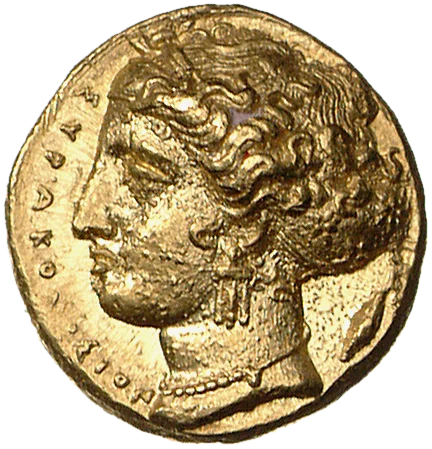
Münzkabinett, Staatliche Museen zu Berlin · Public Domain Mark 1.0
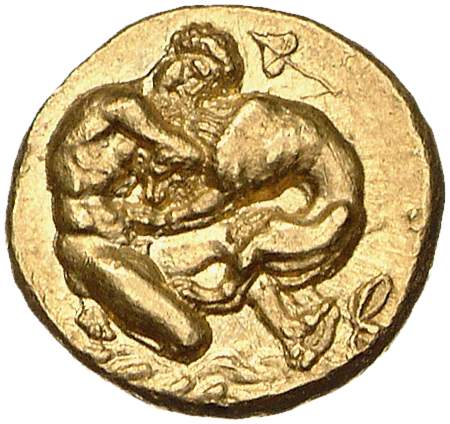
Source: Classical Numismatic Group, Triton XXIII (2020), lot 131: "Obverse die signed by Kimon", barley grain and KI behind the neck ↗ · Classical Numismatic Group, Triton XXVII (2024), lot 74: "Obverse die signed by Euainetos", Bérend D5/R5, "Full signature visible", sold for $100,000 ↗ · Museum of Fine Arts, Boston: 100-litra piece of Syracuse, "signed by Euainetos" ↗ · Leu Numismatik (Swiss auction house), Auction 6, lot 78: Euainetos's signature "appears on the earliest dies of the gold series" ↗
Sources
- Denyse Bérend, 'Le monnayage d'or de Syracuse sous Denys I', in La monetazione dell'età dionigiana (1993)
- Giuseppe de Ciccio, Gli aurei siracusani di Cimone e di Eveneto (1957)
- KBR SILVER die-study database (26 obverse and 23 reverse dies, after Bérend)
- Münzkabinett Berlin 18205549 (Bérend 5,2)