 Gold Coin Catalogue
Pantikapaion: the satyr at the edge of the world
A Greek grain port in the Crimea struck a gold coin that collectors rank beside Kimon's Arethusa, and in 2023 it became the most expensive ancient coin ever sold. Why there, and why so good?
Pantikapaion at a glance
Pantikapaion, today's Kerch in eastern Crimea, was the capital of the Greek Bosporan kingdom, and for about 75 years it struck some of the finest gold coins of the Greek world.
It sat on the narrow strait between the Black Sea and the Sea of Azov. Behind it lay the steppe of the Scythian horsemen; in front, the sea road to Athens. Its kings grew rich on grain, and from about 380 to 304 BC the city struck gold staters with the same two pictures: a satyr's head and a griffin with a spear in its mouth. One rare issue turned the satyr to look at us, and that coin is the subject of this story. Syracuse made beautiful coins because it was a great power competing with others. Pantikapaion did it at the far edge of the Greek world, which makes it the more surprising.
Sources
- MacDonald, An Introduction to the History and Coinage of the Kingdom of the Bosporus (2005)
- NAC Auction 138 (2023), lots 155–156, catalogue essays
A Milesian port on the steppe
Greek settlers from Miletus founded Pantikapaion around 600–575 BC, on a hill above the strait the Greeks called the Cimmerian Bosporus.
It became the leading Greek city of the region. To a Greek in Athens it lay at the edge of the known world: beyond it were Scythian nomads, the one-eyed Arimaspians of legend, and the griffins that were said to guard the gold of the north. Around 480 BC the city was ruled by the Archaeanaktid family. In 438/7 BC a man named Spartokos took power, perhaps a Thracian mercenary captain, and founded the Spartokid dynasty, which ruled for more than three hundred years.

Derevyagin Igor, Wikimedia Commons · CC BY-SA 3.0
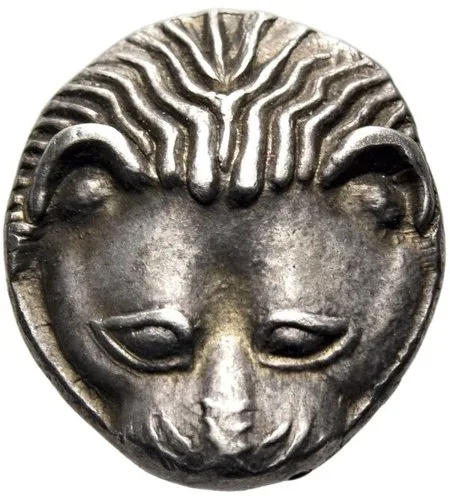
Nomos AG, Auction 39 (2026), lot 108 · Auction photo, credited
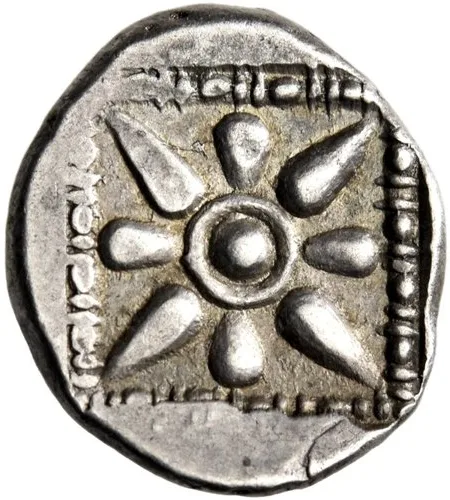
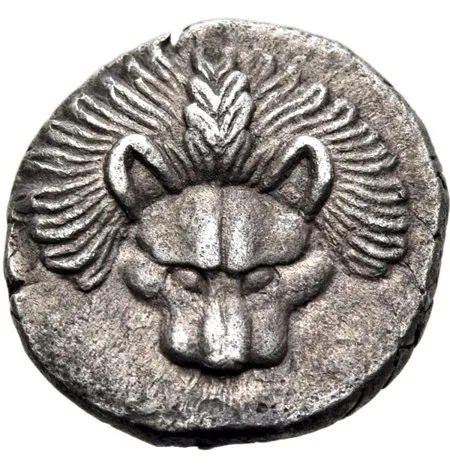
Nomos AG, Auction 39 (2026), lot 110 · Auction photo, credited
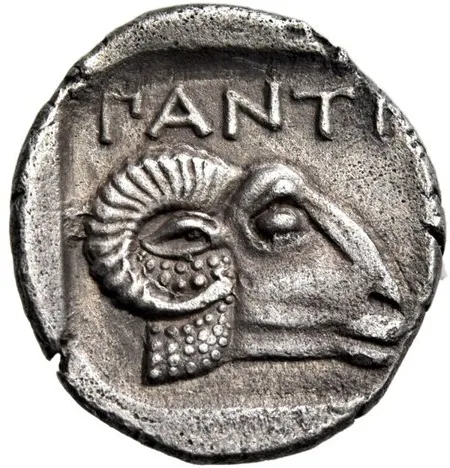
The acropolis today, and the city's early silver, which already liked faces that look straight out at you.
Source: Diodorus of Sicily, Greek historian (1st century BC), 12.31.1: the Archaeanaktids and Spartokos ↗ · Herodotus, Greek historian of the 5th century BC, 4.13: Arimaspians and griffins ↗
Sources
Grain for Athens
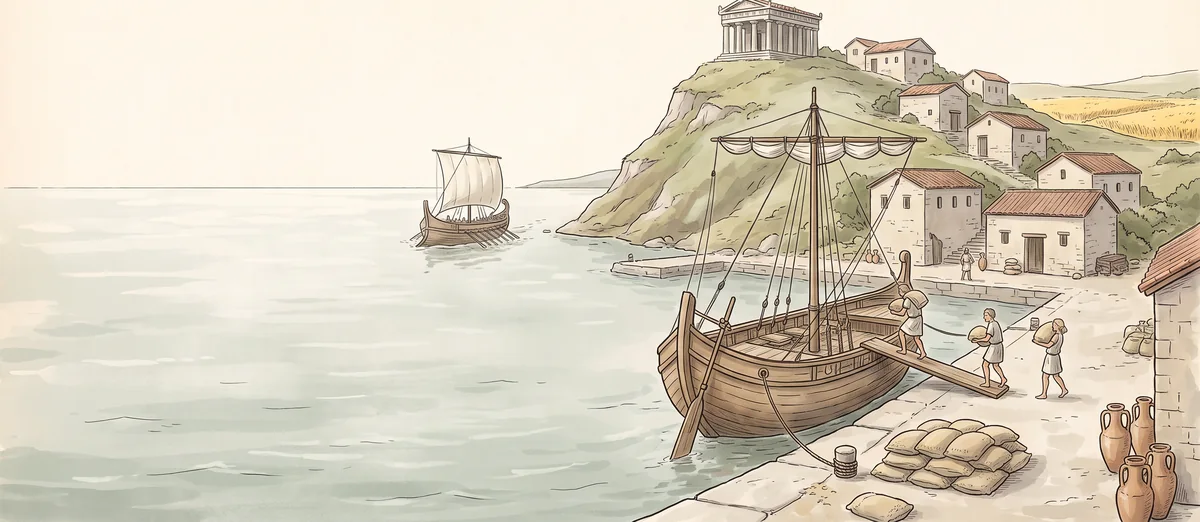
Under King Leukon I, Pantikapaion fed Athens: ships loading grain for Athens went first and paid no export duty.
In a speech of 355/4 BC Demosthenes says about 400,000 medimnoi of grain came to Athens from the Bosporus each year, which he puts at half of what Athens imported. Athens made Leukon a citizen and honoured him with crowns and statues. That wealth paid for the city's gold coinage and for engravers good enough to cut it. The ear of corn under the griffin on every gold stater says where the money came from.
Sources
- Demosthenes 20 (Against Leptines) 29–40
- Strabo 7.4.6
- Moreno, Feeding the Democracy (2007)
A satyr, a griffin and an ear of corn
Every gold stater of the city shows the same three things: a satyr's head, a horned griffin with a spear in its jaws, and an ear of corn.
The head was long called Pan, a pun on the city's name (Pan-tikapaion), but its features are a satyr's, probably a badge for Satyros I, the king who built the Bosporan kingdom. The griffin is the beast that, Herodotus heard, guarded the gold of Scythia against the Arimaspians: a fitting picture for a gold coin, and much of the gold probably came from Scythian trade. The staters weigh about 9.1 g, a local standard heavier than Athens' 8.6 g, and turn up as far away as a gold hoard on Prinkipo, near Istanbul.
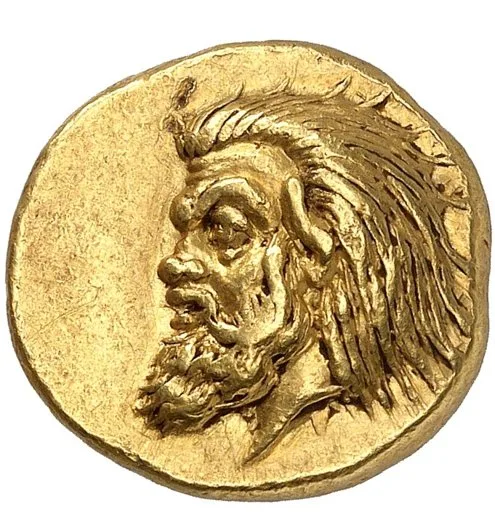
Künker, Auction 383 (2023), lot 2025 · Auction photo, credited
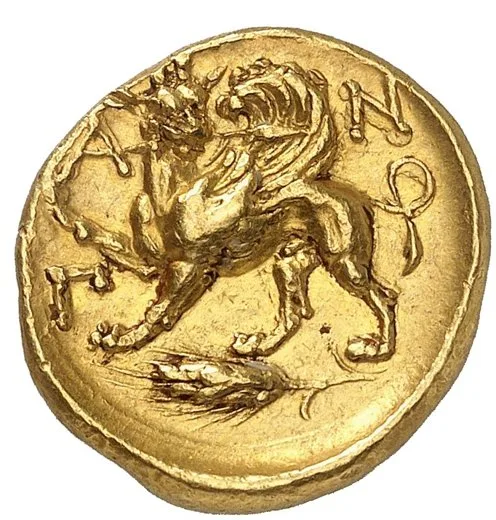


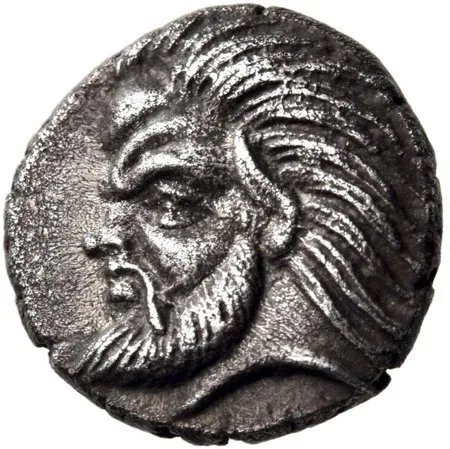
Nomos AG, Auction 39 (2026), lot 112 · Auction photo, credited
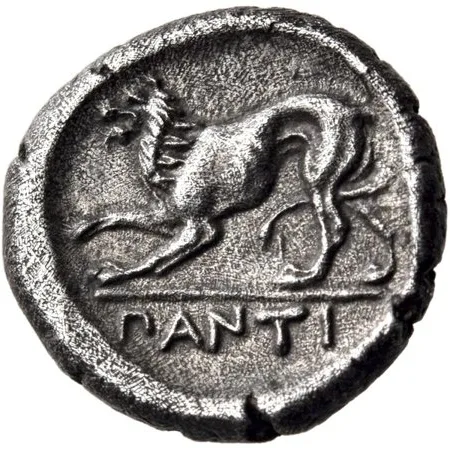
Some of the first gold staters, c. 380–370 BC: the satyr in profile, no wreath yet. Künker's plate coin, the Berlin coin 18203029, and the silver hemidrachm with Pan.
Source: Herodotus, Greek historian of the 5th century BC, 4.13: griffins guarding gold ↗ · Pliny the Elder, Roman naturalist (AD 77), Natural History 7.2: the Arimaspians and griffins ↗ · Pliny the Elder, Natural History 10.70: fabulous birds ↗
Sources
- NAC Auction 138 (2023), lot 155, essay
- Regling, 'Der griechische Goldschatz von Prinkipo', ZfN 41 (1931)
The satyr turns to face us
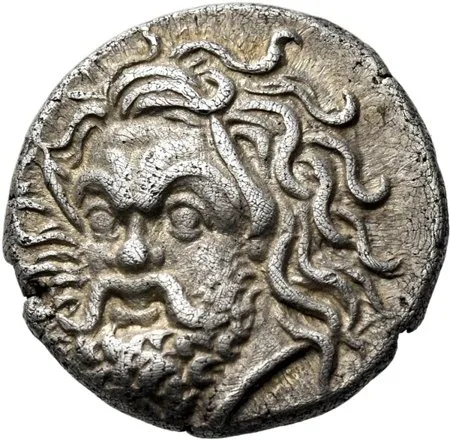
For one rare issue the engraver broke the rule and turned the satyr three-quarters towards us: wild hair, a furrowed brow and eyes that seem caught by surprise.
Facing heads were the newest fashion in Greek coins after Kimon's Arethusa at Syracuse around 405 BC, and Larissa, Amphipolis, Ainos, Klazomenai and Rhodes all tried them. They are hard to cut, because the nose and brow point straight out of the die. Pantikapaion's engraver did it best: Godfrey Locker Lampson, who owned a coin from the same dies, called the head 'a marvel of speaking portraiture' and the work of the greatest of all die-engravers. We do not know his name, because no one signed dies here as they did at Syracuse.
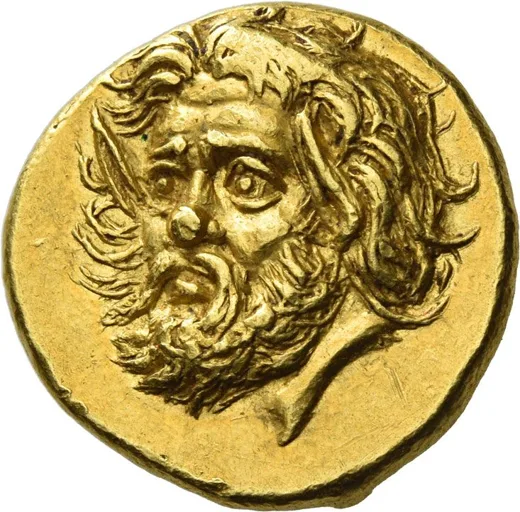
Numismatica Ars Classica, Auction 138 (2023), lot 155 · Auction photo, credited
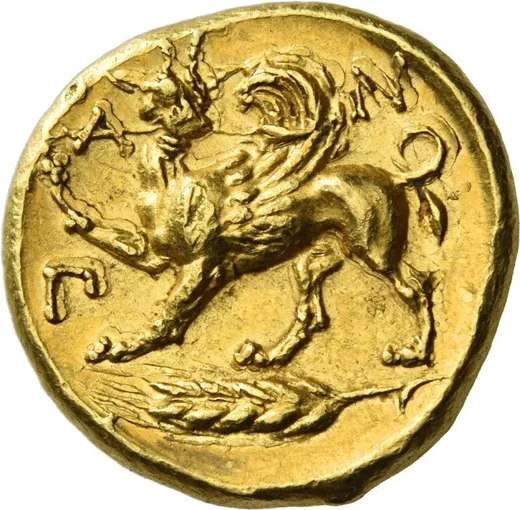
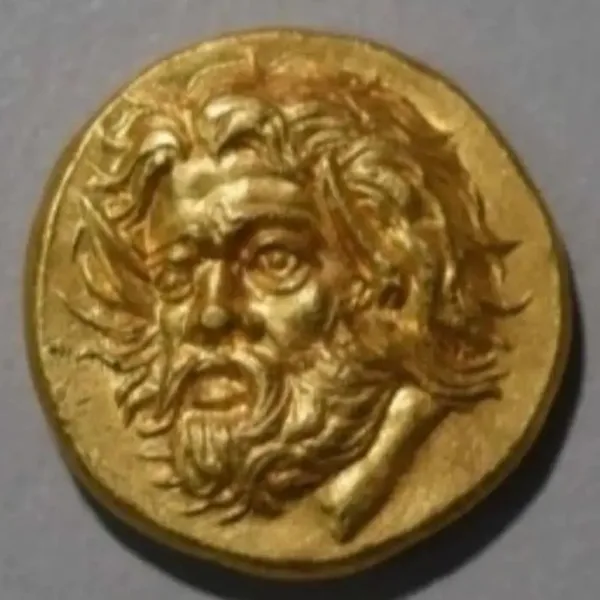
Hellenic Police (2023), via The History Blog · Press photo, credited
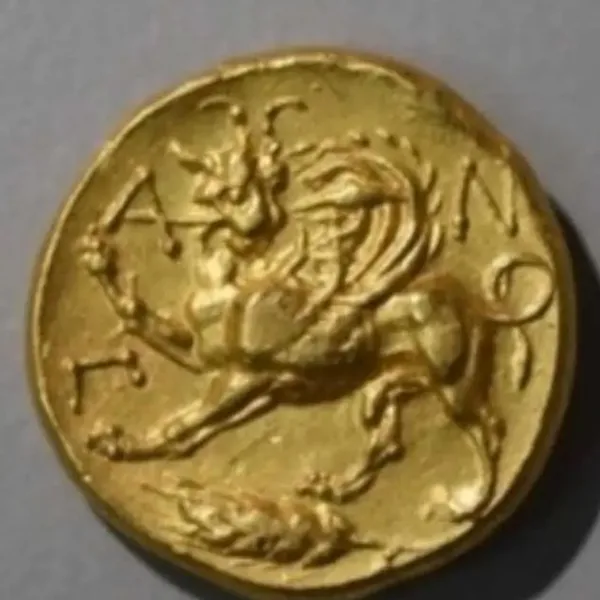


Three of the very few known: the record coin, the coin seized in Athens, and the Berlin coin (9.09 g).
Sources
- MacDonald 2005, type 39
- Locker Lampson collection catalogue, p. vii (quoted by NAC)
- NAC Auction 138 (2023), lot 155
Practising on silver
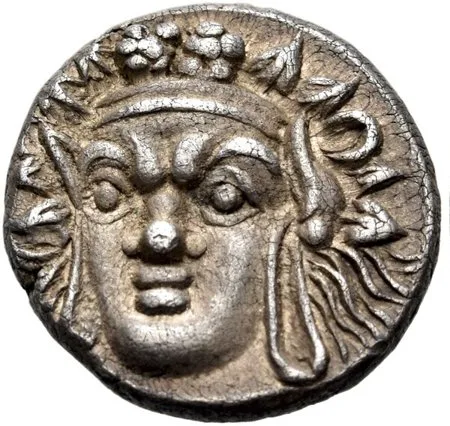
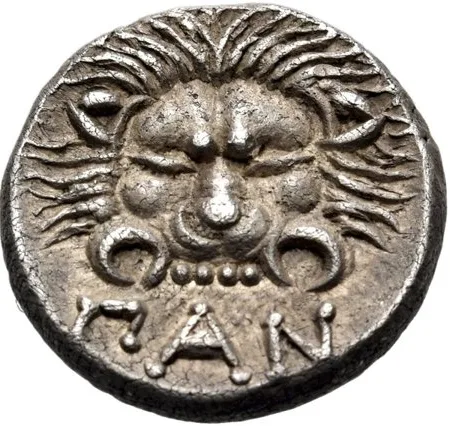
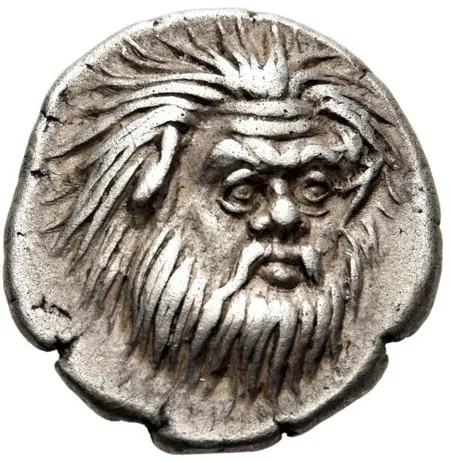
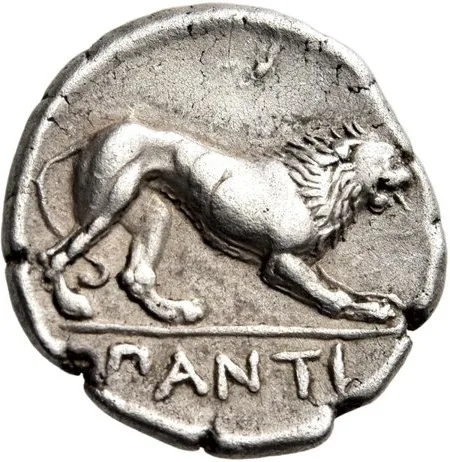
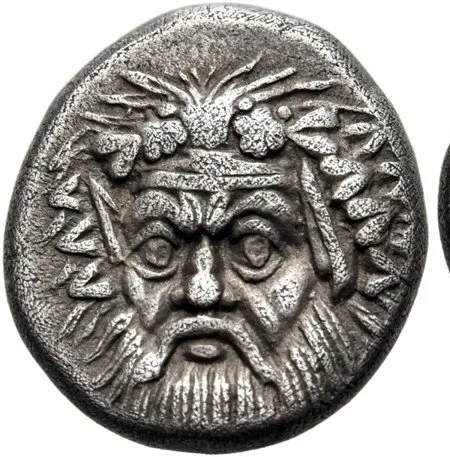
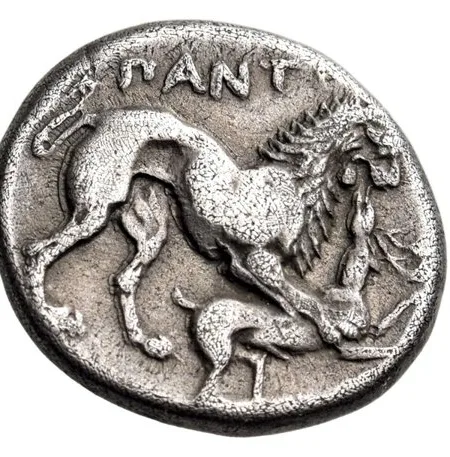
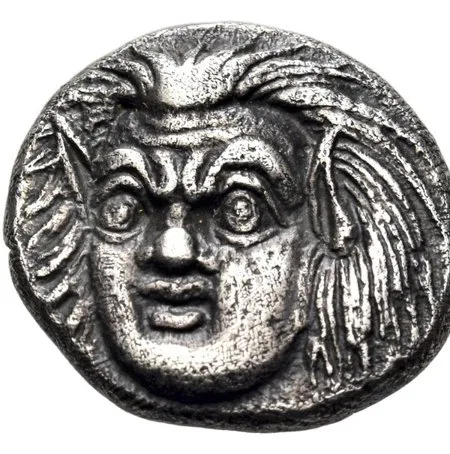
The small silver coins of the same years show the engravers working out the facing satyr, old and young, with and without ivy, before and after the gold.
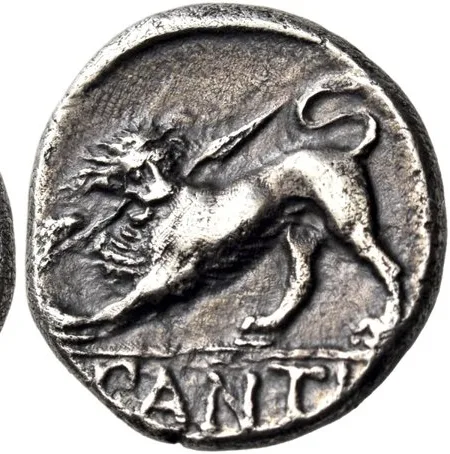
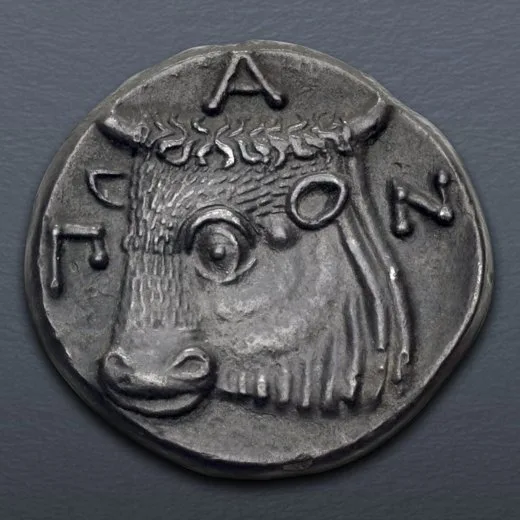
On hemidrachms of about 370–355 BC the satyr looks straight out over lions, a lion attacking a stag, and a lion's mask: animal scenes close to the Scythian art the city's goldsmiths knew well. Later drachms bring the three-quarter face back, with a bull's head turning towards us on the other side. The gold stater is the finest form of an idea the workshop kept returning to.
Nomos AG, Auction 39 (2026), lot 117 · Auction photo, credited
Nomos AG, Auction 39 (2026), lot 114 · Auction photo, credited
Nomos AG, Auction 39 (2026), lot 115 · Auction photo, credited
Nomos AG, Auction 39 (2026), lot 116 · Auction photo, credited
Nomos AG, Auction 39 (2026), lot 119 · Auction photo, credited
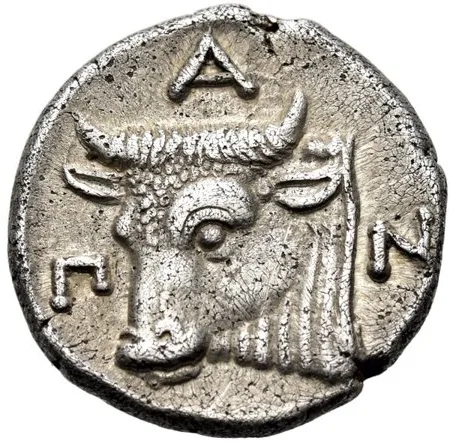


Silver hemidrachms of c. 370–355 BC, then drachms of c. 340–325 BC with the three-quarter satyr and a bull's head (the last two: Nomos 39 lot 119 and Berlin 18200500).
Sources
- MacDonald 2005, types 40–44 and 57
- Nomos AG, Auction 39 (2026), lots 114–119 (descriptions)
Why the art is so good here
Money, master goldsmiths, the latest fashion, a workshop that practised, and gold itself. The goldsmiths are the biggest part of the answer.
Money: the grain trade made the Spartokids rich enough to hire the best. Goldsmiths: the same Greek workshops around Pantikapaion made gold for the Scythian kings of the steppe, some of the finest metalwork of the ancient world. The Scythians were nomad horsemen who loved gold and paid for it in grain, horses and slaves, and Greek craftsmen gave them Greek modelling and realism with Scythian subjects and the steppe taste for animals fighting. The Kul-Oba mound, dug up in 1830 just outside the city, held an electrum cup with Scythian warriors bandaging a leg and pulling a tooth, and hundreds of stamped gold plaques sewn onto clothes, many of them faces looking straight out, like the satyr. The Solokha comb shows three warriors fighting over a fallen horse, every strap and wound modelled in the round. The Tovsta Mohyla pectoral, 1.15 kg of gold, has griffins attacking horses: the same beast as on the city's staters. Hands that could chase a lock of hair this finely could cut a die. Fashion: the facing head was the boldest thing a Greek engraver could try after Kimon. Practice: the silver shows the same idea refined over years. Gold: it is soft and does not corrode, so it fills deep dies and keeps every hair. The staters are thick and broad, struck in very high relief with few dies and great care.

Joanbanjo, Wikimedia Commons · CC BY-SA 3.0

Unknown 19th-century artist, Wikimedia Commons · Public domain

PHGCOM, Wikimedia Commons · CC BY-SA 3.0

World Imaging, Wikimedia Commons · CC BY-SA 3.0

Maqs (Russian Wikipedia), Wikimedia Commons · Public domain

Terminator (Ukrainian Wikipedia), Wikimedia Commons · Public domain

Curryfauvel, Wikimedia Commons · CC0
Greco-Scythian gold of the 4th century BC: Kul-Oba, the Solokha comb and the Tovsta Mohyla pectoral.
Sources
- NAC Auction 138 (2023), lot 155, essay
- State Hermitage Museum (Kul-Oba, Solokha)
- Museum of Historical Treasures of Ukraine (Tovsta Mohyla pectoral)
- Jacobson, The Art of the Scythians (1995)
- Kraay, Archaic and Classical Greek Coins (1976), on facing heads
The classic ivy-wreathed stater
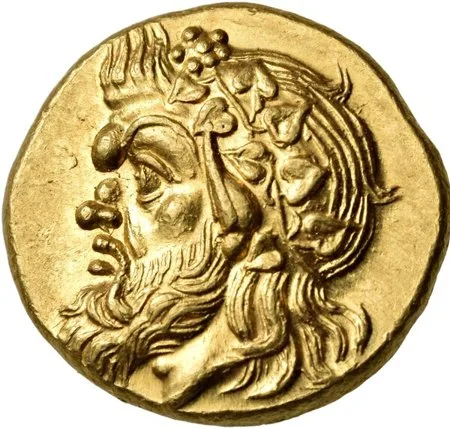
After the facing issue the satyr went back to profile, now crowned with ivy, on the stater most museums and collectors know.
They run from Leukon I's last years through Spartokos II and Pairisades I. The best are still superb, struck in high relief on broad flans, and the griffin now carries the letters Π-Α-Ν round it. Gold coinage ended around 304 BC, when the Spartokids took the title of king and, later, put their own portraits on the coins.
Nomos AG, Auction 39 (2026), lot 118 · Auction photo, credited
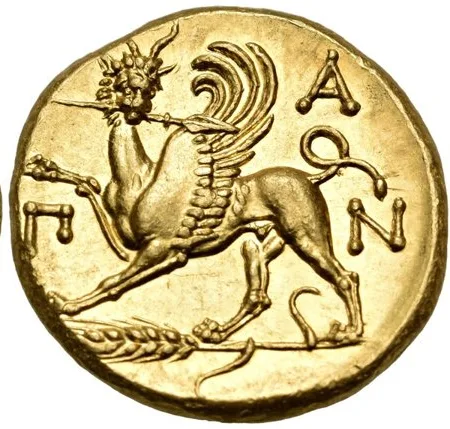
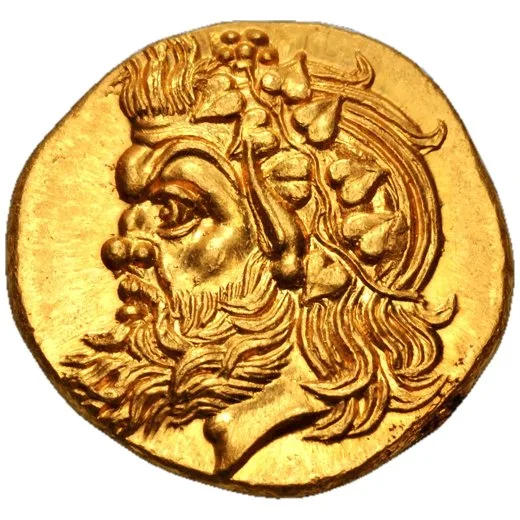
Classical Numismatic Group · Auction photo, credited
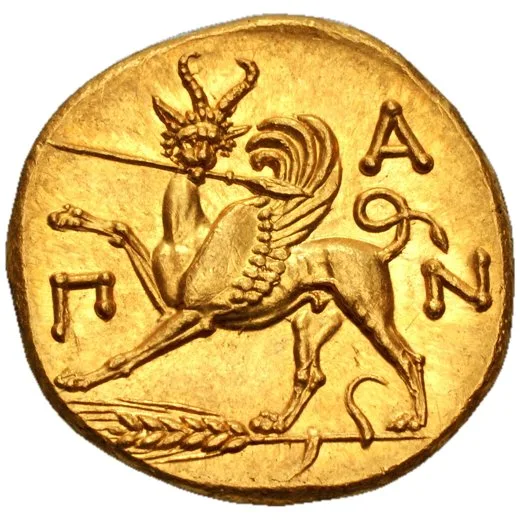
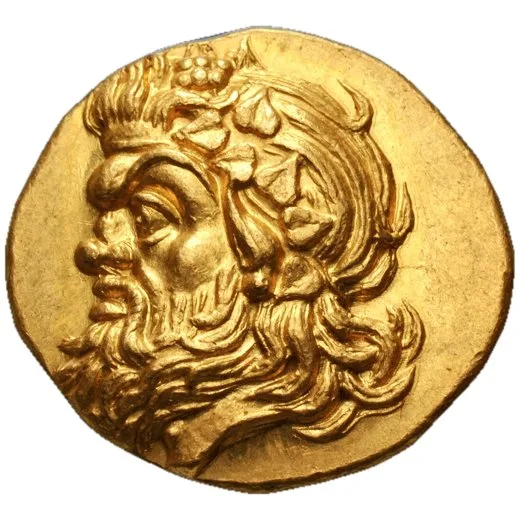
Classical Numismatic Group · Auction photo, credited
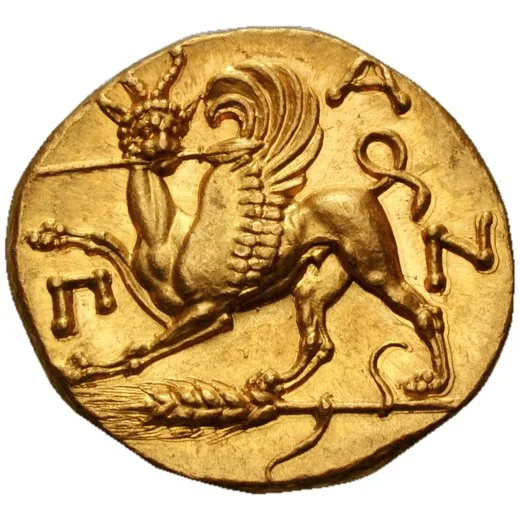
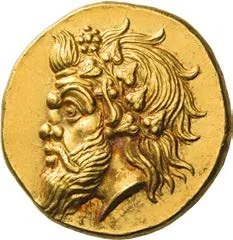
Numismatica Ars Classica, Auction 138 (2023), lot 156 · Auction photo, credited
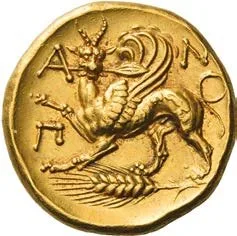


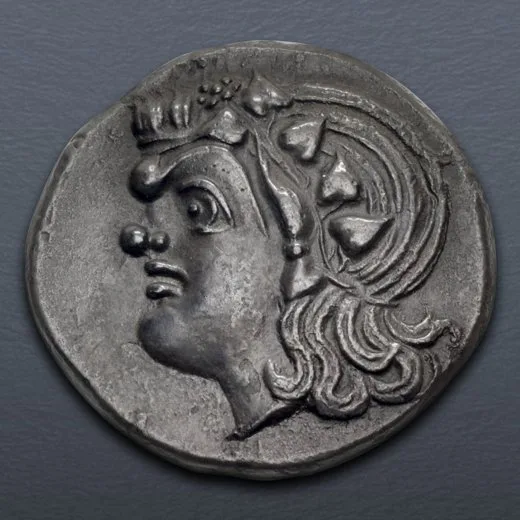
Classical Numismatic Group · Auction photo, credited
The best-graded ivy-wreathed staters we found, the Berlin coin (9.08 g), and the big silver tridrachm of the same years.
Sources
- MacDonald 2005, types 48, 54 and 63
- SNG British Museum, Black Sea, 867
Kings, Mithradates and Caesar
Pantikapaion stayed a royal capital: Mithradates VI of Pontus took it over in 108 BC and died there in 63 BC.
His son Pharnakes II ruled from Pantikapaion and struck gold staters with his own portrait. In 47 BC he fought Julius Caesar at Zela and lost so fast that Caesar wrote 'veni, vidi, vici'. Asandros, who then took the throne, put Nike on a ship's prow on his gold. Bosporan kings went on striking staters under Rome for three more centuries, but the gold slowly turned to electrum and then to base metal. The great age of its art was the 4th century BC.

Bibliothèque nationale de France · CC BY 4.0

Bibliothèque nationale de France · CC BY 4.0
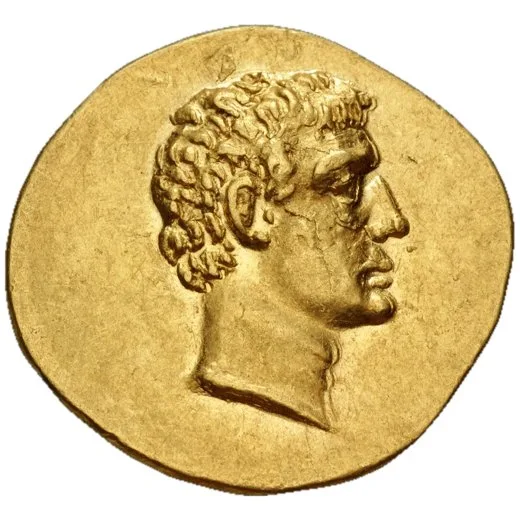
Classical Numismatic Group · Auction photo, credited
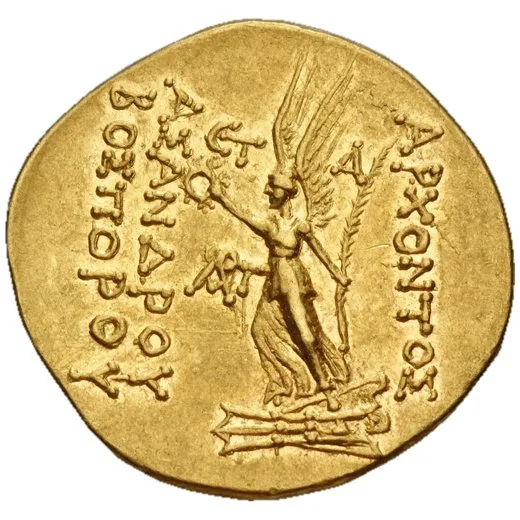
Sources
- Appian, Mithridatic Wars 111–120
- Suetonius, Julius Caesar 37; Plutarch, Caesar 50
- MacDonald 2005, types 182–216
A coin worth CHF 5.39 million
In May 2023 a three-quarter satyr stater sold in Zurich for CHF 5.39 million with fees, the highest price ever paid for an ancient coin.
It had already set a record in New York in 2012, at $3.8 million with fees. Very few are known. The Royal Library of Belgium holds three, and in September 2023 Greek police recovered another, better centred, from smugglers in Athens. Valued at about €6 million, it went to the Numismatic Museum of Athens.
Sources
- NAC Auction 138 (18 May 2023), lot 155
- The Art Newspaper, 26 May 2023
- The History Blog, 23 Sep 2023 (the Athens seizure)
- Royal Library of Belgium (KBR) coin cabinet, public post on its de Hirsch staters