 Gold Coin Catalogue
Coins as propaganda
Why is this face or picture on the coin, and who was meant to see it? From the Persian king's archer to Christ on Byzantine gold.
Gods and city badges
A coin spoke for its city
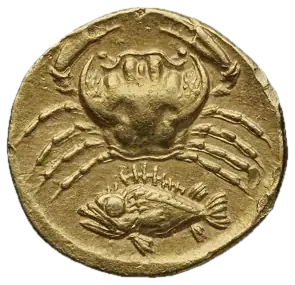
Greek coins carried the badge of the city that made them: an owl for Athens, a crab and an eagle for Akragas in Sicily, a tuna for Kyzikos. The badge told you who stood behind the metal.
A badge worked like a seal. Anywhere in the Greek world people could see at a glance whose coin it was and whether to trust its weight, so cities changed their badges very rarely. Gold was rare too, struck mostly in a crisis. Akragas made these small gold coins in 406 BC, the year a Carthaginian army besieged and took the city, and still put its crab on them: in an emergency, the familiar picture was what people trusted.
Bibliothèque nationale de France · CC BY 4.0
Sources
- Kraay, Archaic and Classical Greek Coins (1976)
- Jenkins, Ancient Greek Coins (1990)
Why there were no faces
For two hundred years the only faces on Greek coins were the faces of gods. A god vouched for the coin; a living man's face would have looked like a tyrant's boast.
Athena watched over the money of Athens, Apollo, Zeus or Artemis over other cities'. Near the end of its long war with Sparta, in 407/6 BC, Athens ran out of money, melted the golden statues of Victory on the Acropolis and struck its first gold. It still showed Athena and her owl. The comic poet Aristophanes joked a year later that Athens treated its best citizens like 'the old coinage and the new gold': the finest coins of all, left unused while cheap new bronze went round. Even Alexander the Great put gods on his coins, not himself.
Source: Aristophanes, the Athenian comic poet, Frogs 718–737 (405 BC): 'the old coinage and the new gold' ↗
Sources
- Aristophanes, Frogs 718–737
- Kraay, Archaic and Classical Greek Coins (1976)
- Kroll, The Athenian Agora XXVI: The Greek Coins (1993)
The Great King's archers
The Great King as an archer
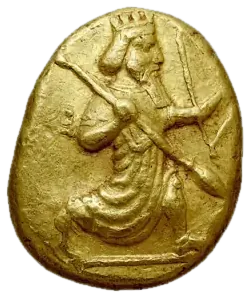
Persia's gold coin, the daric, showed the king running with a bow and a spear. The design hardly changed for nearly two hundred years, so it showed the office of king, not one man.
Darius I brought in the daric around 500 BC, and it was struck at Sardis, the old mint of the Lydian kings, until Alexander took the empire. Greeks simply called the coins 'archers'. They paid Greek soldiers and bought Greek politicians. In 395 BC, Xenophon writes, a Persian governor sent an agent to Greece with gold worth fifty talents of silver, to turn Thebes, Corinth and Athens against Sparta, so that Sparta's king Agesilaus, then winning in Asia, had to sail home. Agesilaus joked that the king had driven him out of Asia with his archers. Plutarch tells the story twice, once with ten thousand archers and once with thirty thousand.
Bibliothèque nationale de France, via Wikimedia Commons · Public domain
Source: Xenophon, the Athenian soldier and historian who knew Agesilaus, Hellenica 3.5.1 (the Persian gold) ↗ · Plutarch, the Greek biographer (about AD 100), Agesilaus 15.6 (ten thousand archers) ↗ · Plutarch, Artaxerxes 20.4 (thirty thousand) ↗
Sources
- Xenophon, Hellenica 3.5.1
- Plutarch, Agesilaus 15.6
- Plutarch, Artaxerxes 20.4
- Carradice, 'The regal coinage of the Persian Empire', in Coinage and Administration in the Athenian and Persian Empires (1987)
The first real faces
The first portraits of living men on coins were not Greek kings but Persian governors, more than half a century before Alexander.
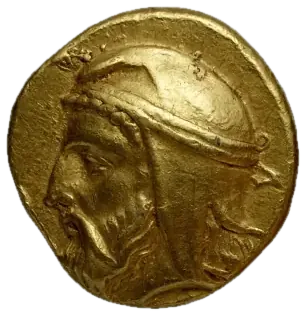
The governors, called satraps, of Persia's western provinces in today's Turkey hired Greek engravers, who gave them faces with real character: a hooked nose, a full beard, the soft Persian cap tied with a royal band. The earliest, on silver around 410 BC, is usually said to be the governor Tissaphernes. This gold stater of Lampsakos, a Greek city on the Dardanelles, shows another satrap in the 350s BC. The old books call him Orontes, a satrap who rebelled against his king. Either way, a living ruler had put his face on gold a generation before Alexander.
Bibliothèque nationale de France, via Wikimedia Commons · Public domain
Sources
- Troxell, 'Orontes, satrap of Mysia', Schweizerische Numismatische Rundschau 60 (1981)
- Kraay, Archaic and Classical Greek Coins (1976)
Showing off a win
Philip's racing chariot
Philip II of Macedon put a racing chariot on his gold. Plutarch says he did it on purpose, to boast of his wins at Olympia.
Philip took the gold mines near Mount Pangaion and refounded the mining town as Philippi in 356 BC. Diodorus, a Greek historian of the 1st century BC, says the mines then gave him more than a thousand talents a year, and from that gold came the staters Greeks called philippeioi. Apollo of Delphi is on the front; on the back a two-horse chariot races at full gallop over Philip's name. Delphi and Olympia belonged to every Greek, so the coin spoke to all of Greece, not just to Macedon.
Source: Plutarch, Alexander 4: Philip 'took care to have the victories of his chariots at Olympia engraved upon his coins' ↗ · Diodorus of Sicily, Library of History 16.8.6–7 (the mines and the philippeioi) ↗
Sources
- Plutarch, Alexander 4.9
- Diodorus of Sicily 16.8.6–7
- Le Rider, Le monnayage d'argent et d'or de Philippe II (1977)
Alexander's Victory holds a ship's mast
Alexander's gold paired Athena in her war helmet with Victory holding a wreath and a ship's mast. It announced a winner without showing his face.
Alexander paid for his conquest with the treasure of the Persian kings, and much of their gold was melted down into his own. The coin that had shown the Great King as an archer gave way to Athena and Victory, struck in huge numbers at mints from Macedonia to Babylon. The mast, a stylis, stood at the stern of a warship, so this Victory is a victory at sea. The double stater shown here was his largest gold coin, struck in far smaller numbers than the stater with the same two goddesses.
Sources
- Price, The Coinage in the Name of Alexander the Great and Philip Arrhidaeus (1991)
Pyrrhus's Victory carries a trophy
Pyrrhus of Epirus came to Sicily to fight Carthage and struck gold at Syracuse: Athena on one side, Victory with a trophy of captured armour on the other.
A kinsman of Alexander through Alexander's mother, Pyrrhus chose the same two goddesses as Alexander's gold, a claim to be his heir. Plutarch tells how he stormed Eryx, the strongest Carthaginian fortress in Sicily, after vowing games to Herakles; the trophy is that kind of boast. The wins did not last. Leaving Sicily in 276 BC, Pyrrhus looked back and said: 'My friends, what a wrestling ground for Carthaginians and Romans we are leaving behind us!'
Source: Plutarch, Pyrrhus 22.4–5 (Eryx) ↗ · Plutarch, Pyrrhus 23.6 ('what a wrestling ground') ↗
Sources
- Plutarch, Pyrrhus 22.4–5 and 23.6
- BMC Pyrrhus 1
Kings who became gods
Stealing Alexander
Ptolemy, Alexander's general in Egypt, seized the king's body on its way home to Macedonia, then put Alexander, and finally himself, on his gold.
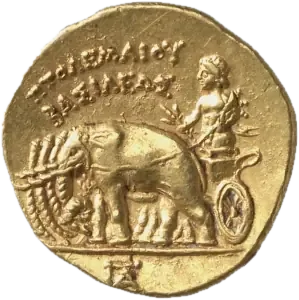
Pausanias, a Greek travel writer of the 2nd century AD, says Ptolemy talked the Macedonians escorting the body into handing it over. Owning Alexander was Ptolemy's claim to rule. He made himself king in 305 BC, and his gold then showed his own heavy-jawed face on the front, with Alexander on the back riding a chariot drawn by four elephants, the beasts of his Indian campaign. In the east Seleukos, another general, struck gold 'double darics', keeping the old Persian name, with Alexander in an elephant-scalp headdress.
Münzkabinett, Staatliche Museen zu Berlin · CC BY-SA 4.0
Source: Pausanias, Description of Greece 1.6.3 (Ptolemy takes the body) ↗ · Diodorus of Sicily, Library of History 18.28 (the tomb in Alexandria) ↗
Sources
- Pausanias, Description of Greece 1.6.3
- Diodorus of Sicily 18.28.2–4
- Lorber, Coins of the Ptolemaic Empire I (2018)
Alexander made a god
Once Alexander was dead, his generals did put his face on their coins, but as a god, with the curling ram's horn of Zeus Ammon.
In 331 BC Alexander crossed the desert to the oracle of Ammon at Siwa in Egypt, which greeted him as the god's son. Lysimachos, one of his generals and later king of Thrace, put that divine Alexander on his gold from about 297 BC, with his own name and royal title on the back beside a seated Athena: he borrowed Alexander's glory instead of showing his own face. Plutarch says Alexander let only the sculptor Lysippus portray him, and that his successors copied the tilt of his neck and the 'melting glance of his eyes'. The design was so trusted that cities kept striking it for more than a century after Lysimachos died; this coin was made by Chalcedon, on the Bosporus.
Source: Plutarch, Alexander 4.1 (Lysippus, the tilt of the neck and the 'melting glance') ↗
Sources
- Plutarch, Alexander 4.1
- Thompson, 'The mints of Lysimachus', in Essays Presented to Stanley Robinson (1968)
- Marinescu, The Posthumous Lysimachi Coinage (1996)
Bigger and bolder
Later kings competed with ever grander gold. Eukratides of Bactria struck a coin of twenty staters, 169 grams, the heaviest gold coin to survive from the ancient world.
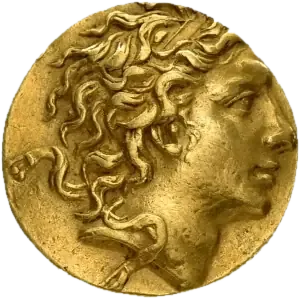
Eukratides ruled Bactria, in today's northern Afghanistan, around 170–145 BC. His giant coin shows him in a cavalry helmet on one side and the twin horsemen Castor and Pollux charging on the other, under the words 'of the great king Eukratides'. Only one is known, in the Bibliothèque nationale in Paris. Mithradates VI of Pontus, Rome's most dangerous enemy in the east, chose another way to look great: his portrait borrows Alexander's wind-blown hair, and he claimed to be a new Dionysus.
Münzkabinett, Staatliche Museen zu Berlin · CC BY-SA 4.0
Sources
- Bopearachchi, Monnaies gréco-bactriennes et indo-grecques (1991)
- de Callataÿ, L'histoire des guerres mithridatiques vue par les monnaies (1997)
Queens on gold
A family album in gold
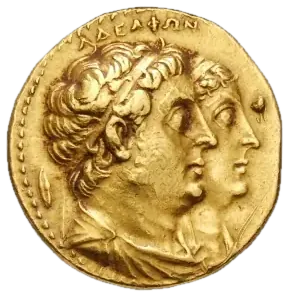
Ptolemy II's 'Sibling Gods' coin puts the living king and queen on one side and his dead parents on the other, all four as gods.
Ptolemy II married his full sister Arsinoe, as Egypt's pharaohs had done, which shocked many Greeks. Around 272 BC the pair were declared the Sibling Gods. On the front they appear side by side over the word ΑΔΕΛΦΩΝ, 'of the siblings', his shield behind them; on the back are his parents, Ptolemy I and Berenike, over ΘΕΩΝ, 'of the gods'. Read across both sides, the coin names the family's new cult: a dynasty divine from father to son.
Münzkabinett, Staatliche Museen zu Berlin · CC BY-SA 4.0
Sources
- Lorber, Coins of the Ptolemaic Empire I (2018)
A queen made a goddess
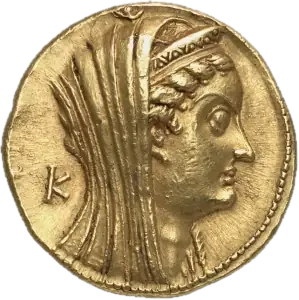
Arsinoe II, sister and wife of Ptolemy II, was worshipped as a goddess after her death, and her face went on the biggest gold coins of the age.
She died around 270 BC. Ptolemy II made her a goddess and struck gold coins of a mina, worth a hundred silver drachms, with her veiled head. A small ram's horn curls behind her ear, the sign of Ammon that Alexander's coins had made famous, and a lotus sceptre rests on her shoulder. Most have her emblem on the back, a double horn of plenty; this one has the Ptolemies' eagle. Her coins went on being struck long after her death: a dead queen had become the face of Egypt's wealth.
Münzkabinett, Staatliche Museen zu Berlin · CC BY-SA 4.0
Sources
- Lorber, Coins of the Ptolemaic Empire I (2018)
- Carney, Arsinoë of Egypt and Macedon (2013)
Rome: from family pride to one man
Ancestors and triumphs
In Rome the young men who ran the mint each year put their own family's heroes on the coins. Then the generals took over.
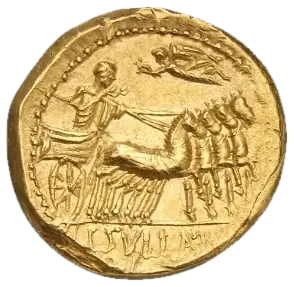
From about 130 BC the moneyers, young nobles at the start of their careers, used the silver coinage to advertise their ancestors: a famous consul, an aqueduct a forefather built, a family legend. Rome hardly struck gold except in emergencies, until its civil wars. In 82 BC Sulla, fighting his way back to Rome, paid his army in gold showing a general in a triumphal chariot, crowned by a flying Victory, with his own name. Forty years later Sextus Pompey, master of the seas around Sicily, put his famous father Pompey the Great and his dead brother on his gold, and called himself Pius, the loyal son.
Münzkabinett, Staatliche Museen zu Berlin · CC BY-SA 4.0
Sources
- Crawford, Roman Republican Coinage (1974), nos. 367 and 511
- Meadows and Williams, 'Moneta and the monuments', Journal of Roman Studies 91 (2001)
Caesar's face
Early in 44 BC Rome's mint put Julius Caesar's head on its coins: the first living Roman on the city's money, weeks before he was murdered.
For Romans a living man's face on a coin was what kings did, and Rome had thrown out its kings long before. The moneyers of 44 BC put Caesar's wreathed head on the silver denarius with his titles, first 'dictator for the fourth time', then 'dictator for life', the office he took in February. On the Ides of March he was dead. His gold never showed his face while he lived.
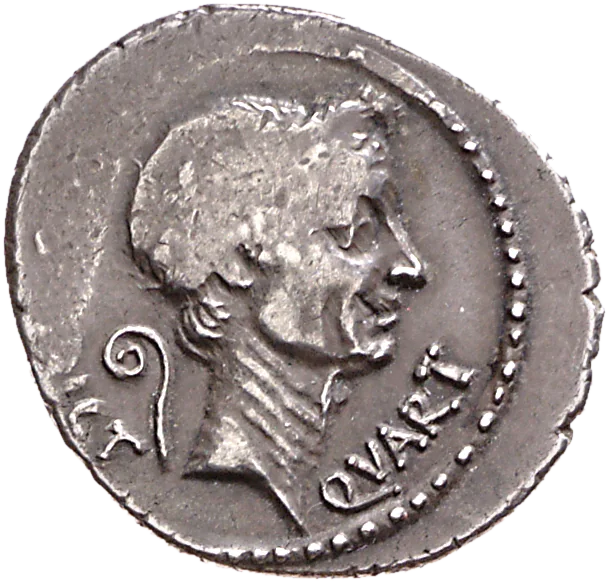
Münzkabinett, Staatliche Museen zu Berlin · Public Domain Mark 1.0
Source: Cassius Dio, Roman History 44.4.4 (honours voted to Caesar) ↗
Sources
- Crawford, Roman Republican Coinage (1974), no. 480
- Cassius Dio, Roman History 44.4.4
- Münzkabinett Berlin 18217185 (RRC 480/2c)
EID MAR: a murder on a coin
Brutus, one of Caesar's killers, struck coins with his own face on the front and, on the back, two daggers either side of a freed slave's cap: EID MAR, the Ides of March.
They were struck for his army in 42 BC, months before he died at Philippi. The cap was given to slaves on the day they were freed, so the message is plain: we killed the tyrant and freed Rome. Cassius Dio, a Roman senator who wrote a history of Rome around AD 230, describes this very design. The irony is on the front: the man who killed Caesar for acting like a king put his own living face on his money, just as Caesar had. Only three gold examples are known.
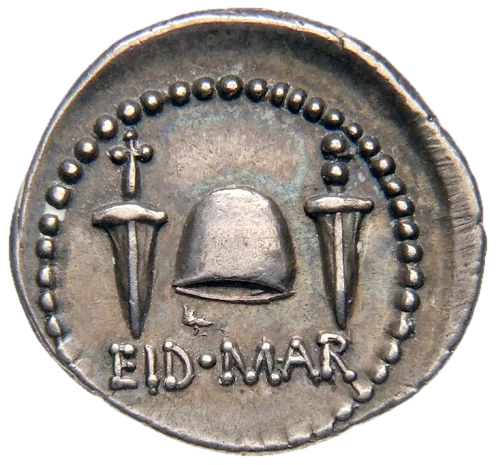
Münzkabinett, Staatliche Museen zu Berlin · Public Domain Mark 1.0
Sources
- Cassius Dio, Roman History 47.25.3
- Crawford, Roman Republican Coinage (1974), no. 508/3
A war of faces
After Caesar's murder every rival put his face on gold: Antony, Octavian, Lepidus, Brutus, Sextus Pompey, even a Roman who had gone over to the Parthians.
In 42 BC the moneyers in Rome struck gold for each of the three men who now ruled together, Antony, Octavian and Lepidus, one face to a coin. After their victory at Philippi, Octavian and Antony shared a coin, one head on each side; Octavian wears a beard, a sign of mourning for Caesar. Ten years later they were at war. Quintus Labienus went further. Having joined the Parthians, Rome's enemy, he led their army into Roman Syria in 40 BC and struck gold with his own head and a Parthian horse, calling himself Parthicus. Cassius Dio points out the scandal: that title was for Romans who beat the Parthians, and Labienus took it from the people he led against Rome.
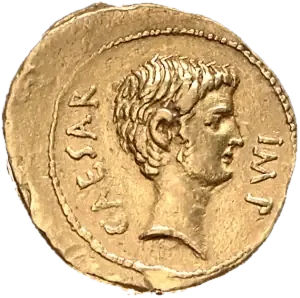
Münzkabinett, Staatliche Museen zu Berlin · CC BY-SA 4.0
Source: Cassius Dio, Roman History 48.26.5 (Labienus calls himself Parthicus) ↗
Sources
- Cassius Dio, Roman History 48.26.5
- Crawford, Roman Republican Coinage (1974), nos. 494, 524, 529
News in every purse
Augustus wins without a battle
Augustus told the empire about his successes on gold: Egypt captured, and Rome's lost army standards returned by Parthia.
After Antony and Cleopatra died in 30 BC, a crocodile and the words AEGVPT CAPTA, Egypt captured, went on his coins. The second story needed more spin. In 53 BC the Parthians had crushed a Roman army at Carrhae and taken its eagle standards. In 20 BC Augustus got them back by treaty, without a fight, and presented it as a victory: SIGNIS RECEPTIS, the standards recovered. In his own account of his reign he says he 'compelled' the Parthians to give them back and to seek Rome's friendship as suppliants. The capricorn was his star sign: the Roman biographer Suetonius says Augustus made his horoscope public and struck a silver coin with the capricorn on it.
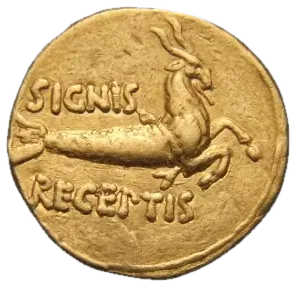
Münzkabinett, Staatliche Museen zu Berlin · CC BY-SA 4.0
Source: Augustus' own account of his reign, set up in bronze at his tomb (Res Gestae 29) ↗ · Suetonius, the Roman biographer (about AD 120), Augustus 94.12 (the capricorn coin) ↗
Sources
- Res Gestae divi Augusti 29
- Suetonius, Augustus 94.12
- RIC I² Augustus 521 and 544
Britain conquered
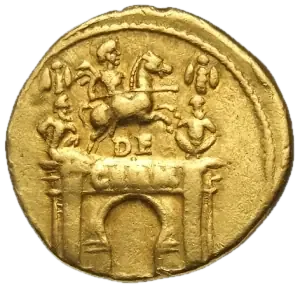
Claudius invaded Britain in AD 43, and his gold showed the triumphal arch the Senate voted him, inscribed DE BRITANN, over the Britons.
Claudius was no soldier, and the guard, not the army, had made him emperor. Britain gave him a conquest of his own. He spent only sixteen days on the island, says Cassius Dio, yet the Senate voted him the name Britannicus, a triumph and two arches, one in Rome and one in Gaul, where he had set sail. The coin shows the arch topped by the emperor on horseback between two trophies of captured arms. Gold like this went first to soldiers and officers, the men who had done the fighting.
Münzkabinett, Staatliche Museen zu Berlin · CC BY-SA 4.0
Source: Cassius Dio, Roman History 60.22.1 (the arches) ↗ · Cassius Dio 60.23.1 (sixteen days in Britain) ↗
Sources
- Cassius Dio, Roman History 60.22.1 and 60.23.1
- RIC I² Claudius 33
Empresses of Rome
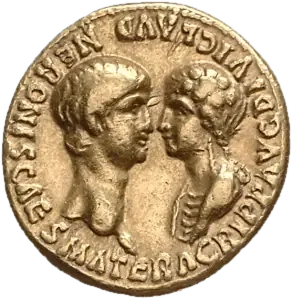
Roman coins show who really held power. In AD 54 the new emperor Nero, aged sixteen, shared his gold with his mother Agrippina, face to face, and her titles came first.
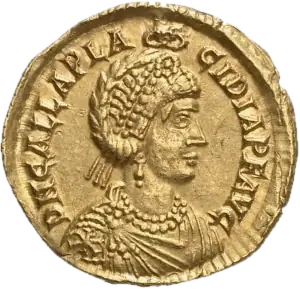
Agrippina had made her son emperor. On his first gold the two face each other, and the words around them are hers: 'Agrippina Augusta, wife of the deified Claudius, mother of Nero Caesar'. Nero's names are pushed to the back. The historian Tacitus says that on the first day of the reign Nero gave the guard the password 'the best of mothers'. Within a year her head had slipped behind his on the coins, and in AD 59 he had her killed. Four centuries later Galla Placidia, daughter of Theodosius I and once a captive of the Goths, ruled the West for her young son Valentinian III. On her gold the hand of God holds a crown over her head.
Münzkabinett, Staatliche Museen zu Berlin · CC BY-SA 4.0
Münzkabinett, Staatliche Museen zu Berlin · CC BY-SA 4.0
Source: Tacitus, the Roman historian (about AD 115), Annals 13.2: the password 'the best of mothers' ↗
Sources
- Tacitus, Annals 13.2
- RIC I² Nero 1 and 6
- Kent, RIC X (1994)
Captured!
Emperors stamped their conquests like headlines: IVDAEA for Vespasian's war in Judaea, PARTHIA CAPTA for Trajan's in the east.
In AD 70 Vespasian's son Titus took Jerusalem and destroyed its Temple. For years afterwards coins in gold, silver and bronze showed Judaea as a mourning woman, seated under a palm or beside a trophy of arms. Trajan's coins of AD 116 announced PARTHIA CAPTA, Parthia captured, with two captives at the foot of a trophy. They spoke too soon: revolts broke out behind his army, and his successor Hadrian gave up the new provinces in 117. Coins tell you what the emperor wanted known, not what happened next.
Sources
- RIC II² Vespasian 1315
- RIC II Trajan 324
- Cody, 'Conquerors and conquered on Flavian coins', in Flavian Rome (2003)
Making and unmaking an emperor
A coin that thanks the guard
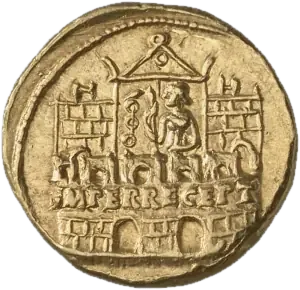
When Caligula was murdered in AD 41, soldiers of the Praetorian Guard found his uncle Claudius hiding and carried him to their camp. His gold shows that camp.
Suetonius, who wrote the lives of the first twelve emperors, says Claudius let the soldiers swear loyalty to him and promised each man fifteen thousand sesterces, making him 'the first of the Caesars who resorted to bribery to secure the fidelity of the troops'. That is 150 gold coins a man. The coin shows the walls of the camp and the words IMPER RECEPT, the emperor received; a twin design shows him clasping a guardsman's hand. New gold went to the army first, and the soldiers knew exactly what it was for.
Münzkabinett, Staatliche Museen zu Berlin · CC BY-SA 4.0
Source: Suetonius, Claudius 10.4 (fifteen thousand sesterces a man) ↗
Sources
- Suetonius, Claudius 10
- RIC I² Claudius 25
An empire for sale
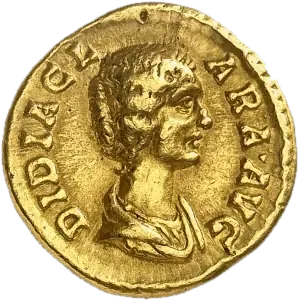
In AD 193 the guard murdered the emperor Pertinax and auctioned the throne. A rich senator, Didius Julianus, won it with 25,000 sesterces a soldier.
Cassius Dio, who sat in the Senate at the time and saw it, writes that 'both the City and its entire empire were auctioned off'. The bidding reached twenty thousand sesterces a man before Julianus offered twenty-five thousand. He at once struck gold for his wife, Manlia Scantilla, and his daughter, Didia Clara, and coins praising the loyalty of the soldiers, CONCORD MILIT. It did not hold. The armies on the frontiers chose their own emperors, and Julianus was killed after sixty-six days. His family's gold is among the rarest of all Roman coins.
Münzkabinett, Staatliche Museen zu Berlin · CC BY-SA 4.0
Source: Cassius Dio, Roman History 74.11.3–5 (the auction) ↗
Sources
- Cassius Dio, Roman History 74.11
- RIC IV Didius Julianus 5 and 10
Erased
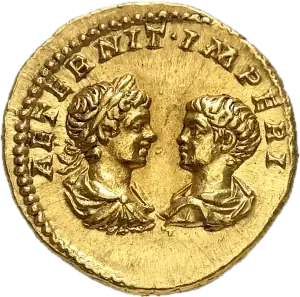
Caracalla had his younger brother Geta killed at the end of AD 211, then tried to wipe him from memory: his name was chiselled off stone and his face scraped out of paintings.
This painted family portrait, made about AD 200 and probably found in Egypt, shows Septimius Severus, the empress Julia Domna and their two sons. One face is gone: Geta's, scraped away after his murder. Cassius Dio says Caracalla abolished Geta's birthday, raged at the stones that had carried his statues and 'melted down the coinage that displayed his features'. Yet gold showing the two brothers face to face, under the words 'the eternity of the empire', still survives.

Antikensammlung Berlin; photo via Wikimedia Commons · Public domain
Münzkabinett, Staatliche Museen zu Berlin · CC BY-SA 4.0
Source: Cassius Dio, Roman History 78.12.6 (the coins melted) ↗
Sources
- Cassius Dio, Roman History 78.12.6
- Antikensammlung Berlin, inv. 31329 (the Severan tondo)
- RIC IV Septimius Severus 155
An emperor of Britain quotes Virgil
Carausius, commander of the Channel fleet, made himself emperor in Britain in 286, and his coins quoted Virgil.
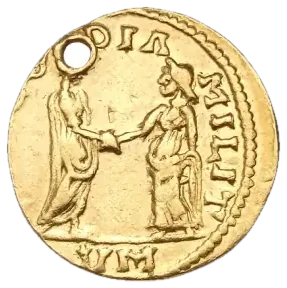
His silver carries puzzling letters, RSR and INPCDA. They are the first letters of two lines of the poet Virgil that every educated Roman knew: 'the reign of Saturn returns; now a new generation is sent down from high heaven'. Other coins greet him with EXPECTATE VENI, 'come, long-awaited one', an echo of the Aeneid. A rebel was claiming a golden age in the words of Rome's greatest poet. His gold shows him clasping hands with Concordia, CONCORDIA MILITVM, the harmony of the soldiers. His own minister Allectus murdered him in 293, and in 296 Constantius I took Britain back; a gold medallion found near Arras shows London kneeling at its gate to greet him as 'restorer of the eternal light'.
Münzkabinett, Staatliche Museen zu Berlin · CC BY-SA 4.0
Source: Virgil, Rome's great poet (70–19 BC), Eclogue 4.6–7: 'redeunt Saturnia regna' ↗ · Virgil, Aeneid 2.282–283: 'exspectate' ↗
Sources
- Virgil, Eclogue 4.6–7
- Virgil, Aeneid 2.282–283
- de la Bédoyère, 'Carausius and the marks RSR and INPCDA', Numismatic Chronicle 158 (1998)
- RIC V Carausius 624
Holy emperors
From the Sun god to Christ
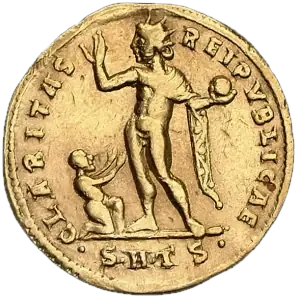
Constantine, the first Christian emperor, kept the Unconquered Sun on his coins for more than ten years after his famous vision.
Before the battle of the Milvian Bridge in 312, Constantine is said to have seen a sign in the sky. Yet his gold and bronze went on showing Sol, the sun god, raising his hand, often with the words SOLI INVICTO COMITI, 'to the Unconquered Sun, my companion'. Sol fades from the coins only around 325. Christian signs crept in slowly and small: a Chi-Rho badge on a helmet, a standard spearing a snake. The coins changed far more slowly than the emperor's faith.
Münzkabinett, Staatliche Museen zu Berlin · CC BY-SA 4.0
Sources
- Bruun, RIC VII (1966)
- Bruun, 'The Christian signs on the coins of Constantine', Arctos 3 (1962)
The upward gaze
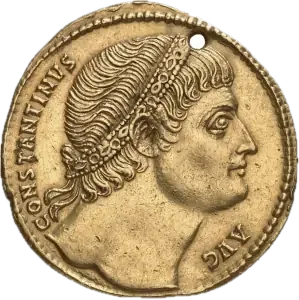
Late in his reign Constantine's portrait changed: the head tilts back, the eyes are raised to the sky.
Eusebius, bishop of Caesarea in Palestine, who wrote an admiring life of the emperor soon after his death in 337, saw prayer in it: Constantine had 'his likeness to be stamped on the golden coin of the empire with the eyes uplifted as in the posture of prayer to God'. This big piece of four and a half solidi, struck in Rome, was a gift for high officials rather than money for the market. Eusebius also describes the coin struck after Constantine died: the emperor in a chariot, and a hand reaching down from heaven to take him up.
Münzkabinett, Staatliche Museen zu Berlin · CC BY-SA 4.0
Source: Eusebius, bishop and church historian (died 339), Life of Constantine 4.15 and 4.73 ↗
Sources
- Eusebius, Life of Constantine 4.15 and 4.73
- Bruun, RIC VII (1966)
Christ on the front, and the caliph's answer
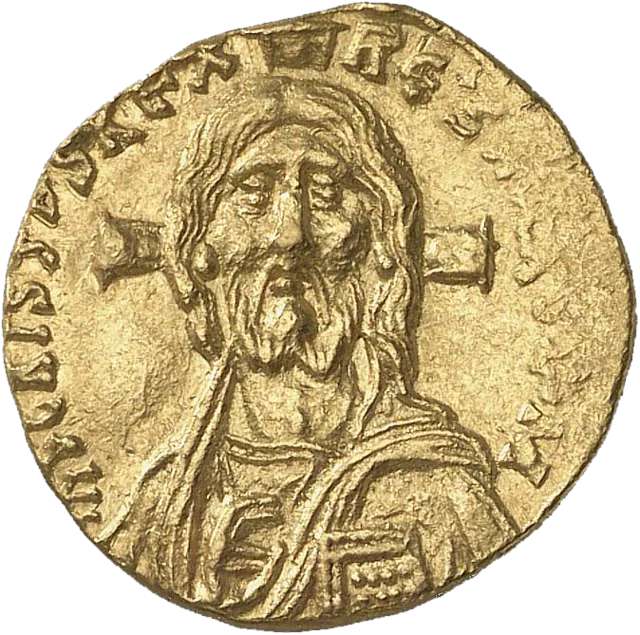
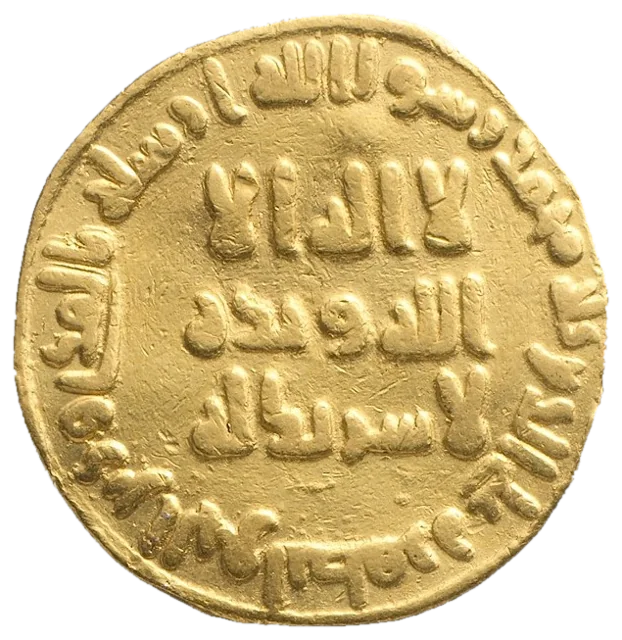
About 692 Justinian II put the face of Christ on the front of his gold and moved himself to the back, as 'servant of Christ'. The caliph in Damascus answered with gold of his own.
Around Christ's head runs 'Jesus Christ, king of those who rule'. In the same years a church council in Constantinople ordered that Christ be painted as a man rather than shown as a lamb. In Damascus the caliph Abd al-Malik had been using Byzantine-looking gold; from about 694 he struck dinars with his own standing figure, hand on sword, and in 696/7 he swept every image away. His reformed dinar carries only words: there is no god but God, and Muhammad is his messenger. Theophanes, a Byzantine monk who wrote a chronicle about a century later, says Justinian broke the peace with the Arabs when he refused their new coin, 'new and never seen before'. The coin itself had become a battlefield.
Münzkabinett, Staatliche Museen zu Berlin · Public Domain Mark 1.0

PHGCOM, Wikimedia Commons (coin in the British Museum) · CC BY-SA 3.0
The Metropolitan Museum of Art · Public domain (Met Open Access)
Source: Council in Trullo (692), canon 82: Christ to be shown 'in human form' ↗ · Theophanes the Confessor, Chronographia AM 6183 (Greek text, de Boor 1883) ↗
Sources
- Theophanes, Chronographia, AM 6183 (ed. de Boor, 1883, p. 365)
- Council in Trullo (692), canon 82
- Grierson, Byzantine Coins (1982)
- Album and Goodwin, Sylloge of Islamic Coins in the Ashmolean 1 (2002)
Christ removed, then restored
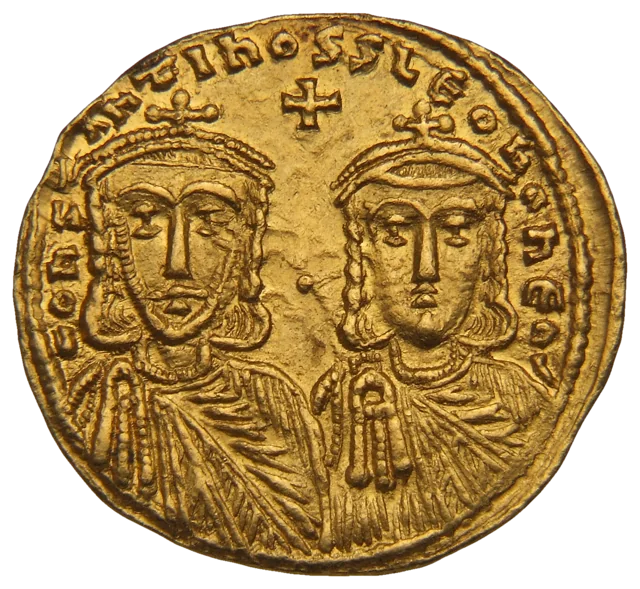
For more than a century Christ vanished from Byzantine gold. Emperors who distrusted holy images showed only themselves and their families, until Christ came back in 843.
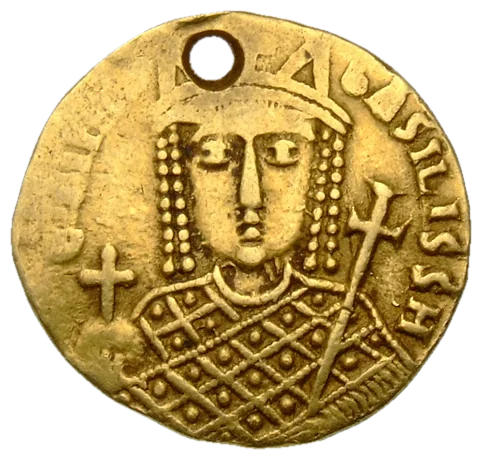
After Justinian II, Christ's face did not return. Under the Iconoclast emperors, who had icons taken down, the gold showed the ruling family: Constantine V with his young son on the front and his dead father Leo III on the back, three generations and no saint. Irene, who restored the icons in 787 and in 797 blinded her own son to rule alone, put herself on both sides, the first woman to reign over the empire in her own name. Iconoclasm came back in 815 and ended for good in 843, when the regent Theodora and her young son Michael III put Christ back on the front of the gold, where he stayed for centuries.
Münzkabinett, Staatliche Museen zu Berlin · Public Domain Mark 1.0
Münzkabinett, Staatliche Museen zu Berlin · Public Domain Mark 1.0
Sources
- Grierson, Byzantine Coins (1982)
- Grierson, Dumbarton Oaks Catalogue III (1973)
- Brubaker and Haldon, Byzantium in the Iconoclast Era (2011)
Did people get the message?
'Whose image is this?'
Two ancient witnesses show that people did look at the face on a coin.
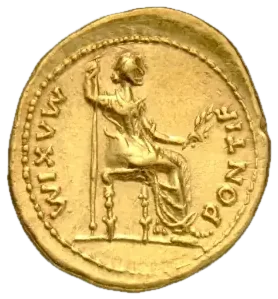
In the Gospel of Mark, men try to trap Jesus with a question about paying tax to Rome. He asks for a denarius: 'Whose is this image and superscription?' 'Caesar's.' 'Render to Caesar the things that are Caesar's.' The coin is usually thought to be Tiberius's silver with a seated woman on the back, the design of this gold coin. About seventy years later Epictetus, a Greek philosopher who had been born a slave, compared people to coins: a coin with Trajan's face you accept, but 'It is the stamp of Nero. Throw it away: it cannot be accepted.' Everyone knew a good emperor's face from a bad one's.
Münzkabinett, Staatliche Museen zu Berlin · CC BY-SA 4.0
Source: Gospel of Mark 12:16 (King James Version) ↗ · Epictetus, Stoic teacher (about AD 100), Discourses 4.5.17 (Nero's stamp) ↗
Sources
- Gospel of Mark 12:13–17
- Epictetus, Discourses 4.5.17
- RIC I² Tiberius 29
Answering back
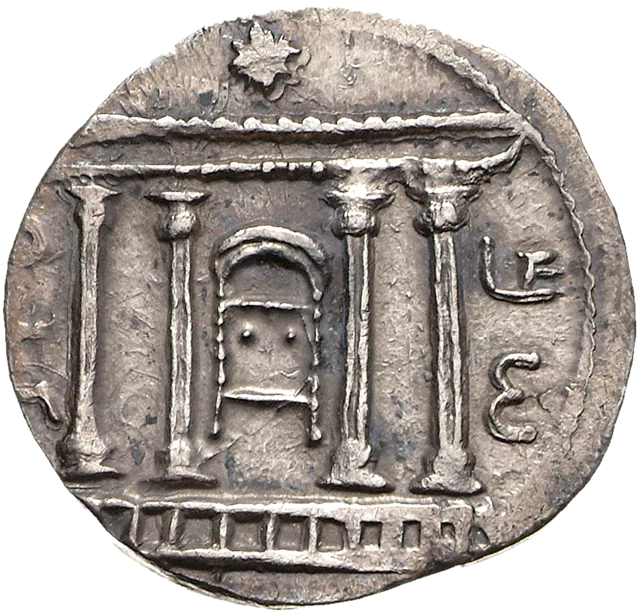
Jewish rebels against Hadrian took Roman coins and struck them again with their own designs: the Temple of Jerusalem, which Rome had destroyed, and the words 'for the freedom of Jerusalem'.
The revolt led by Shimon bar Kosiba, called Bar Kokhba, 'son of the star', held part of Judaea for three years. It had no gold and no fresh metal of its own. Instead it hammered new designs onto Roman silver: on the big coins the front of the Temple, perhaps with the Ark of the Covenant inside, and on the back the palm branch and citron of the festival of Tabernacles. On many the emperor's head still shows underneath: a Roman face struck over with a Jewish answer. The revolt was crushed in 135.
Münzkabinett, Staatliche Museen zu Berlin · Public Domain Mark 1.0
Sources
- Mildenberg, The Coinage of the Bar Kokhba War (1984)
- Münzkabinett Berlin 18204073
Historians disagree: did it work?
Nobody doubts that rulers chose what went on their coins. What historians argue about is who looked, and whether the messages changed anyone's mind.
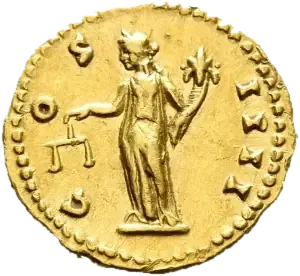
In 1956 A. H. M. Jones argued that most people never read the designs and that minor officials picked them. C. H. V. Sutherland answered in 1959 that they were deliberate and could be understood. Barbara Levick suggested in 1982 that much of it was flattery aimed at the emperor himself. In 2011 Carlos Noreña counted the designs on thousands of coins from hoards and found the same few virtues, like Fairness with her scales, repeated across the empire: a steady, simple message rather than daily news. Gold adds a twist. It went mostly to soldiers, officials and the rich, so its audience was the people a ruler most needed to keep loyal.
Münzkabinett, Staatliche Museen zu Berlin · CC BY-SA 4.0
Source: Sutherland 1959 ↗ · Levick 1982 ↗ · Wallace-Hadrill 1986 ↗
Sources
- Jones, 'Numismatics and history', in Essays in Roman Coinage Presented to Harold Mattingly (1956)
- Sutherland, 'The intelligibility of Roman imperial coin types', Journal of Roman Studies 49 (1959)
- Levick, 'Propaganda and the imperial coinage', Antichthon 16 (1982)
- Wallace-Hadrill, 'Image and authority in the coinage of Augustus', Journal of Roman Studies 76 (1986)
- Noreña, Imperial Ideals in the Roman West (2011)