 Gold Coin Catalogue
Pedigree and provenance
Every old coin has a past: who owned it, where it was found, how it left its country. How to read that past, where the great collections went, what the law asks, and what happened to the gold EID MAR.
Two words, two questions
Pedigree: who owned it
A coin's pedigree is its chain of owners and sales, from the oldest known to today. Each link is a collection or an auction that can be looked up.
This Brutus aureus in Berlin has one of the clearest chains of any gold coin. It belonged to the Vicomte de Ponton d'Amécourt, a French numismatist famous for his Roman gold; then to the Vicomte de Quelen, whose coins were sold by Rollin & Feuardent in Paris in May 1888; and at that sale the Berlin Münzkabinett bought it. Berlin's register number (1888/119) is the last link. Every step can be checked in a printed catalogue or a museum record.
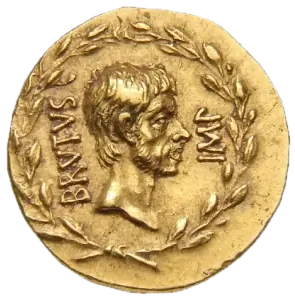
Münzkabinett, Staatliche Museen zu Berlin · CC BY-SA 4.0
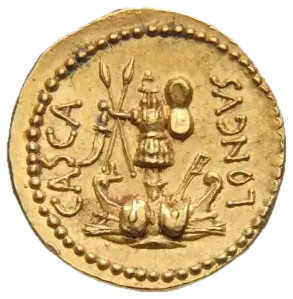
Source: Münzkabinett Berlin 18202195: Brutus aureus, ex de Quelen 1888 ↗ · Gustave de Ponton d'Amécourt (1825–1888), French numismatist ↗
Sources
- Münzkabinett Berlin 18202195 (provenance record)
- Rollin & Feuardent, sale of the de Quelen collection, Paris, 14–26 May 1888, lot 499
Provenance: where it came from
Provenance asks a wider question: where the coin was found, and how it travelled from there to here. The EU's own guidance borrows the museum world's definition: the full history of an object from its discovery to the present day.
In March 2019 a metal detectorist found a gold aureus of Allectus, who ruled Britain as a breakaway emperor in AD 293–296, in a ploughed field near Dover. The British Museum confirmed it, and Dix Noonan Webb sold it in London that June, the first time the coin had ever been on the market. It had no owners before the finder, but its provenance is as good as it gets: a known field, a known date, a museum check and a public sale.
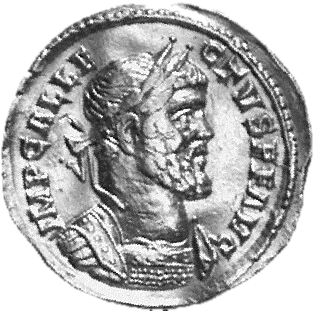
Münzkabinett, Staatliche Museen zu Berlin · Public Domain Mark 1.0
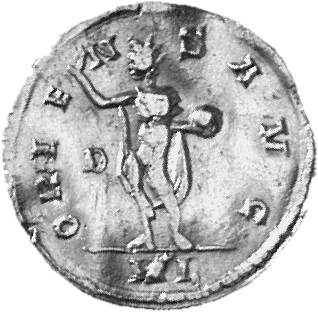
Source: Antiques Trade Gazette (2019): Allectus aureus found near Dover sold by Dix Noonan Webb ↗ · European Commission Q&A on the import of cultural goods (provenance, Q38) ↗ · Münzkabinett Berlin 18201461: Allectus aureus, London mint ↗
Sources
- Antiques Trade Gazette, June 2019 (the Dover find and its sale)
- European Commission, Questions & Answers on Regulation (EU) 2019/880, Q38 'What is provenance?' (quoting ICOM)
Why both matter
A good history does three jobs at once: it helps show a coin is genuine, that it can be owned and moved legally, and it adds a story of its own.
A coin seen and published by experts decades ago is very unlikely to be a recent fake. A coin known to have left its country before 1970 is much easier to sell across borders today (see 'The law', below). And a coin that passed through famous hands carries a little of their story. The catch: a history is only as good as the evidence behind it, and a history can be invented. The last parts of this lesson show what happens when one is. Telling a fake coin from a real one is a separate skill, covered in 'Is it real?'.
Sources
- See the cards below for each point
Reading an 'ex' line, slowly
Five owners in one line
When the gold stater of Leukon I with the facing head of Pan sold in Zurich in May 2023, setting the world record for an ancient coin, its catalogue entry carried a short line of earlier owners.
Read it from the oldest step. It belonged to Charles Gillet (1879–1972), an industrialist of Lyon, and is 'Gillet 851'. His Greek coins were sold after his death without his name (more on that in the next card). Bank Leu sold it privately in 1991. It reappeared in New York in January 2012 in the sale of the anonymous 'Prospero' collection, lot 213. Then NAC 138, lot 155. Sales come with a date and lot number and can be checked in the printed catalogue; collection names often come without dates, so the order of the oldest steps is sometimes a best guess. 'Reading a coin' shows where the 'ex' line sits in a lot.
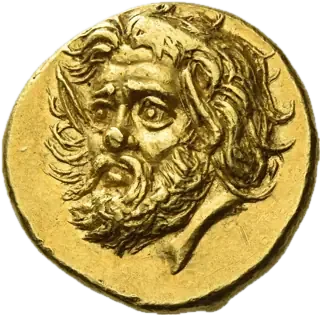
Numismatica Ars Classica (2023), via The Art Newspaper · Auction photo, linked from the source
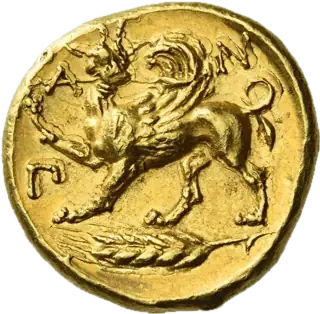
Source: NAC 138 catalogue, lot 155 ↗ · Charles Gillet (1879–1972), collector of Lyon: Berlin coin cabinet's record ↗
Sources
- NAC 138, 18 May 2023, lot 155 (provenance as printed)
- Münzkabinett Berlin, person record: Charles Gillet
Polite disguises
Many collectors sell without their name. The sale gets a title instead, and the title becomes part of every later 'ex' line.
Gillet's Greek coins were sold by Bank Leu and Münzen und Medaillen in Zurich on 28 May 1974 as 'Griechische Münzen aus der Sammlung eines Kunstfreundes': Greek coins from the collection of a man in love with art. Fifty years on, NAC still writes 'From the collection of a Man in Love with Art'. Other disguises: 'Prospero', 'a Student and his Mentor', 'Zhuyuetang'. The catch is that the same polite title can be reused. NAC gave it in 2022 to this huge medallion of Constantine, which had been sold in Munich in 2013, and it may come from a different collection altogether. A disguise is a lead, not a proof.

Numismatica Ars Classica, Auction 135 (2022), via Wikimedia Commons · Auction photo, linked from the source
Source: Charles Gillet and the 1974 Zurich sale: Berlin coin cabinet's record ↗ · NAC 135 catalogue, lot 392 ↗
Sources
- Münzkabinett Berlin, person record: Charles Gillet (the 1974 sale)
- NAC 135, 21 November 2022, lot 392
'This coin': numbers that pin a coin down
'Gillet 851, this coin' means the coin itself is number 851 in a published book with a photo. 'cf.' or a bare reference means only the type, not this coin.
The difference matters. A reference like 'Jameson 476' tells you which design a coin is; 'Jameson 476 (this coin)' tells you this very piece was photographed in 1913 and has a history from then on. This gold 100 litrai of Syracuse is number 55 in Friedrich Imhoof-Blumer's 'Monnaies grecques' of 1883. Imhoof-Blumer (1838–1920), a Swiss numismatist of Winterthur, sold his great Greek collection to Berlin in 1900, and the coin has been there ever since. A good sale catalogue says 'this coin' only when it has checked the photo.
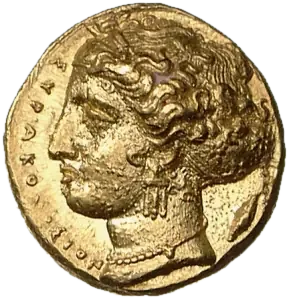
Münzkabinett, Staatliche Museen zu Berlin · CC BY-SA 4.0
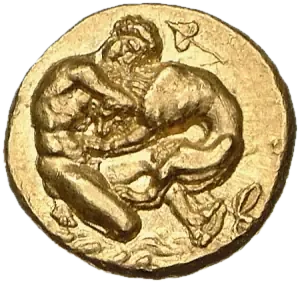
Source: Münzkabinett Berlin 18205549: gold 100 litrai, ex Imhoof-Blumer ↗
Sources
- Münzkabinett Berlin 18205549 (provenance record)
- Imhoof-Blumer, Monnaies grecques (1883) no. 55
Royal cabinets and museums
Princes' coin rooms
The great coin museums began as rulers' private cabinets: the French kings' in Paris, the Habsburgs' in Vienna, the Brandenburg electors' in Berlin.
Their oldest coins often have no earlier history at all, because nobody wrote one down. Berlin marks them 'Alter Bestand (vor 1700)': old stock, in the collection before 1700. This stater of Philip II is one of them. Paris files its old royal coins under 'Fonds général', and many have no earlier owner on record. That is not suspicious: a coin in a royal cabinet in 1700 left the ground long before any modern law. It just means the chain starts there.
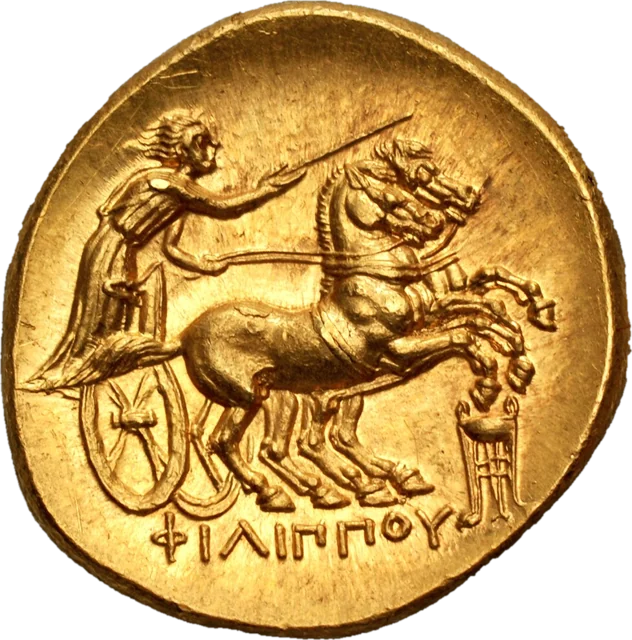
Classical Numismatic Group, Triton XXVII (2024), lot 152 · Auction photo, credited
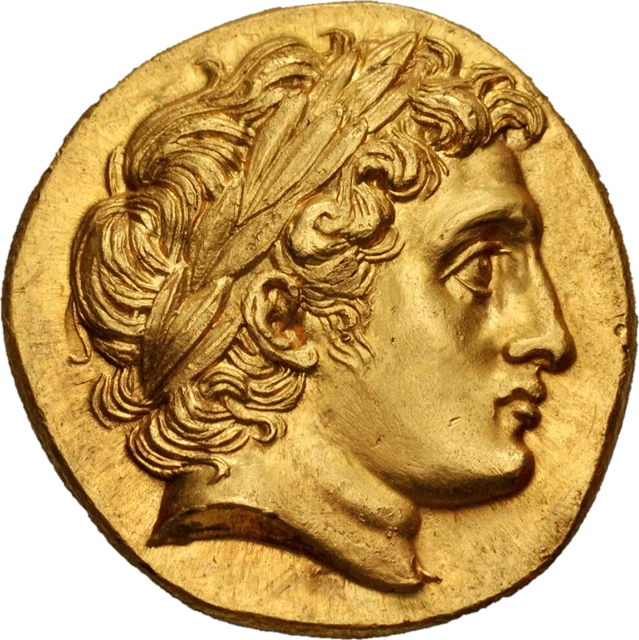
Source: Münzkabinett Berlin 18252755: Philip II stater, old stock before 1700 ↗
Sources
- Münzkabinett Berlin 18252755 ('Alter Bestand, vor 1700')
- BnF catalogue, 'Fonds général' records
Gifts that made museums
In 1862 the Duc de Luynes gave his whole collection of coins and antiquities to the Cabinet des médailles in Paris, now part of the national library (BnF).
Honoré d'Albert, 8th Duc de Luynes (1802–1867), was an archaeologist as well as a collector. His Greek coins were catalogued by Jean Babelon in the 1920s and 30s, so every coin has a 'Luynes' number. This gold stater struck at Syracuse for Pyrrhus of Epirus is Luynes 1894. Gifts like this are why the best museum coins have a clean history: once given, they stay put, and anyone can check the register.
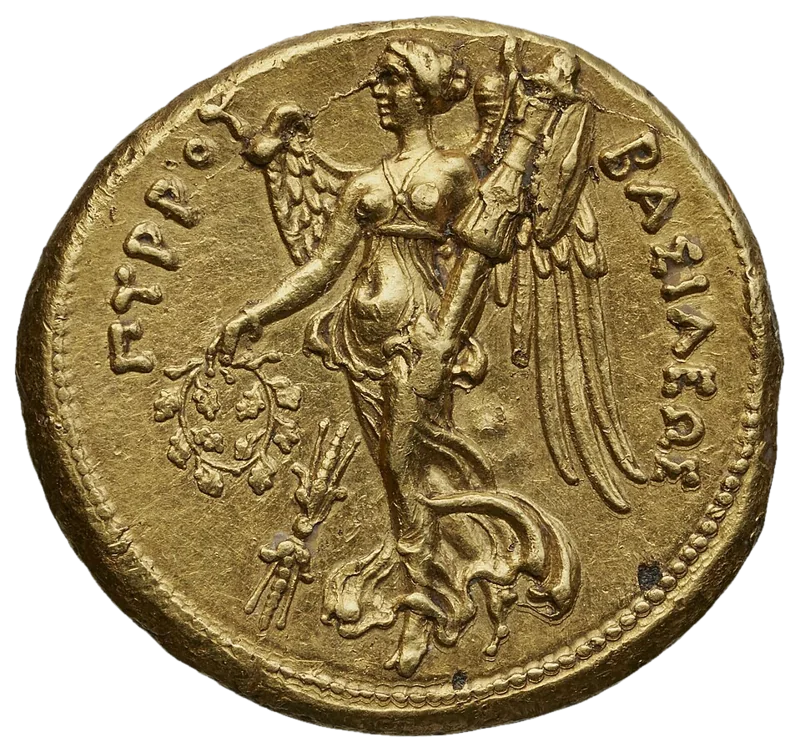
Bibliothèque nationale de France · CC BY 4.0
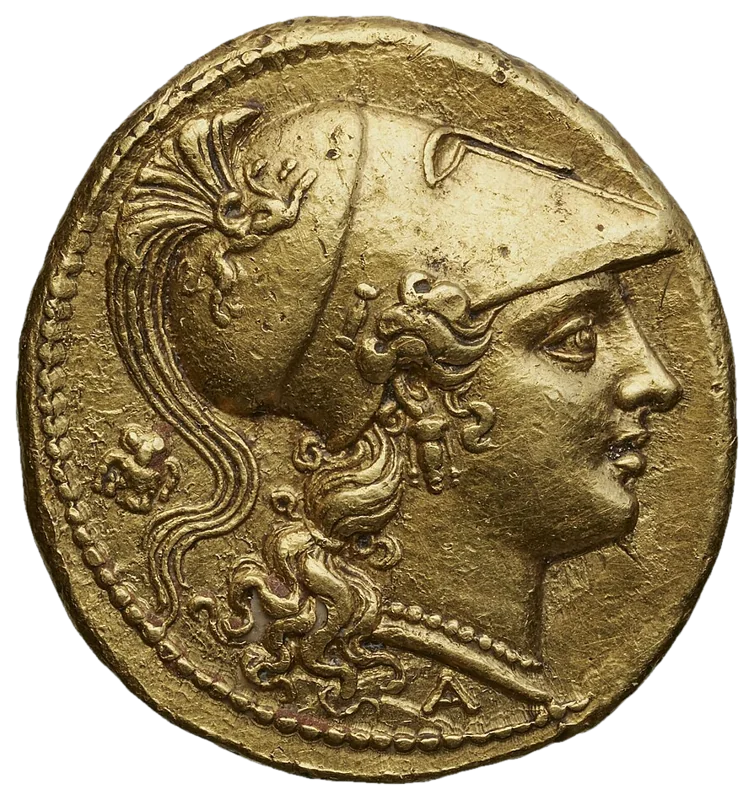
Source: BnF catalogue: gold stater of Pyrrhus, Luynes 1894 ↗ · Honoré d'Albert, Duc de Luynes (1802–1867) ↗
Sources
- BnF catalogue record cb41746497d (Luynes 1894)
- J. Babelon, Catalogue de la collection de Luynes (1936) no. 1894
Dealers who fed the museums
Much of what museums hold was bought from dealers living near the finds: Athens, Smyrna, Cairo. The museum's register names the dealer and the year, and that is often the oldest link there is.
Berlin bought this lion stater of Sardis in 1872 from Paulos Lambros, an Athens dealer, and this huge gold coin of Ptolemy II in 1902 from Giovanni Dattari, a collector and dealer in Cairo famous for the coins of Roman Egypt. Neither register says where the coin was found. For coins bought this long ago that is normal, and nobody expects more; for a coin first seen in 2015, it would not be enough.
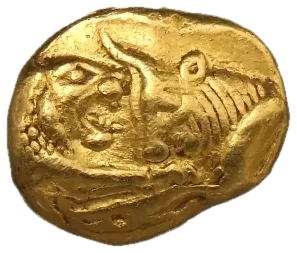
Münzkabinett, Staatliche Museen zu Berlin · CC BY-SA 4.0
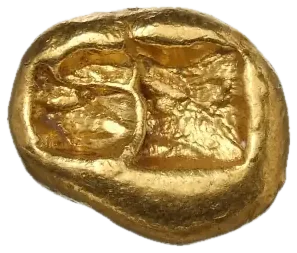
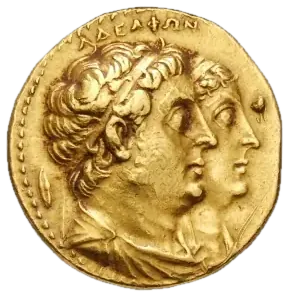
Münzkabinett, Staatliche Museen zu Berlin · CC BY-SA 4.0
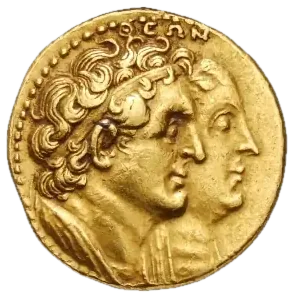
Source: Münzkabinett Berlin 18202899: lion stater, from P. Lambros 1872 ↗ · Münzkabinett Berlin 18312689: mnaieion, from G. Dattari 1902 ↗
Sources
- Münzkabinett Berlin 18202899 (acc. 1872/11)
- Münzkabinett Berlin 18312689 (acc. 1902/588)
Museums sell too
In 1972–73 the Metropolitan Museum of Art in New York sold thousands of its ancient coins through Sotheby's in Switzerland. Those coins have been on the market ever since.
The trustees approved the sale of 6,664 coins, many of them on loan to the American Numismatic Society. Martin Price of the British Museum's coin department called it 'The Strange Case of the Missing Coins' in the New York Review of Books (19 July 1973), and noted that the papers were busy with the Met's purchase of the Euphronios vase that same autumn, a vase the museum returned to Italy in 2008. One coin from the sale, an aureus of Ahenobarbus with the temple of Neptune, still carries 'ex J.H. Durkee collection; Metropolitan Museum; Sotheby's 10 November 1972, lot 4' in its 'ex' line half a century later.
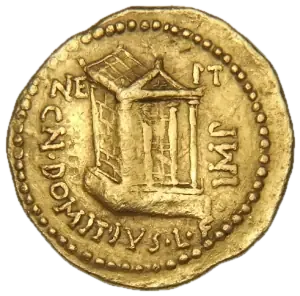
Münzkabinett, Staatliche Museen zu Berlin · CC BY-SA 4.0
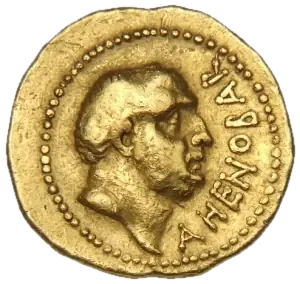
Source: Martin Price, 'The Strange Case of the Missing Coins' (NYRB, 1973) ↗ · NAC 83 catalogue, lot 509 (ex Metropolitan Museum) ↗ · The Euphronios krater and its return to Italy ↗
Sources
- M. J. Price, 'The Strange Case of the Missing Coins', New York Review of Books, 19 July 1973
- NAC 83, 20 May 2015, lot 509
- Euphronios krater: returned to Italy, January 2008
The great private collections
Paris before 1914: Jameson and Pozzi
Robert Jameson (1861–1942) published his Greek and Roman coins with photographs, four volumes from 1913 to 1932. 'Ex Jameson' is still one of the most trusted lines a coin can carry.
His friend Samuel Pozzi (1846–1918), a famous Paris surgeon, collected Greek coins too; they were sold by Naville in Geneva in 1921. One of them, a gold mnaieion of Queen Berenike II, has a chain that reads almost like a family tree: Pozzi; Naville 1921, lot 3236; the Pflieger collection, sold in Paris in 1985; Leu 1992; the Milas collection; NAC 132 in 2022. Because Jameson and Naville printed photos, anyone can check that the coin sold in 2022 is the one sold in 1921.
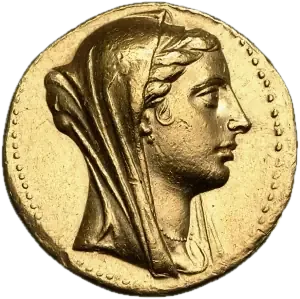
Münzkabinett, Staatliche Museen zu Berlin · CC BY-SA 4.0
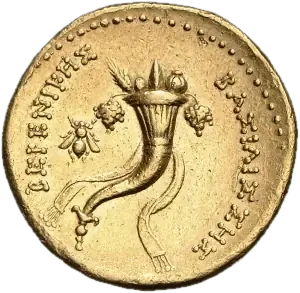
Source: CoinsWeekly Who's Who: Frédéric-Robert Jameson (1861–1942) ↗ · Samuel Pozzi (1846–1918), Paris surgeon and collector ↗ · NAC 132 catalogue, lot 392 ↗
Sources
- CoinsWeekly Who's Who: Jameson, Frédéric-Robert (1861–1942)
- NAC 132, 30 May 2022, lot 392
Biaggi's 2,000 aurei
Leo Biaggi de Blasys (1906–1979), a Swiss industrialist, put together more than 2,000 Roman gold coins, one of the biggest runs ever formed. In 1978 the whole collection was bought at once and sold off from 1979.
Biaggi bought from the great dealers of his day, Herbert Cahn and Lucien Hirsch among them, and he kept an inventory, so today's catalogues still quote 'Biaggi 39' or 'Biaggi 1918, this coin'. His collection was bought en bloc by Marco Ratto with Bank Leu, and Leu's sale of 1979 sent the coins around the world. Biaggi's name turns up again later in this lesson, on one of the three genuine gold EID MARs.
Source: CoinsWeekly Who's Who: Leo Biaggi de Blasys (1906–1979) ↗
Sources
- CoinsWeekly Who's Who: Biaggi de Blasys, Leo (1906–1979)
- NAC 86 lot 23, NAC 132 lot 474, NAC 146 lot 2396 (Biaggi numbers)
The Hunt sales
Nelson Bunker Hunt (1926–2014), a Texas oil heir, and his brother William Herbert formed one of the great ancient collections of the 1970s and 80s. After the brothers lost their fortune, Sotheby's sold the coins in New York in 1990 and 1991.
Part of the collection had been shown to the public in 1983 in an exhibition called 'Wealth of the Ancient World', with a catalogue that numbered and photographed each piece. That makes 'ex Hunt' easy to check. One Hunt coin was the Athenian gold drachm of the war years, 407–405 BC: when NAC sold it in 2012 they called it the fourth known and the only one in private hands. Its sisters are in museums, like this one in Paris.
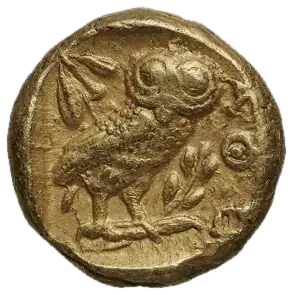
Bibliothèque nationale de France · CC BY 4.0
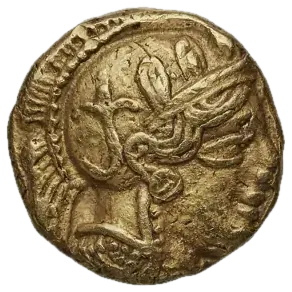
Source: Nelson Bunker Hunt (1926–2014) ↗ · NAC 66 catalogue, lot 46 (Athens gold drachm, ex Hunt) ↗
Sources
- Wikipedia: Nelson Bunker Hunt
- NAC 66, 17 October 2012, lot 46 (ex Hunt)
- NAC 91, 23 May 2016, lot 33 (Wealth of the Ancient World no. 138)
The Men of Rome
John Whitney Walter (1934–2018), a New York businessman, set out in 1984 to own a gold aureus of every Roman ruler. He finished in June 1990 with Clodius Albinus, and sold all 79 that November.
Stack's and Harlan J. Berk sold 'The Men of Rome' in New York on 29 November 1990. Walter had bought at the Hunt sale that June, so some coins carry both names: one Clodius Albinus aureus reads Bank Leu 1978, Hunt, Walter, Berk, the La Borde collection, NAC 2016, NAC 2021. A run like this shows how a pedigree builds up. Every famous sale adds a link, and every link makes the next buyer more confident.
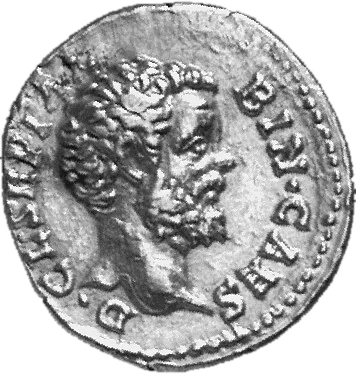
Münzkabinett, Staatliche Museen zu Berlin · Public Domain Mark 1.0
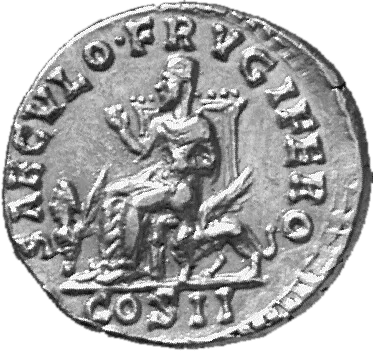
Source: CoinsWeekly Who's Who: John Whitney Walter (1934–2018) ↗ · NAC 91 catalogue, lot 33 (ex Hunt and Walter) ↗
Sources
- CoinsWeekly Who's Who: Walter, John Whitney (1934–2018)
- NAC 91, 23 May 2016, lot 33
Hoards: provenance at its best
The Beaurains treasure
On 21 September 1922 two workmen digging clay for building work at Beaurains, near Arras in northern France, found a pot holding a silver box of about 470 Roman coins, at least 25 gold medallions, jewellery and silver.
Its most famous piece is a gold medallion of Constantius I: the city of London kneels at its gate to welcome him after he defeated Allectus, the breakaway emperor of Britain, in AD 296. It is the oldest known picture of London. The gold original is in the museum at Arras; the British Museum shows a copy, pictured here, next to jewellery and coins from the same find. For a collector, 'from the Arras hoard' is the best provenance there is: a known place, a known date, and a find published by scholars.

PHGCOM and Siren-Com, via Wikimedia Commons · Public domain
Source: The Beaurains (Arras) treasure ↗ · James Grout, Encyclopaedia Romana (University of Chicago): the medallion is "the earliest representation of Londinium" ↗
Sources
- Wikipedia: Beaurains Treasure
- British Museum, Room 70 (Beaurains jewellery, coins and medallion copy)
Scattered within a year
Much of the treasure vanished overnight, and a great part of it was sold on the antiquities market. By April 1923 the dealer Ratto was offering coins from it in a fixed price list.
That list is now evidence. This aureus of Maxentius with a facing portrait, struck at Ostia in AD 310–312, was no. 440 in Ratto's list of April 1923. Robert Jameson bought it and printed it as Jameson 476, 'this coin'. It then went to E. von Schulthess (sold by Hess-Leu in 1961), Leu in 2005, the Markoff collection (NAC 62, 2011) and NAC 141 in 2023: a hundred years of paper behind one coin.
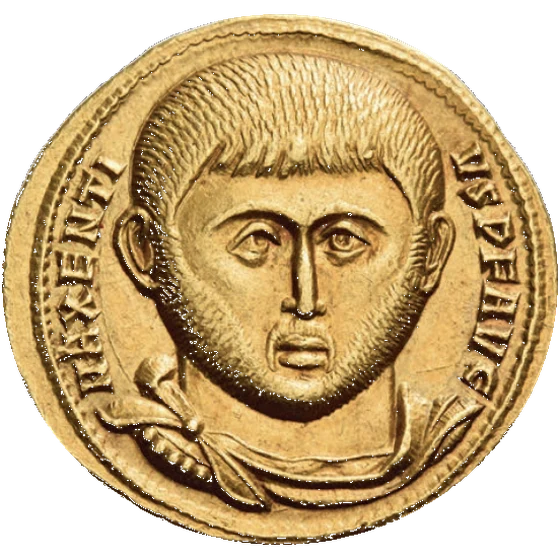
Numismatica Ars Classica, Auction 141 (2023), lot 277 · Auction photo, credited
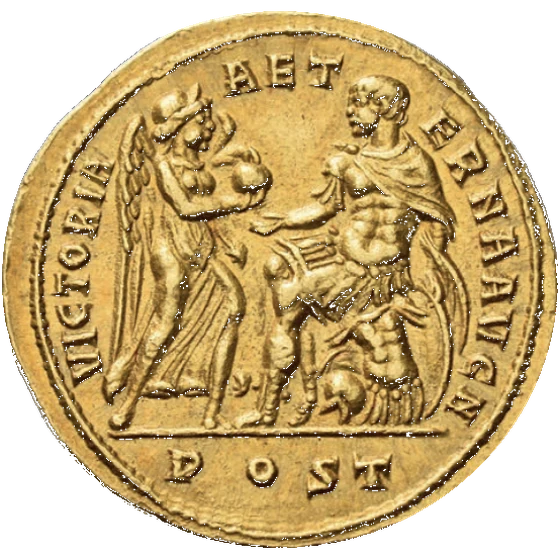
Source: NAC 62 catalogue, lot 2091 (ex Ratto 1923 and Jameson) ↗ · The Beaurains treasure: how it was dispersed ↗
Sources
- NAC 62, 6 October 2011, lot 2091 (provenance as printed)
- Wikipedia: Beaurains Treasure (the dispersal)
One coin, eight steps
A second facing aureus of Maxentius from the same hoard shows how long a chain can grow in a century.
From Beaurains (1922) it went to the L. Avot collection, then to Sir Arthur Evans (1851–1941), the archaeologist who dug Knossos in Crete; his Roman coins were sold in 1934 (Ars Classica XVII, lot 1876). Biaggi owned it next ('Biaggi 1918, this coin'), and Leu sold it in 1979. Sotheby's sold it in 1990 and again in 1995, and NAC in May 2024. Two of these coins are known; both came out of the same clay pit in 1922.
Source: NAC 146 catalogue, lot 2396 ↗ · Sir Arthur Evans (1851–1941), archaeologist and numismatist ↗
Sources
- NAC 146, 8 May 2024, lot 2396 (provenance as printed)
Tracing a coin by its photo
The same coin, not just the same dies
Two coins struck from the same pair of dies look almost identical. To prove that two photos show the same coin, look at what the dies did not make.
The outline of the blank, a crack at the edge, a scratch in the field, a nick on the rim, where the design runs off the flan: these are the coin's own fingerprints. Weight helps too, to a hundredth of a gram. Catalogues use this to keep coins apart as well as together. Two Flamininus staters have come up in a year: one sold by NAC in November 2025 (ex the Levy and Zhuyuetang collections), and the Thyssen coin at Numismatica Genevensis on 16 November 2026, 8.43 g, with a chain of Leu 2001, Leu 2005 and NGSA 2006. Different coins, different chains. How dies themselves are matched is in 'How coins were made'.
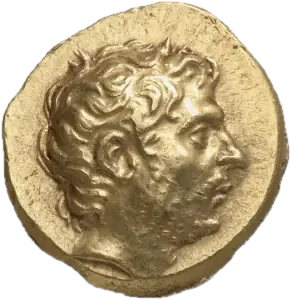
Münzkabinett, Staatliche Museen zu Berlin · CC BY-SA 4.0
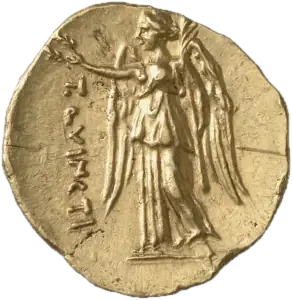
Source: NAC 158 catalogue, lot 49 ↗ · NGSA 25 catalogue (Thyssen-Bornemisza collection) ↗
Sources
- NAC 158, 5 November 2025, lot 49
- Numismatica Genevensis 25, 16 November 2026, lot 53 (Thyssen-Bornemisza collection)
Old plates as evidence
From the late 19th century, books and sale catalogues printed photographic plates, and those plates are the backbone of pedigree research. A coin photographed in 1913 has a past you can see.
Researchers leaf through old plates, or search databases built from them, looking for a coin's fingerprints. A coin that appears on a catalogue cover is easy to follow: this huge octodrachm type of Antiochus III was the cover coin of NFA XVIII in 1987 (the Arthur Houghton collection), and Houghton, a scholar of Seleucid coins, published it in his own books as 'this coin'. When NAC sold it in 2019, nobody had to guess.
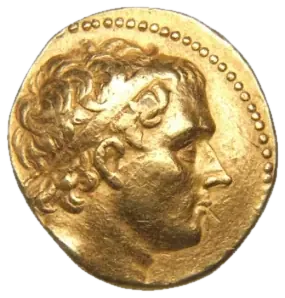
Münzkabinett, Staatliche Museen zu Berlin · CC BY-SA 4.0
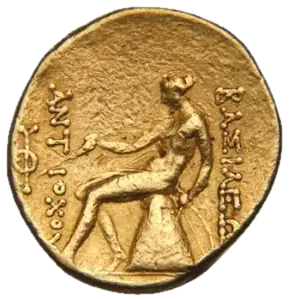
Source: NAC 114 catalogue, lot 349 ↗
Sources
- NAC 114, 6 May 2019, lot 349 (ex Houghton, NFA XVIII 1987, lot 326)
When the paper is wrong
A printed line can be mistaken, and copies of it spread. Always go back to the catalogue page itself.
Two slips this catalogue's own research has met. In the NAC 27 catalogue (2004) lot 281, an aureus of Lentulus Spinther, is 'ex Glendining 1950, Platt Hall'; online copies of the sale put that line on lot 282, the next coin, a gold EID MAR, giving it a false 1950 owner. And a web summary of the Syracuse gold staters of Pyrrhus gave one coin another coin's owners: two different staters, two different chains, merged into one. Both were easy to catch by opening the original page and comparing the photos.
Source: NAC 27 catalogue (2004), lots 281–282 ↗
Sources
- NAC 27, 12 May 2004, lots 281–282 (catalogue PDF)
- Morton & Eden 124 (2023) lot 311; NAC 124 (2021) lot 69; NAC 169 (2026) lot 51
What a name adds, and what a gap means
A famous name on the ticket
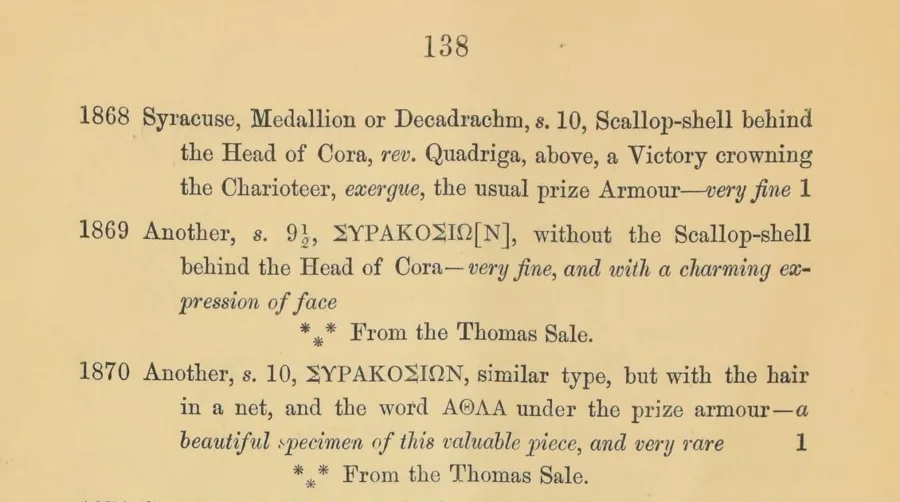
Auction houses put famous collections in their titles and on their covers, and collectors read the 'ex' line before the price.
A named old collection tells a buyer three things at once: experts have seen the coin before, it left the ground long ago, and it has a story worth telling. That is why a coin 'ex Jameson' or 'ex Hunt' draws more attention than its twin with no history. It is not a guarantee: famous collectors bought fakes too, which is why the coin still has to be judged on its own.
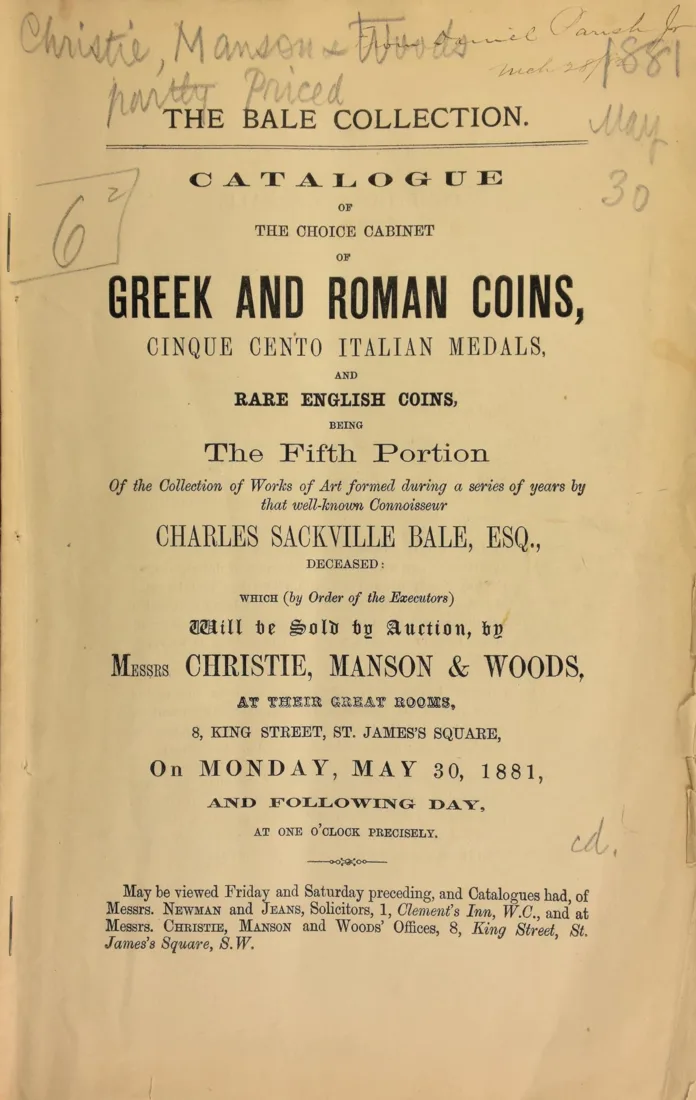
American Numismatic Society library, via Internet Archive · Public domain (1881)
Sources
- See the sale catalogues cited on the cards above
Gaps, and how they get filled
Most coins have gaps: a chain that stops in 1950 and starts again in 2010. A gap is not proof of anything bad, but it is a question.
Sellers fill gaps with whatever evidence survives. This medallion of Probus, showing the emperor crossing the Rhine on a bridge of boats, had no earlier auction. NAC printed two other proofs when it sold it in 2023: a Swiss notary had recorded it on 1 October 2003, and a coin firm had used its picture as the banner of its website in the late 1990s. Dated, outside evidence like that counts. A sentence like 'from an old family collection', with no name or date, does not.
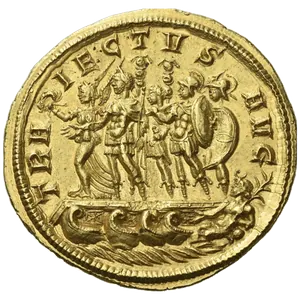
Numismatica Ars Classica, Auction 138 (2023), via Ancient Numis · Auction photo, linked from the source
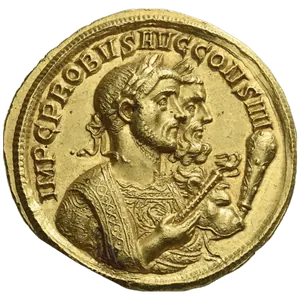
Source: NAC 138 catalogue, lot 802 ↗
Sources
- NAC 138, 18 May 2023, lot 802 (provenance as printed)
Tickets, inventories and register numbers
The small paper that travels with a coin is evidence too: a collector's ticket, an inventory number, a museum register entry, an old dealer's envelope.
Biaggi numbered his coins ('Biaggi 39'), the Hunt brothers' coins carry inventory numbers like H.823, museums write an accession number such as Berlin 1872/11 (the year it came in, and its place in the year), and many old collectors wrote small round tickets in their own hand that are kept with the coin. These are matched to the coin by description and weight, so they are kept, photographed and passed on with it.
American Numismatic Society library, via Internet Archive · Public domain (1881)
Source: Münzkabinett Berlin 18202899: accession 1872/11 ↗
Sources
- NAC 91, 23 May 2016, lot 33 (Hunt inventory H.823)
- NAC 132, 30 May 2022, lot 474 (Biaggi 39)
- Münzkabinett Berlin 18202899 (acc. 1872/11)
The law: when a coin may travel
1970: the line in the sand
In November 1970 UNESCO agreed a convention against the illegal export and sale of cultural property. Its list of protected things names 'antiquities more than one hundred years old, such as inscriptions, coins and engraved seals'.
The convention came into force on 24 April 1972. It binds countries, not collectors, but its date has become the test the trade uses. American art museums decided in 2008 to acquire ancient objects only with proof they were out of their country of origin by 17 November 1970, or legally exported after. That is why sellers work so hard to show a coin was in a collection before 1970. This is a summary, not legal advice; the rules for one coin depend on where it is going and where it came from.
Source: UNESCO 1970 Convention (text) ↗ · AAMD Guidelines on the Acquisition of Archaeological Material and Ancient Art (2013) ↗
Sources
- UNESCO Convention of 14 November 1970, Article 1(e)
- AAMD, Guidelines on the Acquisition of Archaeological Material and Ancient Art (2008, revised 2013)
Into the United States
The United States put the convention into law in 1983 with the Convention on Cultural Property Implementation Act. It limits imports country by country, through agreements that list exactly what is covered.
Coins were added for the first time in 2007, for coins of Cypriot types. The agreement with Greece (2011) lists bronze and silver coins struck at mints inside modern Greece; it was renewed in 2016 and 2021, when some Byzantine coins were added. Listed coins need an export permit or proof they left the country before the rule began. Collectors challenged the coin rules with a test case: in 2009 a guild of collectors imported a few cheap Cypriot and Chinese coins through Baltimore without papers, the coins were seized, and the courts sided with the government in 2012 and again in 2018.
Source: Cultural Property Implementation Act, 19 U.S.C. chapter 14 ↗ · Federal Register, 1 December 2011: import restrictions, Greece (coins in section 7) ↗ · Fourth Circuit opinion, Ancient Coin Collectors Guild (2012) ↗
Sources
- 19 U.S.C. 2601–2613 (CPIA, 1983)
- CBP Dec. 07-52 (Cyprus, 2007)
- CBP Dec. 11-25 (Greece, 1 December 2011)
- Ancient Coin Collectors Guild v. U.S. Customs and Border Protection, 698 F.3d 171 (4th Cir. 2012)
Into the EU, and in Britain
Since June 2025 anyone bringing an ancient coin into the European Union from outside needs an import licence or a signed importer statement, under Regulation (EU) 2019/880.
Archaeological objects over 250 years old need a licence whatever their value. 'Antiquities, such as inscriptions, coins and engraved seals' over 200 years old and worth €18,000 or more need a statement instead. The Commission's guidance lets ancient coins be entered either way, and both routes ask for evidence the coin left its country of origin legally; if it left before 24 April 1972, or its origin cannot be known, evidence that it left its last home of five years or more legally. Great Britain is outside these rules since Brexit. In England, Wales and Northern Ireland the Dealing in Cultural Objects (Offences) Act 2003 makes it a crime, from 30 December 2003, to deal dishonestly in an object knowing or believing it was illegally dug or removed, in the UK or anywhere else.
Source: Regulation (EU) 2019/880, Annex (Parts B and C) ↗ · Commission Q&A, Q37d: ancient coins may use category (c) or (e) ↗ · Dealing in Cultural Objects (Offences) Act 2003 ↗
Sources
- Regulation (EU) 2019/880, Articles 4, 5, 16 and Annex
- European Commission Q&A on 2019/880, Q37d
- Dealing in Cultural Objects (Offences) Act 2003, sections 1–2
Found in Britain
In England, Wales and Northern Ireland, two or more gold or silver coins over 300 years old found together are Treasure under the Treasure Act 1996. They belong to the Crown, a museum may acquire them, and the finder and landowner share a reward.
A single coin found on its own is not Treasure. That is how the Allectus aureus found near Dover could be sold at auction a few months later. Finds that are not Treasure can still be recorded, by choice, with the Portable Antiquities Scheme, whose public database gives each one a number. For a British find, that number, or the coroner's Treasure case number, is the best provenance a coin can have: it pins the coin to a field and a date for good.
Source: Treasure Act 1996, section 1 (what counts as Treasure) ↗ · Portable Antiquities Scheme: database of finds ↗
Sources
- Treasure Act 1996, section 1
- Portable Antiquities Scheme (finds.org.uk)
The gold EID MAR, end to end
Three genuine, and a fake in the British Museum
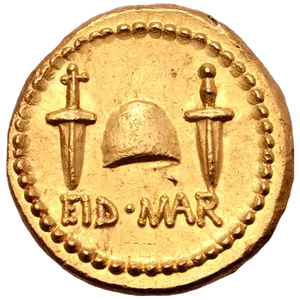
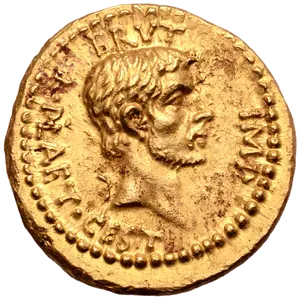
Brutus struck his EID MAR coins in 42 BC to celebrate the murder of Caesar on the Ides of March. The silver ones are famous; in gold, only three genuine coins are known.
One is in the Deutsche Bundesbank's collection in Frankfurt. One, pierced to hang on a chain, was on show in the British Museum from 2010 to 2021 and sold in 2022. The third appeared in London in 2020. And the British Museum's own gold EID MAR, given by George IV in 1825 with his father's coins, is a forgery, as NAC's 2022 catalogue states. The three real ones could hardly have had more different histories.
Roma Numismatics, Auction XX (2020), via CoinsWeekly · Auction photo, linked from the source
Source: NAC 132 catalogue, lot 474 (p. 132) ↗ · The History Blog (2020): the Bundesbank's gold EID MAR in Frankfurt ↗
Sources
- NAC 132, 30 May 2022, lot 474 (the three known; the British Museum's forgery)
- The History Blog, 8 October 2020 (the Bundesbank coin)
The coin with a long paper trail
The pierced coin has been known since at least 1932, when the dealer Oscar Ravel offered it to the British Museum. The Depression meant the museum could not buy it, but it kept a plaster cast.
That cast is the oldest proof of the coin. Biaggi bought it privately from Herbert Cahn in February 1952, and Cahn published it in 1953. In 1975 Michael Crawford, the great scholar of Republican coins, doubted it; later he confirmed it. It sold at NAC in 2004, joined the Barry Feirstein collection (NAC 2008), was lent to the British Museum for its main gallery from 2010 to 2021, and sold again at NAC on 30 May 2022. Ninety years, every step in print.
Source: NAC 132 catalogue, lot 474: the 1932 offer, the cast, Cahn 1953, Crawford ↗
Sources
- NAC 132, 30 May 2022, lot 474, catalogue text (p. 132)
The coin with none
The third coin was bought in Munich in 2015 with no stated history. When Roma Numismatics sold it in London on 29 October 2020, the catalogue gave it a grand one: a 19th-century Swiss baron's collection and his descendants'.
It was invented. A member of the family named in the catalogue wrote that month asking for the claim to be withdrawn, and it was not. The coin sold for a record and went to an American buyer. The Manhattan District Attorney's office seized it and returned it to Greece on 21 March 2023; it is now on show at the Numismatic Museum in Athens. In August 2023 Roma's owner pleaded guilty in New York to charges that included falsifying this coin's provenance, and Roma closed in 2024. The coin was genuine; its history was not, and that was enough to lose it.
Roma Numismatics, Auction XX (2020), via CoinsWeekly · Auction photo, linked from the source
Source: CoinsWeekly (2023): coin dealer pleads guilty ↗ · Smithsonian Magazine (2023): the coin returned to Greece ↗ · CoinsWeekly (2020): the sale, with the update on the forged provenance ↗ · Antiques Trade Gazette (2024): Roma closes ↗
Sources
- CoinsWeekly, 7 September 2023 (the guilty plea)
- Smithsonian Magazine, March 2023 (the return to Greece)
- CoinsWeekly, 22 October 2020, with its later update (the invented provenance)
Good habits
Questions to ask about a coin's past
Before bidding on an expensive ancient coin, ask the seller three things: the oldest owner they can document, the paper behind it, and any published photo.
Ask for copies: the old sale catalogue page, the collector's ticket, the export licence if there is one. Check the old photo against the coin yourself. Check that the dates make sense (a collection 'formed in the 1960s' that includes a coin first published in 2015 does not). A good house answers these questions gladly; it has asked them itself. For checking the coin itself, see 'Is it real?'.
Source: IAPN (International Association of Professional Numismatists): code of ethics ↗
Sources
- IAPN Code of Ethics (members' duties on provenance)
Words to read twice
Some provenance lines say almost nothing: 'old European collection', 'aus altem Privatbesitz' (from an old private collection), 'old family collection', with no name and no date.
Such a line may be perfectly honest: plenty of families own coins with no paper. But it is not evidence, and it cannot be checked. Even great coins carry it: this nine-solidus medallion of Valens, one of the largest Roman gold pieces ever offered, sold at Künker in 2009 described only as 'aus altem Privatbesitz'. Price the uncertainty in, and keep whatever paper comes with it.
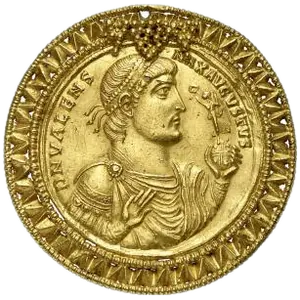
Künker, Auction 158 (2009), lot 839 · Auction photo, linked from the source
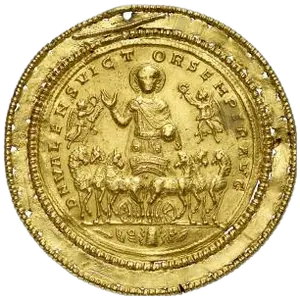
Source: Künker Auction 158, lot 839 ↗
Sources
- Künker Auction 158, 28 September 2009, lot 839
The next owner's pedigree starts with you
Keep everything: the invoice, the lot page, the photos, the tickets, the envelope. One day it is someone else's evidence.
Save the sale catalogue page as a PDF; websites vanish, and the Probus medallion's history now rests partly on an old web page. Photograph both sides in good light, and weigh the coin. Write down where and when you bought it. When the time comes to pass it on, the next 'ex' line is the one you wrote.
Sources
- See 'Gaps, and how they get filled' above