 Gold Coin Catalogue
How coins were made
From the refinery to the hammer blow: how ancient mints turned gold into coins, who did the work, and what the mistakes and the dies themselves tell us.
From mine to refinery
Where the gold came from
Gold for coins came from rivers and mines all over the ancient world, and very often from older gold, melted down and struck again.
The Greek historian Diodorus of Sicily (1st century BC) says Philip II of Macedon made the small mines near Philippi yield over a thousand talents a year, and paid for his army with gold coins called Philippeioi. The Roman naturalist Pliny the Elder (AD 23–79) says north-west Spain sent Rome 20,000 pounds of gold a year, dug by washing whole hillsides away. Plunder mattered just as much: Persian gold taken by Alexander, temple treasure melted in wartime, Gaul's gold brought home by Caesar. The Story 'Where the gold came from' visits the mines one by one.

Rafael Ibáñez Fernández, via Wikimedia Commons · CC BY-SA 3.0
Source: Diodorus of Sicily, Library of History 16.8.6–7 (Philip's mines) ↗ · Pliny the Elder, Natural History 33.21 (33.66–78: how gold is mined in Spain) ↗
Sources
- Diodorus of Sicily, Library of History 16.8.6–7
- Pliny the Elder, Natural History 33.66–78
Not the Pactolus after all
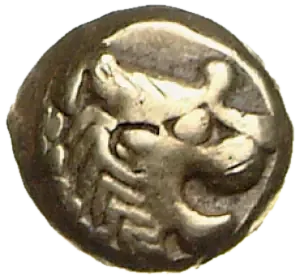
Lydia's first coins were electrum, a mix of gold and silver. For 2,500 years people said it came from the river Pactolus at Sardis. Tests in 2020 found that the Pactolus carries almost pure gold.
The story goes back to the Greek historian Herodotus (about 484–425 BC), who tells of gold dust washed down from Mount Tmolus by the Pactolus. The electrum of the coins probably came from other rivers or mines further north, in the Troad, such as Astyra near Abydos, where gold carries a lot of silver. The coins themselves hold only about 55% gold, less than most natural electrum, so the mint seems to have set the mix itself. Then the coins were heated with salt, which drew silver out of the surface: a coin that is 55% gold inside can be 94% gold on its face, and its worn high points look pale where the wear cut through. The weight was set just as carefully: the usual coin, the third-stater of about 4.7 g, is rarely off by more than a tenth of a gram. A coin was worth what the state said, not just its metal.
Münzkabinett, Staatliche Museen zu Berlin · CC BY-SA 4.0
Source: Herodotus, Histories 1.93 (gold dust from Tmolus) ↗ · Cahill and others, Depletion Gilding of Lydian Electrum Coins and the Sources of Lydian Gold (2020) ↗ · Sardis Expedition: gold and silver refining at Sardis (free essay) ↗
Sources
- Herodotus, Histories 1.93 and 5.101
- Cahill, Hari, Önay and Dokumacı, 'Depletion Gilding of Lydian Electrum Coins and the Sources of Lydian Gold', in White Gold (2020)
- Strabo, Geography 14.5.28 (Astyra)
- Greenewalt, 'Gold and silver refining at Sardis', in The Lydians and their World (2010)
How gold was refined
Most natural gold comes mixed with some silver, and electrum with a lot of it. To strike coins of pure gold, the silver had to come out first, and it could be done with nothing more than salt, clay pots and a fire.
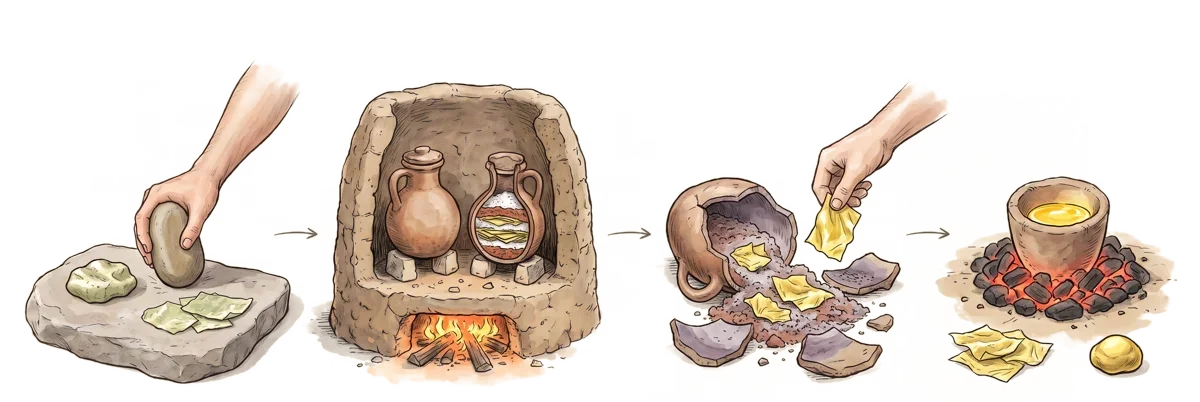
1 · Hammer the electrum thin. Electrum, the natural mix of gold and silver, is beaten into foil as thin as paper, so the salt can reach every part of it. 2 · Bake with salt and brick dust. The foils are packed in a clay pot between layers of salt and crushed brick, sealed and kept at about 800 °C for hours or days. That is hot enough for the salt to attack the silver, but well below gold's melting point (1,064 °C). 3 · Break the pot, pick out the gold. The salt has turned the silver into silver chloride, which soaks into the packing and the clay and stains them grey-violet. The foils keep their shape, now pure gold. 4 · Melt it together. The clean foils are melted in a small clay crucible, blown hot with a blowpipe, into a lump ready to be weighed out as coin blanks.
Copy by Nina de Garis Davies, Metropolitan Museum 31.6.22 · CC0
Source: Greenewalt, gold and silver refining at Sardis (Sardis Expedition, free essay) ↗
Sources
- Ramage and Craddock, King Croesus' Gold (2000)
The oldest gold refinery
In 1968 archaeologists at Sardis, the Lydian capital, found a small open-air workshop beside the river Pactolus where gold was parted from silver. It is the oldest known anywhere.
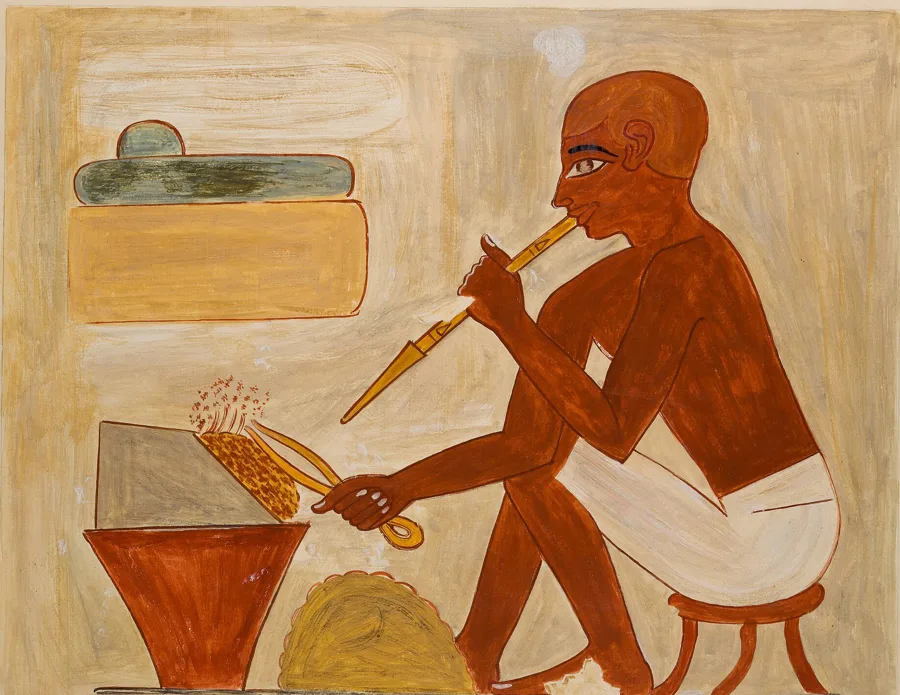
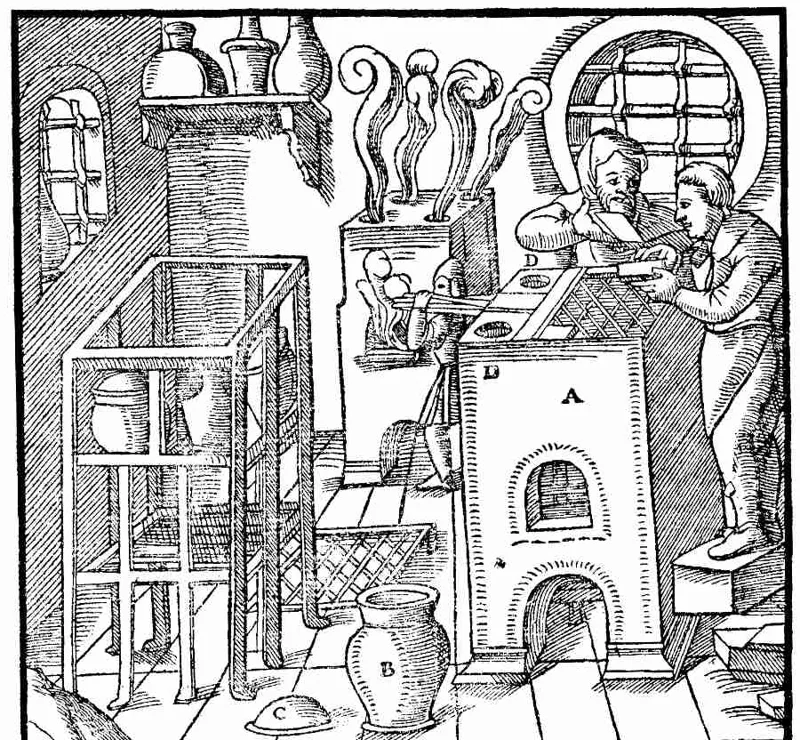
They found the brick ovens with cooking pots still in them, scraps of gold foil, and some 200 small hearths where the silver was won back from the used pots by melting them with lead. It was at work in the time of King Croesus, around when the first coins of pure gold were struck. Herodotus saw the difference at Delphi: of the 117 gold bricks Croesus gave the temple, 4 were refined gold and 113 "white gold", gold still mixed with silver. The method lasted. Four centuries later the Greek geographer Agatharchides of Knidos, quoted by Diodorus, saw Egyptian refiners sealing gold in clay jars with lead, salt, a little tin and barley bran, and baking it for five days and nights. In the 12th century the German monk Theophilus still packed gold leaf between crushed tile and salt, and in 1556 the mining writer Georgius Agricola drew it in a furnace.
Georgius Agricola, De re metallica (1556), Hoover translation 1912 · Public domain
Source: See the excavation photos: the ovens, a pot still in place, the hearths and the gold foils (Sardis Expedition) ↗ · Diodorus of Sicily, Library of History 3.14 (refining in Egypt's gold mines) ↗ · Agricola, De re metallica, Book X (free translation, Project Gutenberg) ↗
Sources
- Ramage and Craddock, King Croesus' Gold (2000)
- Herodotus, Histories 1.50
- Diodorus of Sicily 3.14.3–4, after Agatharchides
- Theophilus, On Divers Arts, Book III
- Agricola, De re metallica (1556), Book X
Croesus or Cyrus?
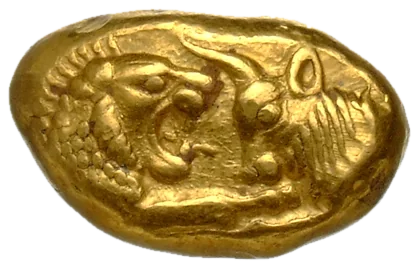
Refined gold made the first pure gold coins possible: the lion and bull staters long credited to King Croesus of Lydia.
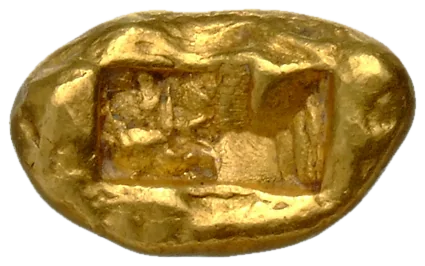
Herodotus says the Lydians were the first to strike coins of gold and silver. But Cyrus of Persia took Sardis around 547 BC, and coins found in recent digs there suggest that some, perhaps most, of these staters were struck under the Persian kings. Berlin dates the coin shown here to Lydia, and another of the same design, under the button, to the Persians. Both are pure gold, and on the back both still show plain punch marks.
Münzkabinett, Staatliche Museen zu Berlin · Public Domain Mark 1.0
Münzkabinett, Staatliche Museen zu Berlin · Public Domain Mark 1.0
Source: Herodotus, Histories 1.94 (the Lydians first to strike gold and silver) ↗ · Münzkabinett Berlin 18202886 ↗
Sources
- Herodotus, Histories 1.94
- Cahill and Kroll, 'New Archaic Coin Finds at Sardis', American Journal of Archaeology 109 (2005)
- Münzkabinett Berlin 18202886, 18202899
Blanks
Making the blanks
Before a coin could be struck, the metal had to be made into blanks, called flans, each of the right weight. Ancient mints did it in three ways: cast one by one in clay cups, cast in strings and cut apart, or chopped from a rod and hammered flat. Strings and rods are known for bronze; gold, where every grain counted, was weighed and made into blanks one at a time.
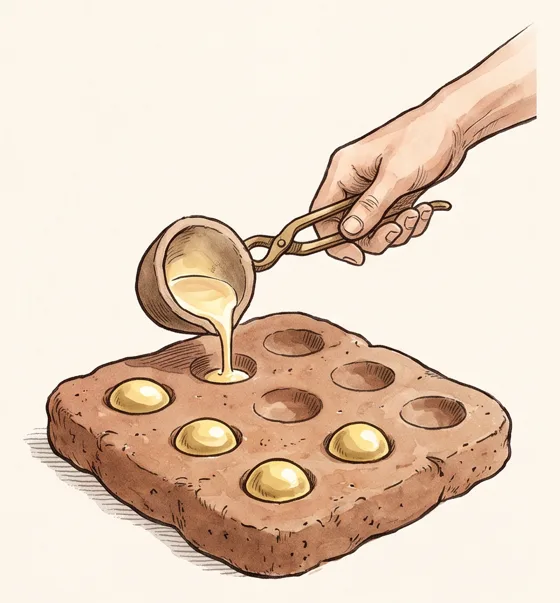
molten metal poured into clay cups
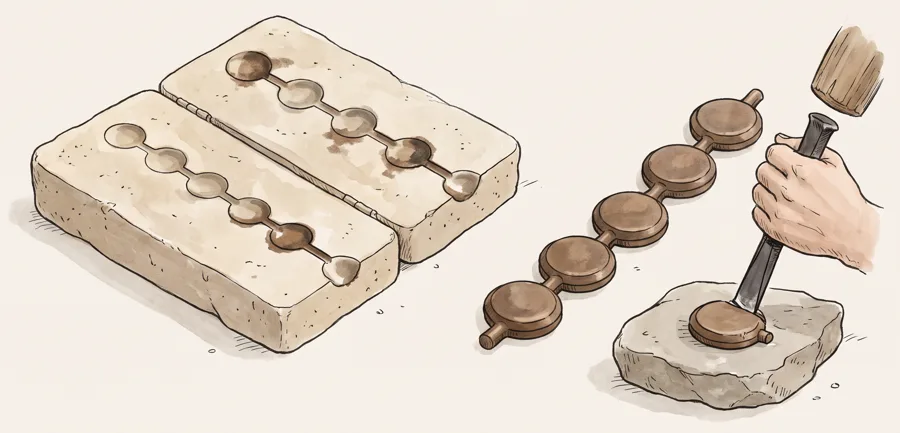
a two-part mould gives a row of flat discs, chiselled apart; each keeps a stub
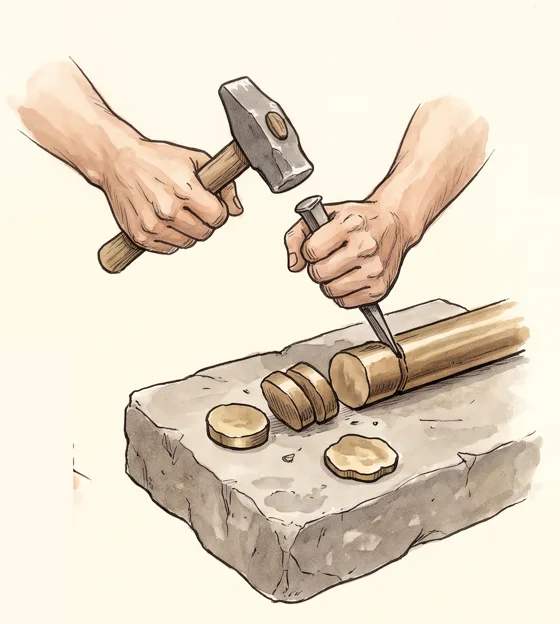
slices cut off with a chisel, then hammered flat
Athens chopped its bronze blanks from forged rods with a chisel; the excavated mint in the Agora shows no furnaces at all. Strings, flans joined by short channels in a two-part mould, are known for Hellenistic and Roman bronze, and the cut stubs still show at the edge of many coins. Mints in Iron Age Britain used clay trays with rows of little cups; more than 2,600 fragments were found at St Albans alone. Shape mattered less than weight, which is why so many ancient coins are a little irregular. Medieval mints cut thin blanks from sheet metal with shears instead, which is why hammered medieval coins are thin and ragged and ancient ones thick and round.

St Albans District Council / Portable Antiquities Scheme · CC BY-SA 2.0
Source: Portable Antiquities Scheme: coin mould fragments from St Albans ↗
Sources
- Camp and Kroll, 'The Agora Mint and Athenian Bronze Coinage', Hesperia 70 (2001)
- Portable Antiquities Scheme, records 414756 and 175276
- Daehn, 'Minting Anomalies in Greek Sicily', KOINON 6 (2023)
From lumps to cups
Blanks changed shape over 1,800 years: thick lumps in Lydia and Ionia, round thick staters, flatter aurei, thin broad solidi, and from the mid-1000s Byzantine gold struck in the shape of a shallow cup.
A wider, thinner blank showed more of the design but bent more easily. Nobody knows for sure why the Byzantine mint went over to cupped coins. They may have been stiffer, or easy to tell apart from older, flat coins of better gold.
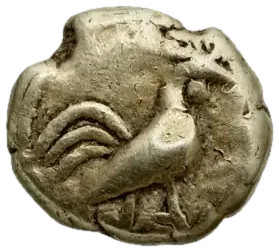
Bibliothèque nationale de France · CC BY 4.0
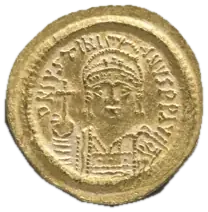
The Cleveland Museum of Art · CC0
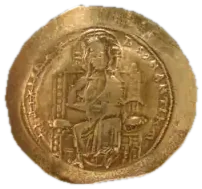
The Cleveland Museum of Art · CC0
Sources
- Grierson, Byzantine Coins (1982)
- Hendy, Coinage and Money in the Byzantine Empire (1969)
Weight
What the scales show
Weigh thousands of museum coins and the history shows. Greek staters held about 8.5 g for two centuries. Rome's aureus slid from 8 g under Caesar to under 5 g in the crisis of the 3rd century, until Constantine's solidus held at 4.4 g for centuries. How exact each coin was depended on the mint. Greek mints weighed every gold blank one by one; Rome cut a set number of coins from each pound of gold and did not check every coin, so Roman coins vary more. The second chart shows 743 museum coins.
Collectors call the Greek way al pezzo, 'by the piece', and the Roman way al marco, 'by the batch'. A pound of gold still made the right number of aurei, but any one coin could be a little heavy or light. That is one reason Romans weighed gold again when they spent it. And the metal itself changed: the first coins were electrum, a mix of gold and silver. By about 350 BC almost every new design was pure gold.
Source: Cindy Nimchuk (University of Toronto), review of Ramage and Craddock, King Croesus' Gold (BMCR 2001): Lydian electrum coins tested at about 55% gold ↗ · Lincoln College, Oxford: George Green and Alice Main's muon analysis of an Ashmolean Croeseid, 94% gold ↗ · Suspène, Blet-Lemarquand and Bocciarelli (IRAMAT, Orléans), Roman gold coinage from Augustus to the Year of the Four Emperors (2023): 282 aurei, above 99% gold ↗ · Andrew Oddy and Susan La Niece (British Museum scientists), Byzantine gold coins and jewellery, Gold Bulletin 19 (1986): solidus about 96.4%, about 30% by 1081, hyperpyron 80–85% ↗ · Nomisma.org: Alexander III ↗ · Nomisma.org: Augustus ↗
Sources
- Weights: Nomisma.org museum specimens (ANS, Berlin, BM, BnF and others), median per 25 years, groups of 15+ coins
- Electrum and gold: Our Ancient catalogue: designs by midpoint date
- Gold purity: Cindy Nimchuk (University of Toronto), review of Ramage and Craddock, King Croesus' Gold (BMCR 2001): Lydian electrum coins tested at about 55% gold; Lincoln College, Oxford: George Green and Alice Main's muon analysis of an Ashmolean Croeseid, 94% gold; Suspène, Blet-Lemarquand and Bocciarelli (IRAMAT, Orléans), Roman gold coinage from Augustus to the Year of the Four Emperors (2023): 282 aurei, above 99% gold; Andrew Oddy and Susan La Niece (British Museum scientists), Byzantine gold coins and jewellery, Gold Bulletin 19 (1986): solidus about 96.4%, about 30% by 1081, hyperpyron 80–85%
- Our count: museum coins with weights on Nomisma.org (5 Nov 2026), coins more than 8% off the median left out
- Kraay, Archaic and Classical Greek Coins (1976)
Checking gold in the market
In AD 363 the emperor Julian ordered a public weigher, the zygostates, in every city to settle quarrels over light gold coins.
A solidus had to weigh one seventy-second of a Roman pound, about 4.5 g by law (coins weighed today average a little less, about 4.4 g), and clipped or worn coins were a constant worry. Bankers and shopkeepers kept bronze weights for one solidus, marked EXAG SOL, 'weight of a solidus', and ounce weights for bigger sums. An ounce was a twelfth of a pound, so one ounce of gold was six solidi. The weight here is marked ΓΑ, short for 'one ounce'.
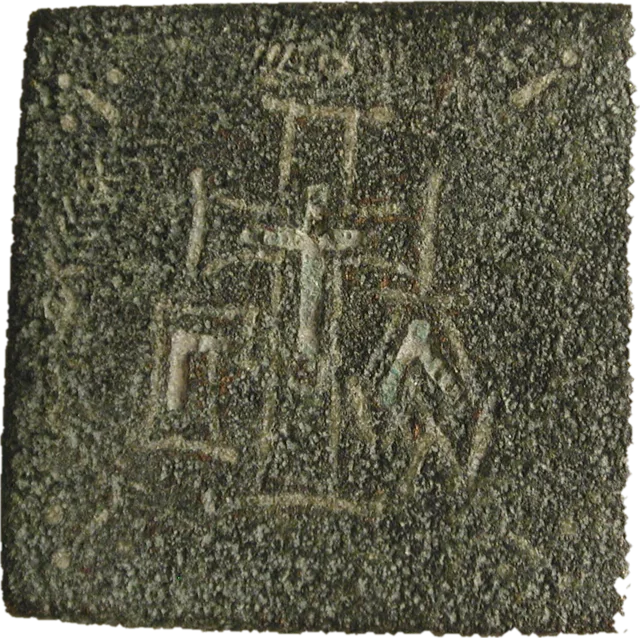
The Metropolitan Museum of Art · Public domain (Open Access)
Source: The Met: bronze balance weight with a cross in a wreath ↗
Sources
- Codex Theodosianus 12.7.2 (AD 363)
- The Metropolitan Museum of Art, object 473643 (balance weight)
Dies and striking
Cutting a die
A die is a block of bronze or iron with the design cut into it in reverse, deepest where the coin rises highest. Few survive: worn dies were recut or melted.
Engravers worked with small chisels called gravers, punches for dots and letters, and a drill that left perfectly round pits: the pearls of a necklace, the curls of a beard. Everything had to be cut as a mirror image, often at the size of a fingernail. Whether they used magnifying lenses is not known.

Burkhard Mücke, via Wikimedia Commons · CC BY 4.0
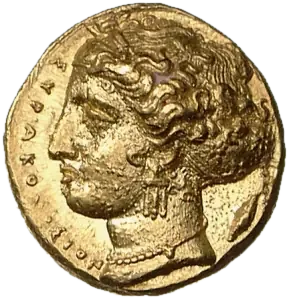
Münzkabinett, Staatliche Museen zu Berlin · CC BY-SA 4.0
Sources
- Sellwood, 'Some experiments in Greek minting technique', Numismatic Chronicle 1963
- Malkmus, Ancient and Medieval Coin Dies (2007)
Two dies and a hammer
The lower die sat in an anvil. The blank went on top, a worker held the upper die over it, and a hammer blow struck both sides at once.
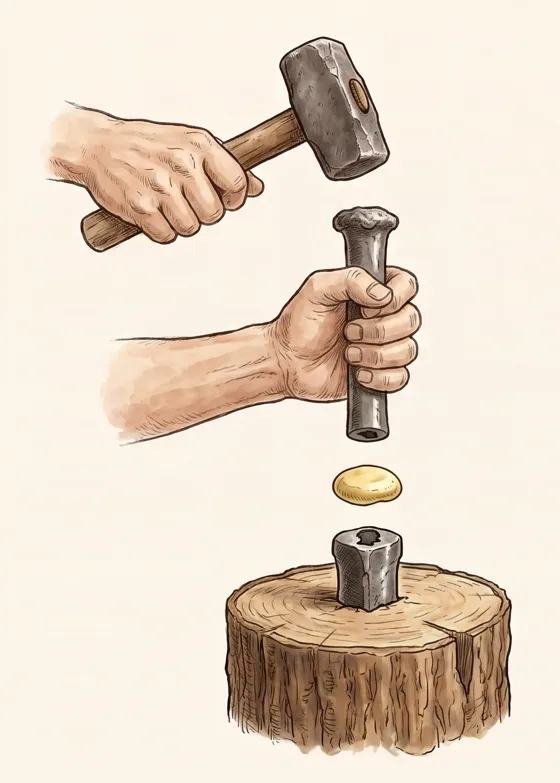
reverse design cut into its face
plain, thick, weighed in advance
obverse design, set into the block
a block of wood or stone
In 46 BC the Roman moneyer Titus Carisius put the tools on his coin: the anvil die with Vulcan's cap above it, tongs and a hammer. Tongs suggest the blanks were sometimes handled hot, at least for silver and bronze; soft gold could be struck cold, and the one ancient picture of a team at work, a Roman token in Vienna, shows the blank set down by hand. In Rome a team was three: one to place the blank, one to hold the die, one to swing. A small Greek mint may have managed with one or two.
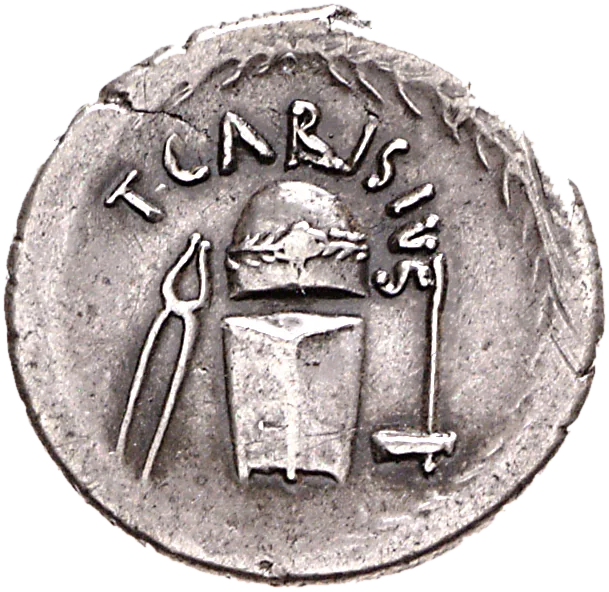
Münzkabinett, Staatliche Museen zu Berlin · Public Domain Mark 1.0
Source: Münzkabinett Berlin 18202022 (T. Carisius denarius) ↗
Sources
- Crawford, Roman Republican Coinage 464/2
- Münzkabinett Berlin 18202022
- Woytek, 'System and product in Roman mints', Revue belge de numismatique 158 (2012), pp. 96–104
- Sellwood, 'Some experiments in Greek minting technique', Numismatic Chronicle 1963
Which die wore out first
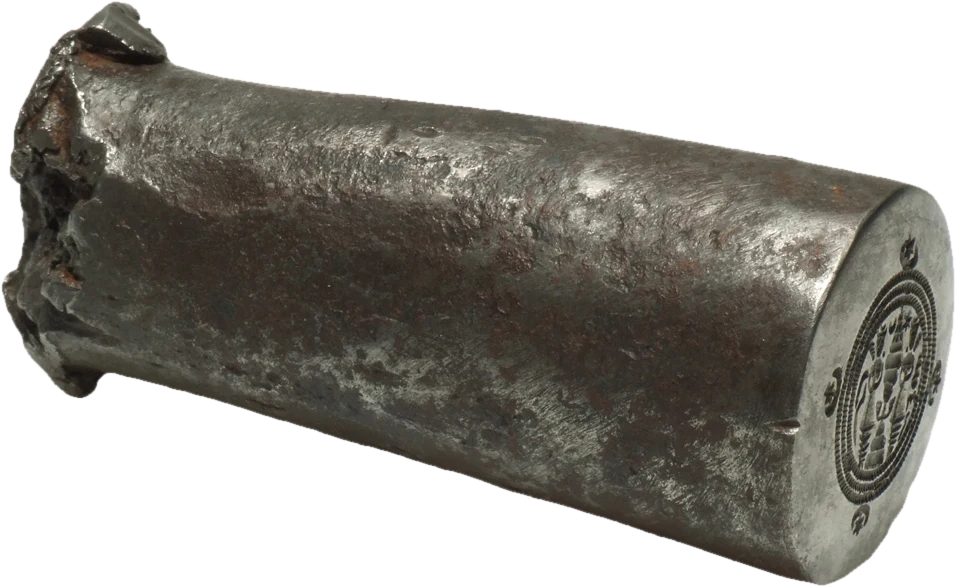
The upper die took the hammer, so it cracked and wore out sooner. Die studies usually find two or three upper dies for each lower one.
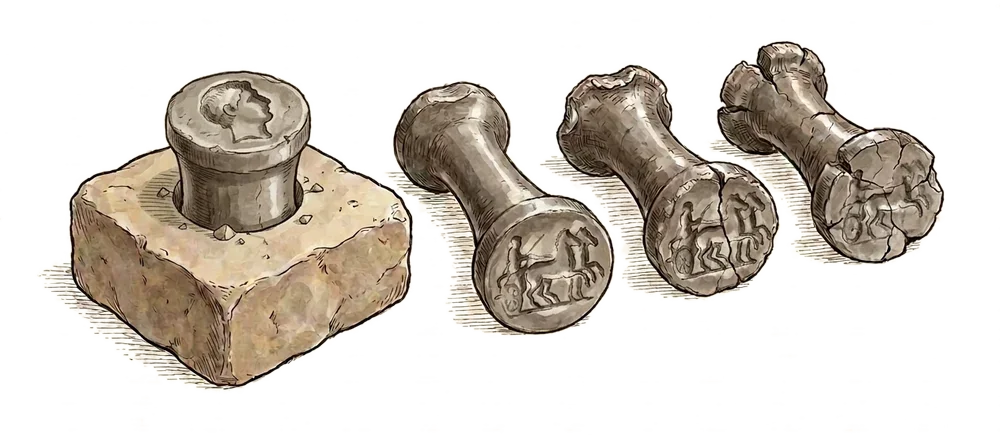
That is also why the lower die usually carried the more important side, the head of the god or the ruler, and why collectors call it the obverse. Early Greek mints let the two dies sit at any angle. Roman and Byzantine coins mostly come out at 12 or 6 o'clock, so the dies were kept at the same turn every time. 'Reading a coin' shows how to check a coin's die axis.
Münzkabinett, Staatliche Museen zu Berlin · Public Domain Mark 1.0

Classical Numismatic Group, via Wikimedia Commons · CC BY-SA 3.0
Source: Münzkabinett Berlin 18201599 (Sasanian upper die of Khusro II) ↗
Sources
- de Callataÿ, 'Calculating ancient coin production: seeking a balance', Numismatic Chronicle 1995
- Kraay, Archaic and Classical Greek Coins (1976)
- Münzkabinett Berlin 18201599
- Bopearachchi, 'Deux documents exceptionnels en numismatique indo-grecque', Cahiers Numismatiques 189 (2011)
Why early coins have a square hole
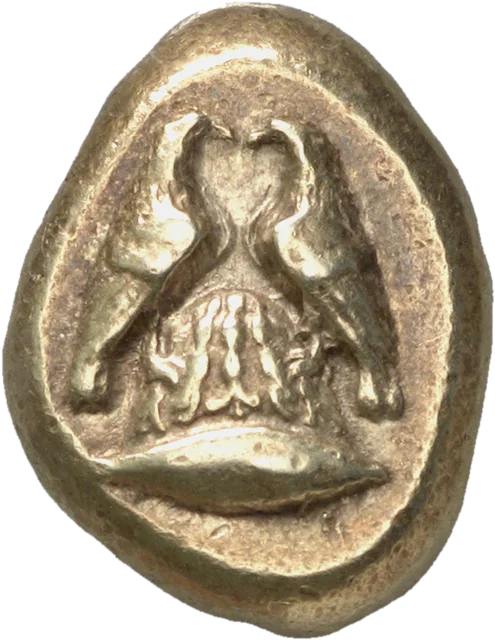
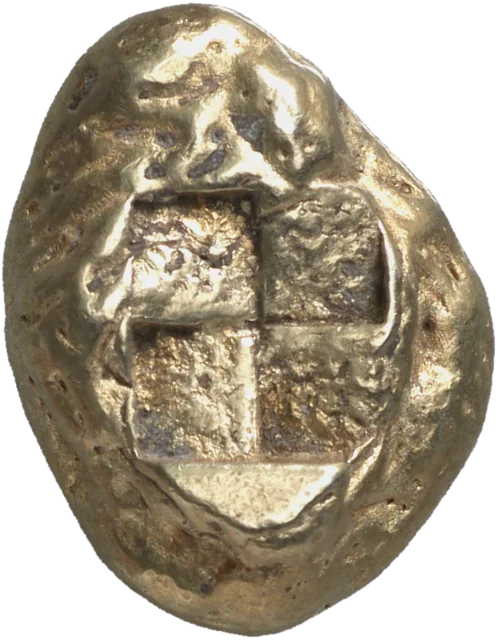
The first upper dies had no picture. A plain square punch drove the blank into the anvil die, and left the sunken square you see on the back of early coins.
Over the 6th century BC the punches got patterns, then a real second design. Some mints kept the old look on purpose: Kyzikos struck its electrum staters with a punch-mark square on the back into the 330s BC, long after other cities had two-sided designs.
Münzkabinett, Staatliche Museen zu Berlin · Public Domain Mark 1.0
Münzkabinett, Staatliche Museen zu Berlin · Public Domain Mark 1.0
Source: Münzkabinett Berlin 18200158 (Kyzikos stater) ↗
Sources
- Kraay, Archaic and Classical Greek Coins (1976)
- Münzkabinett Berlin 18200158
Mistakes that teach
A coin struck by a coin
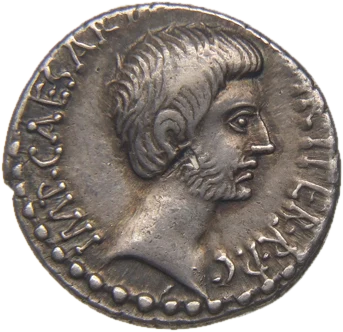
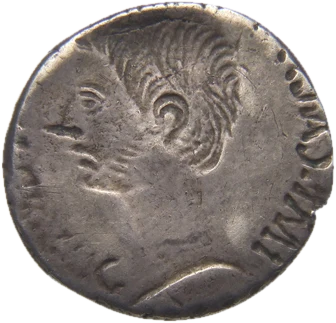
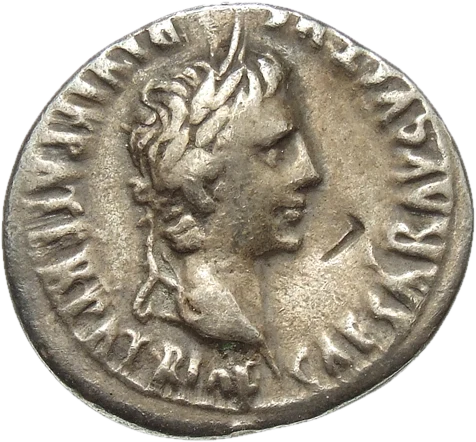
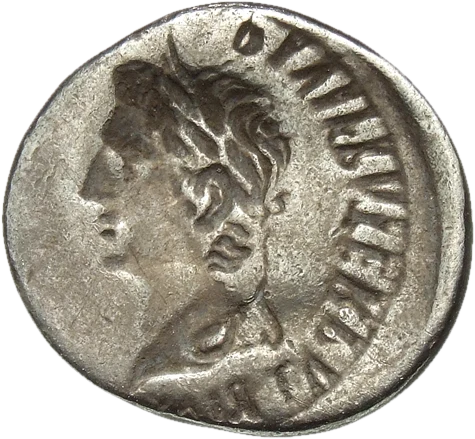
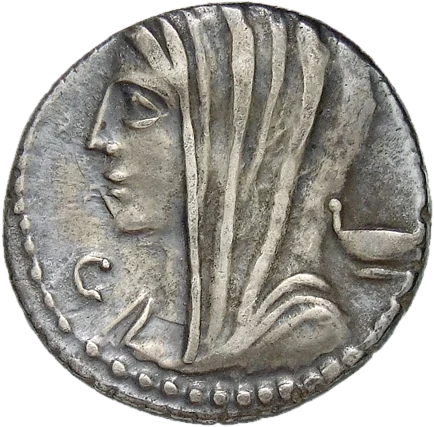
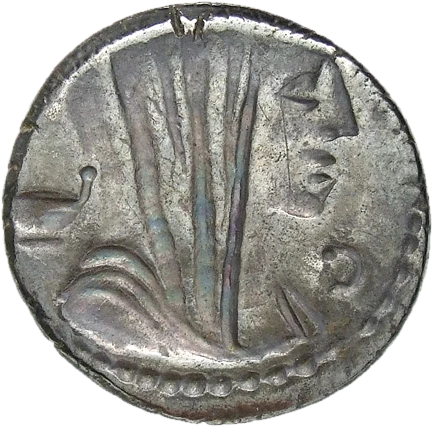
Sometimes a struck coin stuck to the upper die. The next blank was then struck against it: one side came out normal, the other a sunken mirror image.
Collectors call this a brockage. It shows the worker never looked between blows: the team worked fast. Most known brockages are silver or bronze; in gold they are rare.
Münzkabinett, Staatliche Museen zu Berlin · Public Domain Mark 1.0
Münzkabinett, Staatliche Museen zu Berlin · Public Domain Mark 1.0
Münzkabinett, Staatliche Museen zu Berlin · Public Domain Mark 1.0
Münzkabinett, Staatliche Museen zu Berlin · Public Domain Mark 1.0
Münzkabinett, Staatliche Museen zu Berlin · Public Domain Mark 1.0
Münzkabinett, Staatliche Museen zu Berlin · Public Domain Mark 1.0
Source: Münzkabinett Berlin 18206988 (Octavian brockage) ↗ · Münzkabinett Berlin 18210881 (Augustus brockage) ↗ · Münzkabinett Berlin 18247480 (Cassius Longinus brockage) ↗
Sources
- Münzkabinett Berlin 18206988, 18210881 and 18247480
Cracks that grow
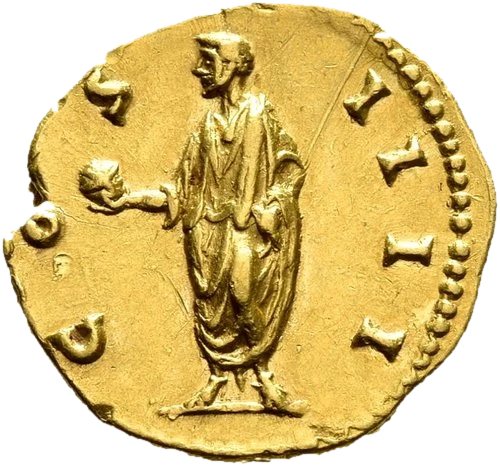
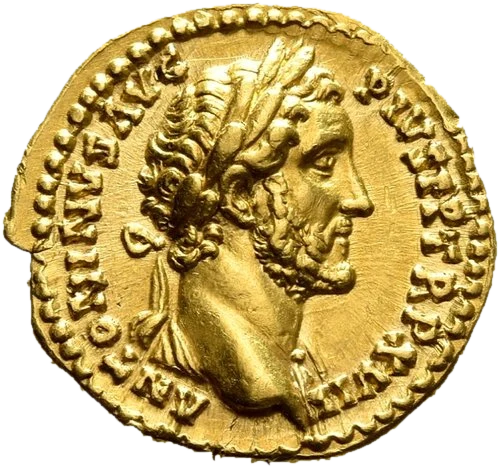
Dies cracked under the hammer, and mints went on using them. A crack shows on every coin from that die, and grows from coin to coin.
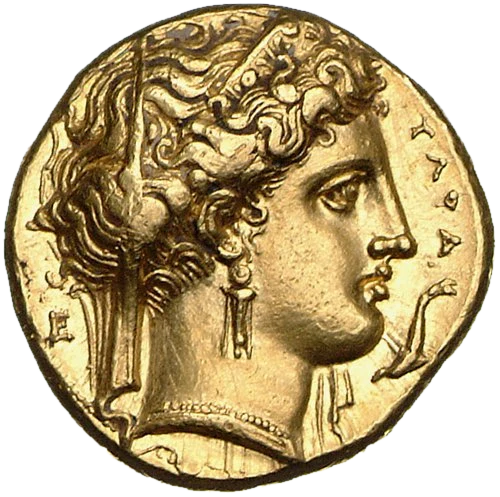
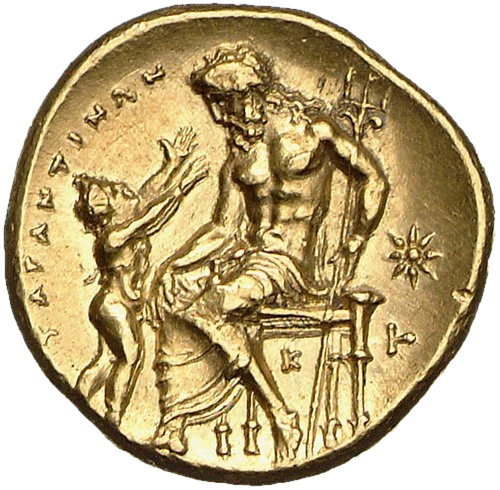
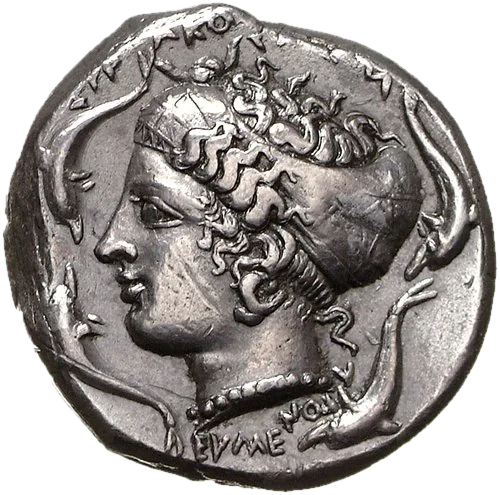
That lets scholars put the coins from one die in the order they were struck: the longer the crack, the later the coin. On this Syracusan tetradrachm a crack runs right across Arethusa's head. Gold dies cracked too: this aureus of Antoninus Pius was struck after a crack had opened across the back die, through the field beside the emperor. A die with a long crack was usually thrown away, but a fine one could be saved: the front die of this gold stater of Taras broke, and the engraver re-cut it, adding a letter E as he went.

Münzkabinett, Staatliche Museen zu Berlin (photo Reinhard Saczewski), via Wikimedia Commons · Public domain
Münzkabinett, Staatliche Museen zu Berlin (photo Reinhard Saczewski), via Wikimedia Commons · Public domain
Münzkabinett, Staatliche Museen zu Berlin · Public Domain Mark 1.0
Münzkabinett, Staatliche Museen zu Berlin · Public Domain Mark 1.0
Münzkabinett, Staatliche Museen zu Berlin · Public Domain Mark 1.0
Münzkabinett, Staatliche Museen zu Berlin · Public Domain Mark 1.0
Source: Münzkabinett Berlin 18273237: aureus of Antoninus Pius, die crack ↗ · Münzkabinett Berlin 18214714: gold stater of Taras, die re-cut after a break ↗
Sources
- Münzkabinett Berlin (via Wikimedia Commons, file 5552538)
- Münzkabinett Berlin 18273237 and 18214714
Struck over an older coin
Mints sometimes struck their design straight onto someone else's coins, without melting them first.
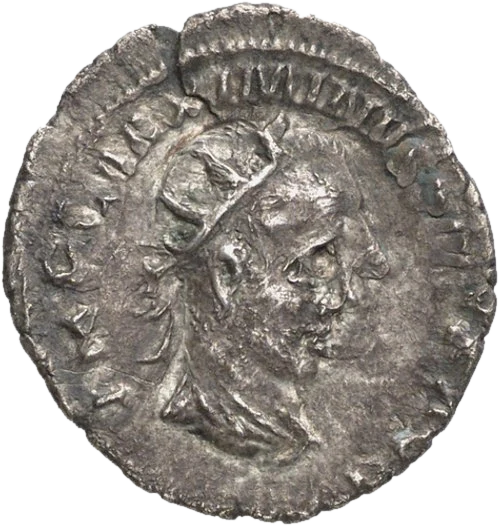
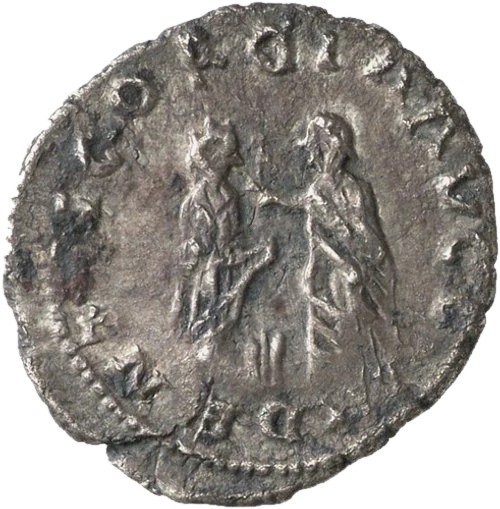
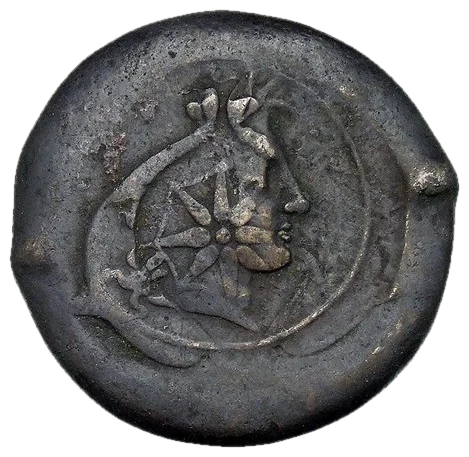
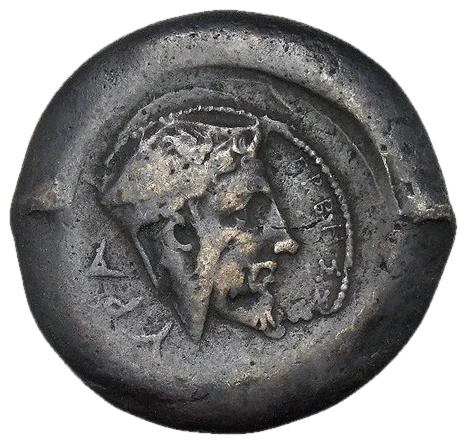
If the old design still shows through, it dates the new coin: it must be later than the coin underneath. Here a ship's prow from Kyzikos sits over a head of Apollo. Overstrikes are one of the best clues for putting undated coins in order. In gold they are rare; most are silver or bronze. Regalianus, proclaimed emperor on the Danube in AD 260, had no time to make new blanks: every coin he issued was struck over an older one, and under his bust the face of Maximinus Thrax, emperor a generation earlier, still shows. At Herbessos in Sicily the mint restruck heavy bronzes of Syracuse: the old coin's starfish between two dolphins is still clear.

HJunghans, via Wikimedia Commons · CC BY-SA 4.0
Münzkabinett, Staatliche Museen zu Berlin · Public Domain Mark 1.0
Münzkabinett, Staatliche Museen zu Berlin · Public Domain Mark 1.0
Münzkabinett, Staatliche Museen zu Berlin · Public Domain Mark 1.0
Münzkabinett, Staatliche Museen zu Berlin · Public Domain Mark 1.0
Source: Münzkabinett Berlin 18201390: Regalianus, overstruck on Maximinus Thrax ↗ · Münzkabinett Berlin 18252827: Herbessos, overstruck on Syracuse ↗
Sources
- Wikimedia Commons, 'Überprägung Kyzikos'
- Münzkabinett Berlin 18201390 and 18252827
Die studies
Chaining coins die by die
If two coins share a die, they were struck at the same time. Link hundreds of coins this way and you get a chain that puts a mint's dies in order.
Scholars photograph every known coin of a type and match the dies by eye, crack by crack. Tudeer did it for Syracuse's signed tetradrachms in 1913, Boehringer for early Syracuse in 1929, Le Rider for Philip II's gold in 1977. Die chains showed, for example, which of Philip's mints, Pella or Amphipolis, struck which staters.
Sources
- Tudeer (1913)
- Boehringer, Die Münzen von Syrakus (1929)
- Le Rider, Le monnayage d'argent et d'or de Philippe II (1977)
How many coins did a die strike?
Count the dies, multiply by the coins per die, and you have the size of an issue. The hard part is the multiplier.
Figures of about 10,000 to 30,000 coins per lower die are often used, so 40 dies might mean about half a million coins or more. Statistics also estimate how many dies are lost from the ones we know. The American numismatist Theodore Buttrey argued that the multiplying can't be done at all, because no ancient source tells us how long a die lasted, and one die might strike a few hundred coins or many thousands.
Sources
- Buttrey, 'Calculating ancient coin production: facts and fantasies', Numismatic Chronicle 1993
- de Callataÿ, 'Calculating ancient coin production: seeking a balance', Numismatic Chronicle 1995
- Esty, 'How to estimate the original number of dies', Numismatic Chronicle 2006
Inside the mint
The building
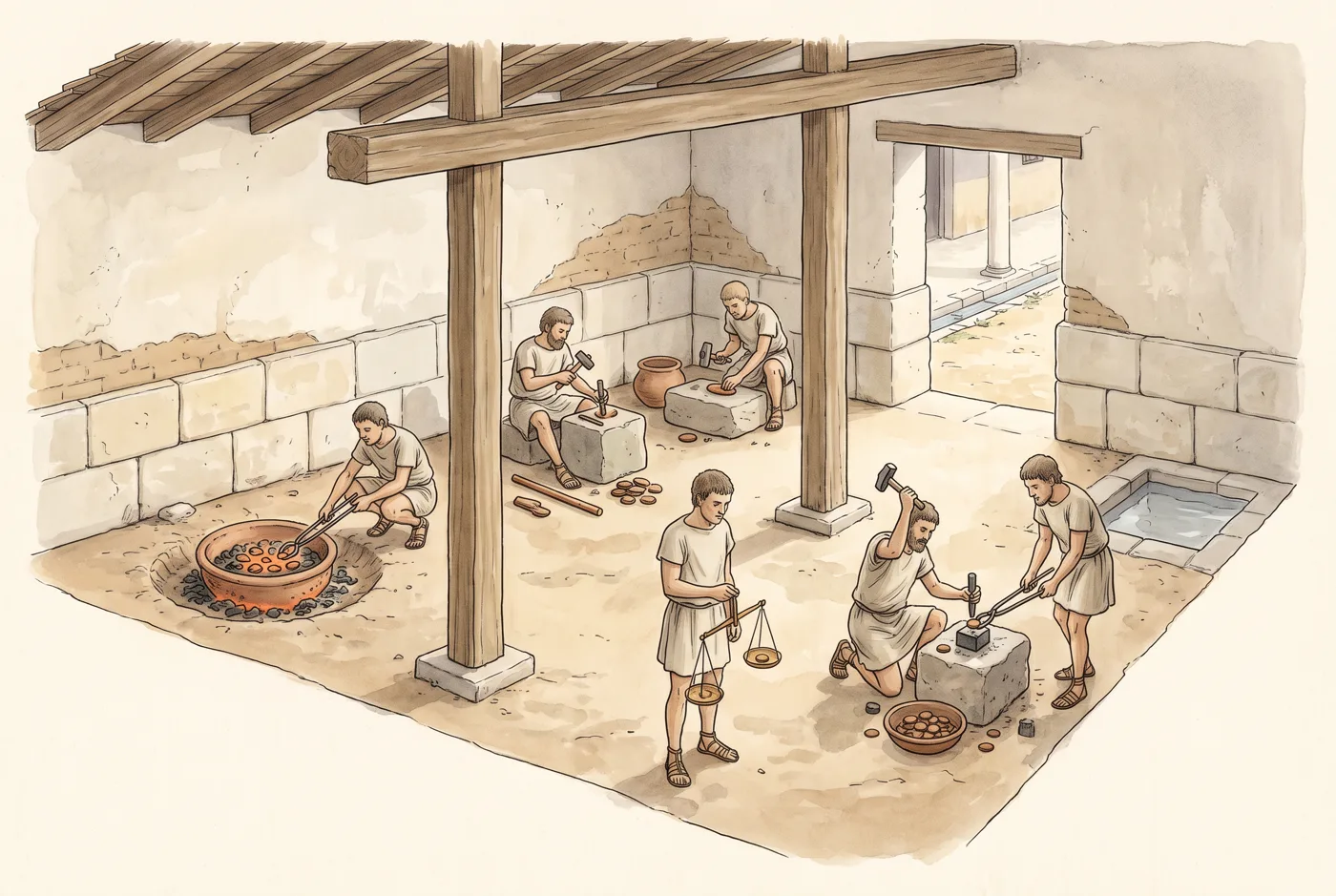
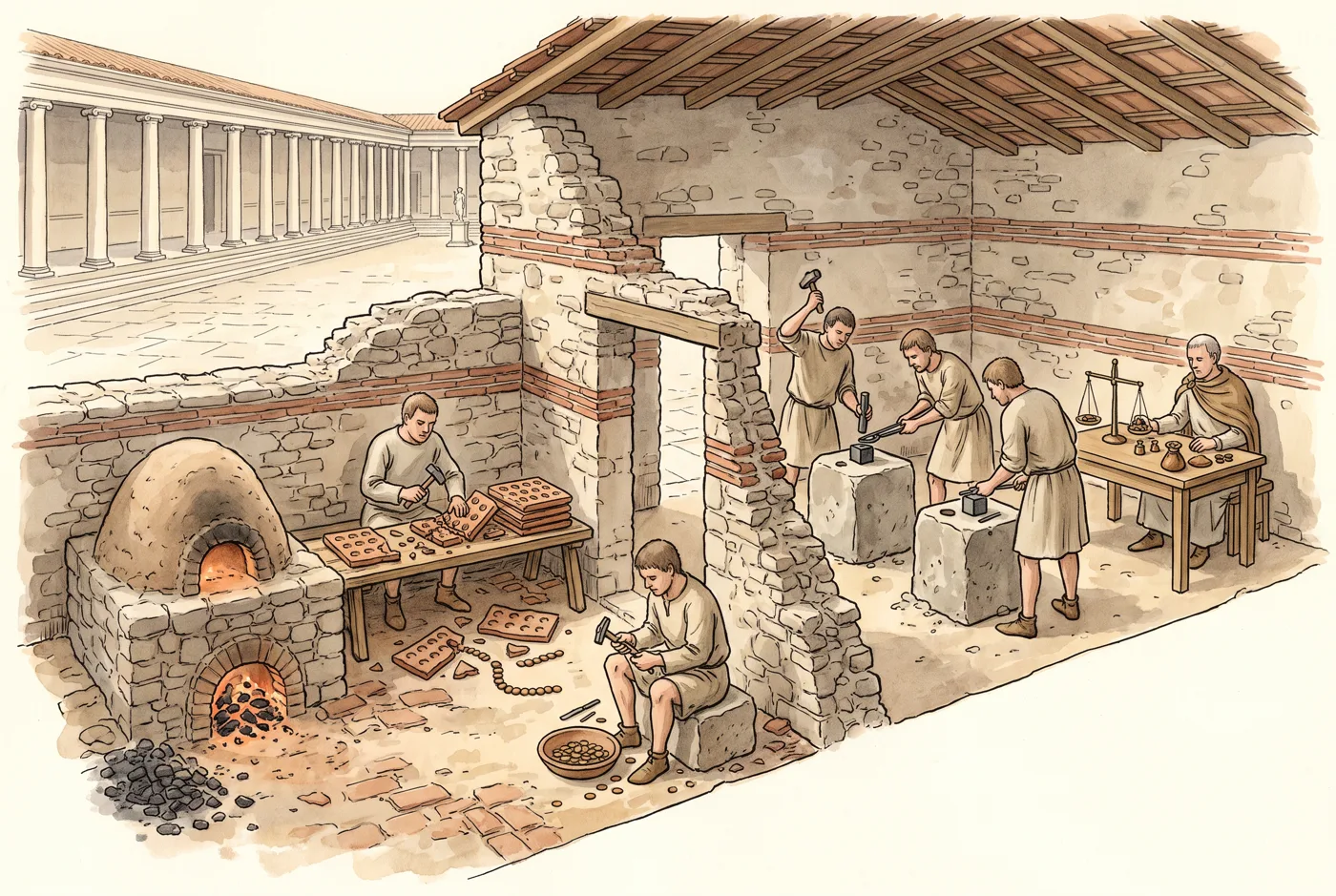
No ancient mint survives whole, and the few that have been dug up changed a lot over 800 years. A Greek city struck its coins in one big workroom, Rome in a block of small workshops, and late Roman mints cast their blanks by the hundred.
■ Confirmed by digs or inscriptions■ Our guess
■ Confirmed by digs or inscriptions■ Our guess
At Athens the mint was a plain building by the market square, about 27 by 29 metres, built around 400 BC. Its workroom had pits, water basins and a drain, and bronze blanks chopped from a rod still lay on the floor. The first diggers took the pits for furnaces, but a lab test found no melting: the metal came in ready. Rome's mint first stood beside the temple of Juno Moneta on the Capitol, and her name gave us 'money' and 'mint'. After a fire in AD 80 it moved near the Colosseum, probably to the vaulted rooms now under the church of San Clemente. By AD 300 a mint like Thessaloniki's, in rooms at the end of the city forum, cast bronze blanks in clay moulds, up to 192 at a pour.
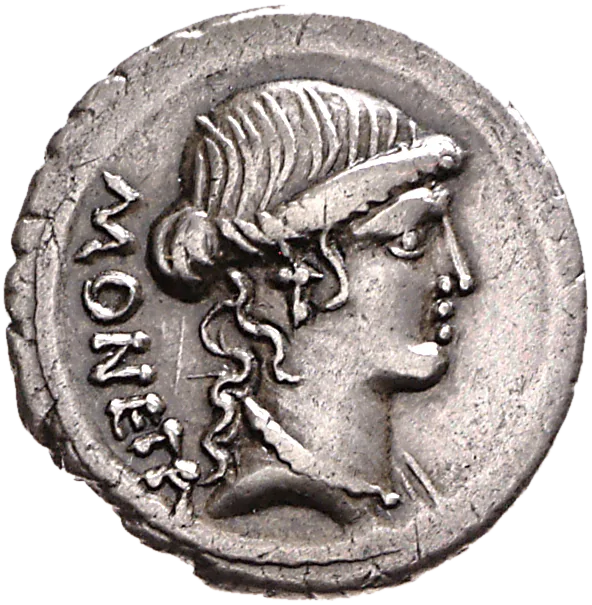
Münzkabinett, Staatliche Museen zu Berlin · Public Domain Mark 1.0
Source: Camp and Kroll, The Agora Mint and Athenian Bronze Coinage (Hesperia, free) ↗ · Livy, History of Rome 6.20 ('where the temple and mint of Moneta now stand') ↗ · Archaeological Museum of Thessaloniki: a clay mould for bronze blanks ↗
Sources
- Camp and Kroll, 'The Agora Mint and Athenian Bronze Coinage', Hesperia 70 (2001)
- Livy, History of Rome 6.20.13
- Coarelli, 'Moneta', in Lexicon Topographicum Urbis Romae III (1996)
- Archaeological Museum of Thessaloniki, exhibit of the month, April 2019
Who gave the orders
Someone above the workshop decided the metal, the weight and the design. In Republican Rome it was three young officials a year. Under the emperors it was a procurator, who answered to the imperial treasury.
The three were the 'men for casting and striking bronze, silver and gold', IIIVIR A A A F F on the coins. They ran the mint in Rome only; coins struck to pay armies in the field were made under the generals and their quaestors. Their names left the coins under Augustus. By Trajan's time a procurator of the mint, often an imperial freedman or knight, ran it for the emperor, and from Diocletian every mint had its own. The order came down, the weight standard of 'What the scales show' was kept, and the goddess of fair money stood on the coins holding a pair of scales.
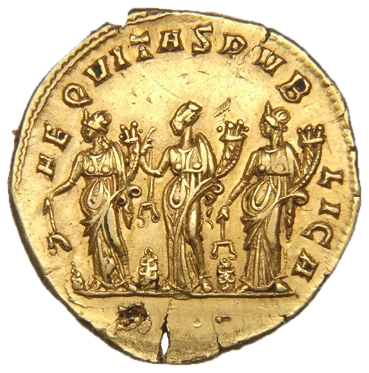
Münzkabinett, Staatliche Museen zu Berlin · Public Domain Mark 1.0
Source: Ostia: the Roman mint, its staff and its officinae ↗
Sources
- Crawford, Roman Republican Coinage (1974)
- Burnett, Coinage in the Roman World (1987)
The engraver
The most skilled person in a mint cut the dies. Almost all of them are nameless, but for a few decades some Greek engravers signed their work. At Klazomenai, Theodotos wrote 'Theodotos made it' beside his facing Apollo.
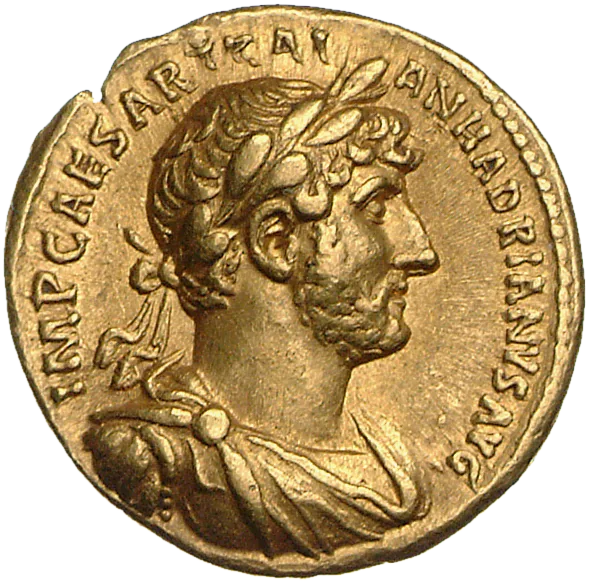
Nameless engravers still left traces of their work: on this aureus of Hadrian you can see the faint circle scratched into the die to line up the letters. At Syracuse, around 415–400 BC, at least a dozen engravers signed in tiny letters: Kimon on Arethusa's headband, Euainetos on a tablet or a dolphin, Eukleidas, Phrygillos and others. A signature on money was rare. It tells us these men were known for their skill, and that cities competed for them. The Syracuse episode of 'Why coins are art' tells their story.
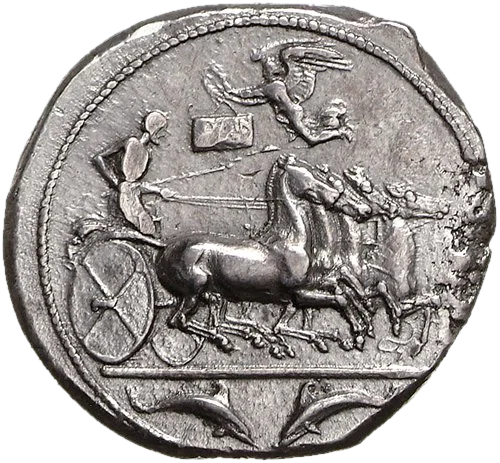
One coin could be the work of two engravers. On this tetradrachm of Syracuse, Euainetos signed the chariot side and Eumenos signed Arethusa's head on the other die. At Rome the die-cutters were a team with a chief: the tombstone of Publius Aelius Felix, a freedman of the emperor, calls him 'assistant to the head of the die-cutters of the sacred mint'. Who cut which part of a die was never written down.
Münzkabinett, Staatliche Museen zu Berlin · Public Domain Mark 1.0

Münzkabinett, Staatliche Museen zu Berlin (photo Reinhard Saczewski), via Wikimedia Commons · Public domain
Münzkabinett, Staatliche Museen zu Berlin (photo Reinhard Saczewski), via Wikimedia Commons · Public domain
Münzkabinett, Staatliche Museen zu Berlin · Public Domain Mark 1.0
Münzkabinett, Staatliche Museen zu Berlin · Public Domain Mark 1.0
Source: Münzkabinett Berlin: Klazomenai tetradrachm signed by Theodotos (via Wikimedia Commons) ↗ · Münzkabinett Berlin 18205393: Syracuse tetradrachm signed by Euainetos and Eumenos ↗ · Woytek, System and product in Roman mints: the die-cutters' tombstone CIL VI 8464 (free PDF) ↗
Sources
- Tudeer, Die Tetradrachmenprägung von Syrakus in der Periode der signierenden Künstler (1913)
- Kraay, Archaic and Classical Greek Coins (1976)
- Corpus Inscriptionum Latinarum VI 8464
- Woytek, 'System and product in Roman mints', Revue belge de numismatique 158 (2012)
The striking team
On 28 January AD 115 the staff of Rome's mint set up statues and listed their names: the foreman Felix, a freedman of the emperor, 16 officinatores under him, and 60 men who did the striking.
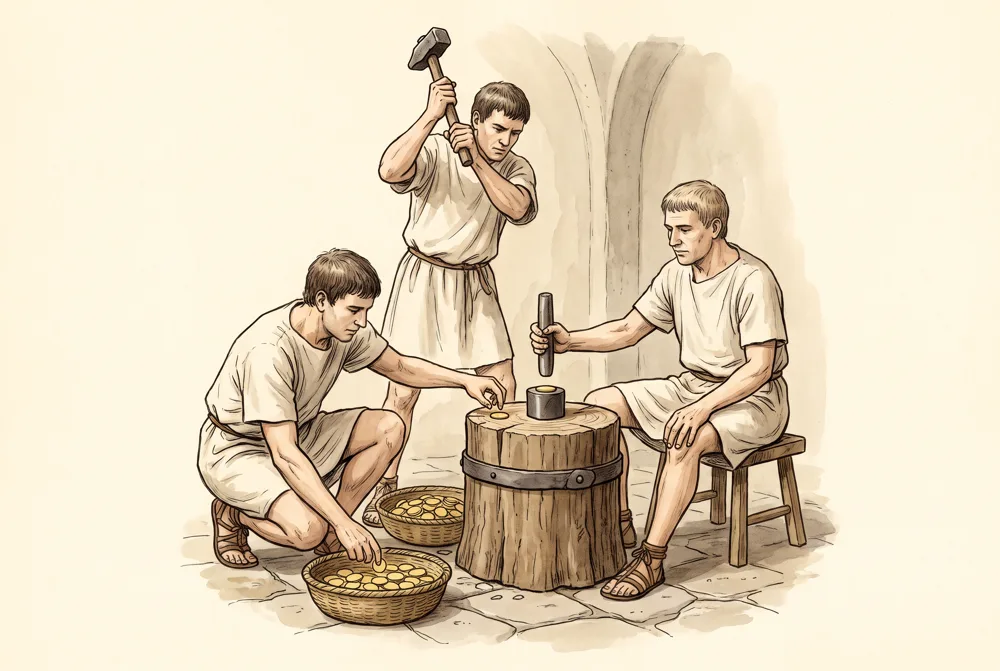
The strikers came in three groups: 17 signatores, 11 suppostores who set the blank on the lower die, and 32 malliatores who swung the hammer. Half of them were slaves, and most of the hammer-men. The officinatores ranked higher and probably kept the records and checks. A Roman token in Vienna shows three men at the anvil, the same team as in 'Two dies and a hammer', and their tools are on the coin of the moneyer Titus Carisius. The silver blanks came from outside the team: in the same year five contractors who ran the mint's silver smelter set up their own dedication, to Victory. The state seems to have hired private firms to make the blanks and kept watch over them. In AD 271 the mint workers of Rome rose against the emperor Aurelian, accused of debasing the coin.
Münzkabinett, Staatliche Museen zu Berlin · Public Domain Mark 1.0
Source: Woytek, System and product in Roman mints (free PDF) ↗ · Woytek, Signatores in der römischen Münzstätte: CIL VI 44 (Chiron, free) ↗ · Historia Augusta, Life of Aurelian 38 (the mint workers' revolt) ↗
Sources
- Corpus Inscriptionum Latinarum VI 42–44 (AD 115)
- Corpus Inscriptionum Latinarum VI 791 (AD 115)
- Woytek, 'System and product in Roman mints', Revue belge de numismatique 158 (2012)
- Woytek, 'Signatores in der römischen Münzstätte', Chiron 43 (2013)
- Historia Augusta, Aurelian 38.2–4
Many teams, each marked
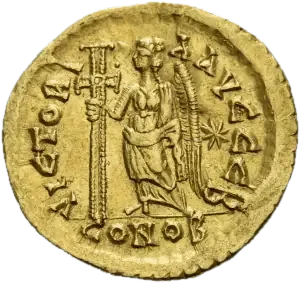
A big mint ran several workshops side by side, each with its own number on the coins. Antioch had fifteen under Constantius II. Constantinople struck its gold in ten.
The mark let each team's work be traced, so a light or impure batch could be blamed on the right team. CONOB under the design means Constantinople and OB, refined gold: the promise that began at the Sardis refinery at the start of this lesson. On many solidi the last letter of the legend on the back, from A to I, is the workshop. Gold was handled apart: from about AD 367 tax gold went to the emperor as stamped bars, and solidi were struck where the court was. 'Reading a coin' shows how to find both marks.
Münzkabinett, Staatliche Museen zu Berlin · CC BY-SA 4.0
Source: Münzkabinett Berlin 18299912 (Leo I solidus) ↗ · Ostia: the Roman mint, its staff and its officinae ↗
Sources
- Grierson, Byzantine Coins (1982)
- Kent, Roman Imperial Coinage X (1994)
- Münzkabinett Berlin 18299912 (VICTORI-A AVGGG B // CONOB)
- Codex Theodosianus 12.6.13 (AD 367)