Gold Coin Catalogue History map ↗ Learn How coins were made Is it real?
All lessons Start here › Reading a coin ×

Reading a coin

Every letter, mark and gram on a gold coin means something. Learn to read them and a coin tells you who made it, where, when, and whether it is what the seller says.

1 of 13

Front and back

The front (obverse) was struck by the die set in the anvil, usually with a head. The back (reverse) came from the die held on top and hit with the hammer, and it carries the message.

Picture: Roma Numismatics, Auction XX (2020), via CoinsWeekly · Auction photo, linked from the source; Leu Numismatik, Auction 24 (2026), lot 1072 · Auction photo, linked from the source
Tell me more

Some coins are famous for the back. Brutus's EID MAR aureus is known for its two daggers and the cap of liberty, and the Athens owl for its owl, so this catalogue shows them back first.

Brutus's gold EID MAR aureus, 43–42 BC, and a silver owl tetradrachm of Athens, about 440 BC.

  • Catalogue: Brutus aureus, EID MAR (the 2020 record coin)
  • Catalogue: Athens owl tetradrachm
The words

2 of 13

Greek: whose coin?

Greek coins name the owner in the genitive, 'of': ΦΙΛΙΠΠΟΥ, '(coin) of Philip'; ΒΑΣΙΛΕΩΣ ΠΥΡΡΟΥ, 'of King Pyrrhus'; ΣΥΡΑΚΟΣΙΩΝ, 'of the Syracusans', a city speaking for itself.

Tell me more

Small symbols and monograms in the field marked the issue, the mint or the official in charge. They are how experts tell a Philip stater struck at Pella from one struck at Amphipolis. At Syracuse the best engravers even signed their dies: see the Syracuse episode of 'Why coins are art'.

  • Le Rider, Le monnayage d'argent et d'or de Philippe II (1977)
  • Price, The Coinage in the Name of Alexander the Great and Philip Arrhidaeus (1991)
3 of 13

Reading a Roman legend

The words round the edge are the legend, cut short to fit. IMP CAES T AEL HADR ANTONINVS AVG PIVS P P reads 'Commander Caesar Titus Aelius Hadrianus Antoninus Augustus Pius, father of his country'.

Tell me more

Names come in the middle, titles around them: IMP commander, CAES Caesar, AVG Augustus, P M chief priest, P P father of his country. After an emperor died and was made a god he became DIVVS: on the right the same man, now DIVVS ANTONINVS, on a coin whose back shows his funeral pyre under the word CONSECRATIO.

  • OCRE (Online Coins of the Roman Empire), RIC III Antoninus Pius 213
  • RIC III Marcus Aurelius 435
4 of 13

A coin that dates itself

TR POT, the power of a tribune, was renewed every year, so its number counts the years. TR POT XV COS IIII means the 15th year of that power and a fourth consulship: AD 151–152.

Tell me more

Emperors counted their own reigns this way. Augustus, the first emperor, wrote near the end of his life that he was 'in the thirty-seventh year of my tribunician power'. Greek coins carry no such count, so they are dated by style, hoards and die links instead.

Source: Augustus, Res Gestae 4 (his own account of his reign) ↗

  • OCRE glossary
  • Kienast, Römische Kaisertabelle (tribunician years)
5 of 13

Who is on it dates it

Byzantine gold carries no year. The people on it do the dating: this solidus shows Constans II with his son Constantine IV on the front and his younger sons Heraclius and Tiberius on the back.

Tell me more

Heraclius and Tiberius were crowned in 659 and Constans was murdered in 668, so the coin dates to 659–668. Earlier coins of the same emperor show him alone, beardless, then with a short and a long beard. Copper coins did carry years: from 538, Justinian's show ANNO and the year of his reign.

  • Sear, Byzantine Coins and Their Values 960
  • Grierson, Byzantine Coins (1982)
  • Cleveland Museum of Art 2012.22
6 of 13

Late Roman shorthand

By AD 400 a legend reads like a formula: D N HONORIVS P F AVG, 'Our Lord Honorius, dutiful and fortunate, Augustus'. On the back, AVGGG has one G for each emperor ruling together: three.

Tell me more

Look in the field and below the line. M and D on either side of the emperor stand for Mediolanum (Milan); RV is Ravenna, RM Rome. COMOB under the line says 'pure gold'.

  • RIC X Honorius 1206
  • Kent, Roman Imperial Coinage X (1994)
7 of 13

CONOB: city and pure gold

CON is Constantinople and OB is obryzum, refined gold. OB is also the Greek number 72: 72 solidi were struck from a Roman pound of gold.

Tell me more

A law of AD 367 in the Theodosian Code, the Roman empire's law book, says gold paid to the treasury must come as refined gold (obryza) at 72 solidi to the pound, because forged solidi kept being slipped in.

Source: Theodosian Code 12.6.13 (Latin text) ↗

  • Grierson, Byzantine Coins (1982)
  • RIC X Theodosius II 257
8 of 13

Workshop letters

On solidi of Constantinople the legend on the back, VICTORIA AVG..., ends in one more letter: A, B, Γ and on up to I. It is usually read as the number of the workshop, from 1 to 10.

Tell me more

Collectors note it as 'officina' (workshop) and catalogues list it, but whether the gold really came from ten workshops is still argued. Either way it is a check: a mint mark or letter that never existed is a warning sign.

Historians disagree: What the letter counted is still debated.
  • Grierson, Byzantine Coins (1982)
  • Sear, Byzantine Coins and Their Values

The object

8.5 gStaterPhilip II4th c. BC7.8 gAureusAugustus27 BC7.2 gAureusafter NeroAD 644.4 gSolidusConstantineAD 30972 solidi = 1 Roman pound (about 327 g)Sizes exaggerated so the fall in weight is easy to see.
9 of 13

Weigh it

Gold was money by weight, so a pocket scale reading to 0.01 g is the first test. A Greek stater is about 8.5 g, an aureus 7.8 g under Augustus and 7.2 g after Nero, a solidus 4.4–4.5 g.

Tell me more

The Roman naturalist Pliny the Elder, writing in the 70s AD, complains that emperors kept shaving the gold coin until Nero struck 45 to the pound instead of 40. The solidus then held its weight for some 700 years. A coin well under its usual weight may be worn, clipped, cleaned hard, once mounted, or not what it claims.

Source: Pliny the Elder, Natural History 33.47 (Bostock's translation, ch. 13) ↗

  • Weights: median of the catalogue's museum coins (aureus 27 BC–AD 63: 7.79 g, 59 types; AD 64–99: 7.25 g, 151 types; solidus 4.42 g, 156 types; stater 8.51 g, 83 types)
Fronthead uprightturn overside to side12 o'clock ↑↑back upright6 o'clock ↑↓back upside downorthis Honorius solidus
10 of 13

Die axis

Hold the coin top and bottom and turn it over side to side. If the back is upright the axis is 12 o'clock (↑↑); upside down is 6 o'clock (↑↓). Catalogues give it in clock hours.

Tell me more

Roman mints mostly set their dies square: 8 in 10 of the catalogue's imperial gold coins sit at 6 or 12 o'clock. Greek dies were often held by hand, and only about 4 in 10 do. An odd axis for a mint that kept them fixed is a reason to look harder, not proof of a fake.

Solidus of Honorius, Münzkabinett Berlin 18210969 (CC BY-SA 4.0): its back sits upside down, 6 o'clock.

  • Die axes recorded by the Berlin Münzkabinett and other museums for 1,372 catalogue coins
11 of 13

A loupe and a lamp

A 10x loupe and one lamp held low to the side show what a photo hides: tool marks, tiny pits, scratches, and how crisp the letters really are.

Picture: Bibliothèque nationale de France · CC BY 4.0
Tell me more

Good signs: sharp letter edges, flow lines from the strike, small die cracks. Warning signs: soft, rounded details and tiny bubbles (a cast copy), a seam or filing on the edge, fields too smooth for the wear, and solder traces or scratches at the top (a coin once worn as jewellery). Hold coins by the edge: gold is soft.

  • Photo: Bibliothèque nationale de France, via Wikimedia Commons

Buying

Fine (F), frontFine (F), back
Fine (F)

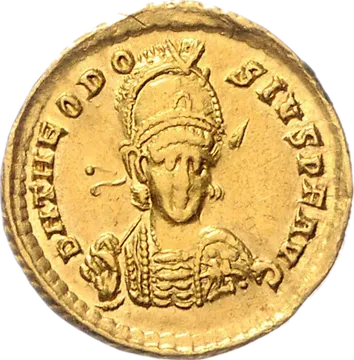
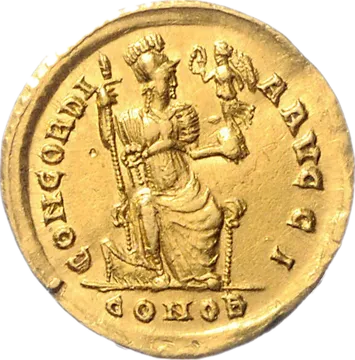
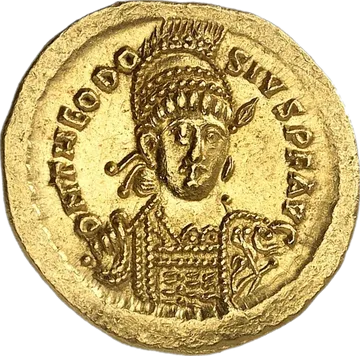
Long wear: the face, helmet and armour are worn smooth, but every letter can still be read.

1 of 4 · graded by the seller: III-/III (the Austrian scale's 'Fine'), with a bend mark · Dorotheum, sale 405

Very Fine (VF), frontVery Fine (VF), back
Very Fine (VF)

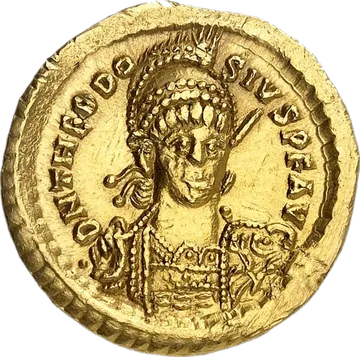
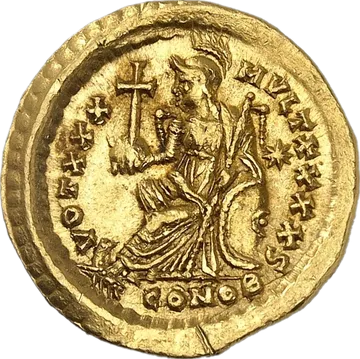
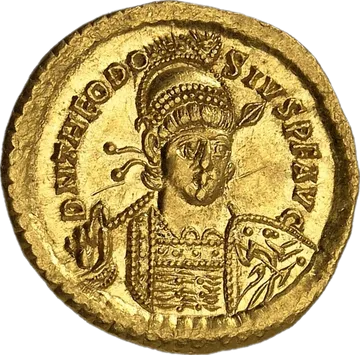
Wear on the highest points (eyes, helmet jewels, armour), most of the detail still there.

2 of 4 · graded by the seller: sehr schön (very fine) · Künker, Auction 447, lot 1250

Extremely Fine (EF), frontExtremely Fine (EF), back
Extremely Fine (EF)

Only a touch of wear on the very tops; hair, pearls and armour crisp.

3 of 4 · graded by the seller: vorzüglich (extremely fine) · Künker, Auction 447, lot 1248

FDC (as struck), frontFDC (as struck), back
FDC (as struck)

'Fleur de coin': no wear at all, the gold still shining as it left the dies.

4 of 4 · graded by the seller: Stempelglanz (as struck) · Künker, eLive Auction 448, lot 3649

12 of 13

Grade words

Sale descriptions grade wear: Fine, Very Fine (VF), Extremely Fine (EF), and FDC, 'fleur de coin', as struck. The grade measures wear only, not beauty.

Tell me more

Two coins of the same grade can look very different. Check the strike (are the high points sharp?), the centring (is the whole design on the flan?), the flan (round and full, or cracked?) and the surfaces. Words to watch: 'tooled' and 'smoothed' (the fields were worked on), 'graffito' (a scratched mark), 'ex jewellery' or 'traces of mounting'. A beautiful VF can be a better buy than a dull EF.

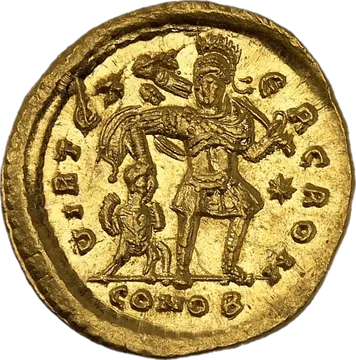
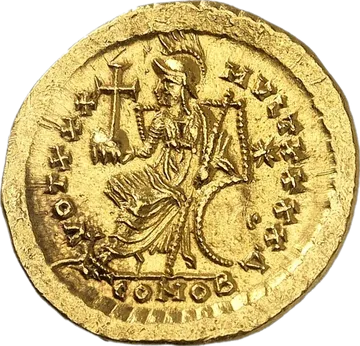
Four gold solidi of Theodosius II (408–450) with the same facing bust; the backs differ. Each grade is the seller's own word. Use ‹ › to step from worn to as struck.

  • NGC Ancients grading scale (grade, strike and surface)
  • Sear, Roman Coins and Their Values
  • Photos: Dorotheum and Künker sale catalogues, as credited on each slide
13 of 13

Reading a sale description

A lot gives the coin, a reference number, weight, axis, grade and often a line starting 'ex': the collections and sales the coin passed through.

Tell me more

References point to the standard books: RIC (Roman Imperial Coinage), RRC (Crawford, Roman Republic), Price (Alexander), SB (Sear, Byzantine), Calicó (Roman gold). The hammer is the winning bid; most houses add a buyer's fee of about 20 to 25%, so the price paid is higher than the hammer. Estimates are often set low to draw bidders.

  • Catalogue card: Antoninus Pius aureus, RIC III 213, Berlin 18204408